SUMMARY
If I had to sum up the 2013 vintage in a phrase, it would be “it’s complicated.” Any generalizations about this difficult vintage are bound to miss the mark to some degree. The growing season oscillated between extremes, and so do the resulting wines: hail damage severely reduced the crop, and affected the quality as well, in Volnay, Pommard, Beaune and Savigny, but the crop had already been substantially reduced across the Côte d’Or by a cold and rainy spring and a late and uneven flowering. While much of July and August were warm and sunny, the vintage was one of the latest in recent times, with most growers not picking until October. October, however, saw some significant rainfall, and botrytis began to affect the vineyards, albeit after most of the picking was done.
The resulting wines seem to fall into several categories:
–the Côte de Beaune reds from vineyards that suffered hail damage, which are only rarely successful, typically exhibiting very dry tannins and in some instances a pruney character;
–Red and White wines in both Côtes that are slightly underripe, and exhibit an excess of acidity (and in many reds, an excess of hard tannins as well);
–Whites from the Côte de Beaune, and reds from the Côte de Nuits, that are sweet, easy and approachable; and
–more serious reds from the Côte de Nuits (and some Côte de Beaune whites) that are precise, structured and well-balanced, with charming fruit.
In the Côte de Nuits, the most successful villages seem to be Gevrey-Chambertin (which according to Bernard Hervet received significantly less rainfall than its neighbors) and Chambolle-Musigny, and within Chambolle, a special nod has to go to a cohort of stunning Amoureuses. As in many vintages where ripeness is an issue, as a generalization the Grands Crus were more successful than the Premiers Crus and the Premiers more successful than the Villages wines. However, exceptions abound.
One of the best and most honest growers in Burgundy (who produced some of the top wines of this vintage) said that while 2013 is a good vintage, and he is very pleased with the quality of his wines, no one should mistake it for a great vintage. I would underscore his remarks, both because I agree with them, and because there is already starting to be commentary—there will be more—that either hypes this vintage beyond what it can bear, or dismisses it entirely. Both extremes can find examples to support their views, but the truth is considerably more complex. Indeed, if this is a winemaker’s vintage—and it is—it is also a Burg geek’s vintage, because those who take the time to poke beneath the surface will in time be rewarded with some very fine drinking experiences.
A Few Comments: Everyone wants a brief headline and definitive answer as to whether the vintage is great, and whether a particular wine, or producer’s range of wines, is great (as a friend recently wrote to me: “are the ‘12s really great and should I buy whatever I can get my hands on, or should I skip it?”). The answer is rarely so simple—especially in Burgundy. This is particularly true when the information you have is gleaned from barrel tastings. As I have written before, one gets a brief moment to taste a particular wine at a particular stage of its development, on a particular day, and from that is expected to make a judgment about how that wine will taste many years later. While several weeks of tasting at the right time (and November after the vintage is usually one of the best times) can give a fairly good picture of the vintage overall (with the caveat that vintages can take unexpected turns in their development), and pinpoint many of the success and failures, inevitably there are vagaries to tasting specific wines, which may depend on ambient temperature, barometric pressure, treatments or lack thereof, whether the sample is representative (is it from an old barrel in a Cuvée that is going to be 80% new oak?), how recently the wine finished malo, or was racked, and other factors (the bio guys, of course, would tell you it’s also a matter of whether its a root day, or fruit day, or whatever, but that’s a different story). When a vintage is difficult, like 2013, it simply exacerbates the problem of knowing whether what you are tasting on a particular day is truly representative. Since I don’t get paid for my views and therefore don’t need to pretend to omniscience, I want to be very clear that this is an extremely complex vintage to taste, with results that are all over the map, and it is likely that some wines will turn out better—and some worse—than predicted.
Finally, while I have commented overall on the ranges of the various domaines, I have only focused in detail on the wines I liked; if this report were to include every wine tasted, it would bore even the writer. However, the reader should keep in mind that we taste most if not all of the range at the individual domaines, and a large sample at the negociants, so that if in a particular case the list of recommended wines is shorter than normal, it is a reflection of the difficulties of this vintage and the need for care in selection.
RED BURGUNDY
Côte de Nuits
The Domaines
As the sweet spots for this vintage seem to have been Gevrey and Chambolle, lets start there:
Roumier: Unfortunately, our appointment had to be moved up by several days, and so we arrived shortly after most of the wines had been racked. Nonetheless, this range is a brilliant success (it didn’t hurt that most of Christophe’s holdings are in the two villages that were the most successful in ’13), with several being among the best wines I tasted on this trip. Christophe’s view of the vintage is that it shows good terroir, and that he likes the freshness of the vintage, but that the wines don’t have the same complexity as the ‘12s. He sees them as ‘friendly” wines, but not long-distance runners. The Chambolle Village was delicious—spicy, generous and charming—and the Chambolle Les Cras was also a winner: showing strawberry fruit on the nose, it was medium weight, minerally, pure and complex. The Charmes-Chambertin had a curious bell pepper note in the nose, which might be an artifact of the recent racking, and a delicacy in the back palate that I don’t tend to associate with Charmes (but like), while the Ruchottes had great perfume in the nose and persistence, purity, even elegance for Ruchottes. The Bonnes Mares, despite its recent racking, showed off a deep nose of red fruit and minerals, and was balanced and transparent, with the tannins more prominent than in the other wines in this range. The Amoureuses outshone it though, with intense spice and complex fruit on the nose; it was delicate, elegant and pure, with refined tannins and some silkiness in the finish. Lastly, the Musigny, which was the only wine not yet racked, had lovely red fruit, spice and the characteristic citrus note, the new oak not yet fully integrated, but with a long, silky, refined finish.
We also tasted the range of 2012s here, including a Chambolle Village whose weight and density—not to mention balance and complexity—made it more like a 1er Cru (91); a pure, long Chambolle Les Cras, with suave tannins (92); a very fine Ruchottes, extremely dense and complex with ripe red fruit and a long pure finish (94); and a Bonnes Mares that seemed to be shutting down (92+?). The Chambolle Amoureuses had ultra-refined fruit, density and an amazing tension in the wine—the epitome of purity and refinement (95); while the Musigny, with a rich nose, great balance, plummy fruit, was still a baby but there is great depth and purity on the extremely long finish and this will surely evolve into a great wine (95+).
Mugnier: though the tasting started a little slowly, the quality eventually began to shine through at the upper levels. Nonetheless, these are not a match for Freddy’s beautiful 2012s, which we tasted from bottle. Freddy noted that the vegetative cycle in 2013 was the longest he’s ever seen, but that it allowed the grapes to achieve phenolic ripeness. He said that the tannins had a rich texture to them, which was unexpected in such a late vintage. He also, as did others, noted that toward the very end of the harvest, botrytis had come on quite suddenly and rapidly: there was none before October 5th in Chambolle, but by the 8th it had become explosive. In his view, the ‘13s are tight and precise, and will need some bottle age to show their best. His Chambolle Village seemed a bit on the lean side, without the brightness or fruit of Roumier’s, but the Chambolle Fuées was a considerable step up, with great fruit on the palate and a cool minerality, a silky texture and a transparent minerally finish. The Amoureuses was superb, with a complex nose of cherries and strawberries plus minerals; it was light, elegant, and silky, with a spicy mineral finish, great length and very refined tannins. The Musigny was also extremely fine, with a complex nose of licorice, currants, strawberries and citrus; it is dense, pure and powerful, with a touch of salinity and powerful but refined tannins.
We then tasted the ‘12s, which Freddy described as a bit closed and austere at the moment. Notwithstanding this caveat, the Chambolle Village had beautiful sweet ripe red fruit and a touch of brown sugar on the nose; while a bit light on entry, it had lovely sweet red fruit and spice on the palate (91). The Chambolle Fuées was very balanced with excellent spice notes and a silky texture (92), while the Chambolle Amoureuses, despite being a bit austere, had great purity, a lovely texture and a delicate spicy finish—this wine is just hinting at greater things to come (95). The Musigny had deep fruit and citrus on the nose, and was very intense, deeply minerally, with red fruit in the back; its power is in evidence, backed by some significant, if refined, tannins, but the finish opens to amazing length, purity and refinement (95+).
Ghislaine Barthod: It is a treat to taste here, as one gets an excellent lesson in terroir. The domaine vinifies 9 different 1er Crus in Chambolle, and it is not hard to see the differences as one moves from one to another. The range overall was very well-crafted, and while some wines reflected the more problematic elements of the vintage (too much acidity and tannin for the fruit and a resulting lack of balance), the best are very fine examples, from a village that was one of the standouts in 2013. I particularly liked the Chambolle Gruenchers, with a light, mineral-driven nose and a spicy and charming palate with open berry fruit and good length; the Chambolle Fuées, which had bright deep cherry fruit on the nose, a penetrating minerality on the palate, and a touch of what Ghislaine described as “bitter orange zest”–overall a wine with a lot of material, and a transparent and persistent finish; and the Chambolle Les Cras, where you could sense the greater density even on the nose, but also some lovely sweet fruit, a touch of new oak, excellent concentration and length.
Francois Bertheau: relatively small quantities again in 2013, but at least there is some Bonnes Mares, unlike in 2012 when there was almost none. The elfin Francois Berthaud is a true Burgundian character, who only sees visitors after 5 pm, when he returns on his tractor from the vineyards (“where else would I be”? he says). The range is small, but he makes seriously good wines here—not quite at the Roumier or Mugnier level, but still excellent examples. The Chambolle Village had charming and easy sweet fruit flavors, while the Chambolle 1er Cru had a nice floral touch to the nose, with currants, citrus and cherries; it had a nice medium weight and good balance, if slight dryness at the finish. The Chambolle Charmes had more material than the 1er Cru but less charm (!), at least at the moment. The Chambolle Amoureuses was yet another fine example from this vineyard, with an intense nose of complex fruit (currants, cherries, etc), deep spice, good lift and not too much acidity, and a long finish developing some silk. The Bonnes Mares was even better, with soft but complex fruit, excellent density, a dry and spicy finish, some oak spice (25% new oak), and also a silky texture.
Bruno Clair: I generally like the wines here quite a bit, so was disappointed when the tasting began, as we worked our way through the Village and lower Premier Crus, all of which showed to some degree or another the characteristic high acidity and/or strong tannins of the vintage. However, the Cazetiers was a significant step up, and the Clos St. Jacques and Clos de Bèze were both brilliant examples, outstanding successes in this vintage. Among the 1er Crus, the Savigny Les Dominodes, with rich red fruit balanced by minerality, had some strong tannins but should be very good in time, while the Gevrey Cazetiers, as noted, was excellent, with a rich nose of red fruit and meats; on the palate it was transparent, with tannins that were not harsh and that dissolved into the pure minerally finish. The Clos St. Jacques had a nose bursting with intense ripe fruit, and amazing richness; on the palate it was pure and intense, with a bright minerally finish and silky refined tannins. The Clos de Bèze had a gorgeous perfumed nose, with delicacy and refinement; on the palate, the power was evident, as was the intensity, and there was a rich fruit finish, with spice, minerals, silk, and refined tannins. Superb wine! The Bonnes Mares was a slight letdown after the Bèze: despite a mysterious and beguiling nose, the tannins seemed more evident and dominant here.
To contrast the vintages, we then tasted the 2012 Gevrey Cazetiers and Clos St. Jacques. Though Philippe Brun warned that the ‘12s were closing up a bit, both still showed extremely well. The Cazetiers had sweet, almost candied fruit on the nose; while it lightened up on the palate slightly, it still had excellent balance and transparency, and the tannins seemed suppressed on the long minerally finish (93). The Clos St. Jacques had exceptional bright ripe fruit and a hint of brown sugar on the nose; on the palate it was succulent, spicy, of medium weight, and had excellent finesse; there was a touch of tannin here but also a sense of refinement (94). Here I felt that the ‘13s of these particular wines might stand up to the ‘12s, though the range overall was not at the level of its older sibling, as tasted last year.
Trapet: This tasting ran considerably over its allotted time, as both Jean-Louis and his father Jean were in expansive moods, and we were delighted to listen—and to taste the 1955 Chambertin! And while Jean-Louis certainly has many years ahead of him, the succession seems assured as his son, who is now part of the team, joined the tasting as well. Overall, while some of the lower-level wines were not entirely persuasive, the top-level wines showed extremely well. While I prefer the ‘12s here (as at most addresses where we were able to taste side-by-side), the Latricières and the Chambertin are no slouches in ’13. (Note there was no Gevrey 1er Cru Capita in 2013, as Jean-Louis only makes this wine when he feels that 100% whole cluster is warranted.) The Gevrey L’Ostrea was slightly reduced but one could still see the excellent balance of sweet red fruit and minerality, a slight saline touch, some black pepper, and a very nice medium weight, and neither the tannins nor the oak were overbearing. The Chapelle-Chambertin had great minerality, and the touch of reduction did not obscure the excellent weight and balance here; it had a high-toned and very long finish as well. The Latricières had great depth of spice on the nose, and minerality. On the palate, the wine was well balanced, with purity, power and drive; there is a fair amount of tannin here but also a lot of deep red fruit on the finish. The Chambertin was also somewhat reduced, but had lovely purity, red fruit, spice and black pepper notes, together with an intense minerality on the palate; the tannins here are strong but suave, and some great spice and roast meat flavors come up on the immensely long finish.
We also tasted several 2012s here. The Gevrey Ostrea had very nice blueberry fruit on the nose and palate, excellent weight, good power, and some strong tannins after (91). The Latricières-Chamberin had an exotic fruit nose, great minerality, smoked meats, slate, and black pepper; it was powerful, balanced, and had silky tannins (93-94). The Chambertin had a subtle nose, while the palate exuded a sense of calm and transparency; this is a self-assured wine with silky tannins and excellent length (95).
DRC: Aubert de Villaine said he was very pleased with the quality of his ‘13s, and a couple of reliable sources said that, in the weeks before our visit, the wines were showing superbly well. However, as Bertrand de Villaine noted, there had been heavy rains two days before our visit, which had briefly flooded the cellar, and he found many of the wines unsettled on the day of our visit. So did I. While the Romanée-Conti showed just how superb the vintage here could be, the other wines, particularly the Richebourg and Grands Echézeaux, seemed in varying degrees to lack harmony. I can only report on what I saw on the particular day, but hopefully a subsequent visit may yield a different result.
That said, there was a nice spicy quality and excellent purity to the Corton, and I think the Domaine has acted wisely in moving to a majority of one-year old barrels for the elevage of this wine. The Romanée-St.-Vivant was also showing some amazing spice on the nose; it is a powerful RSV with a long, spicy, well-delineated finish and amazing persistence. La Tâche had exotic spices on the nose; it was intensely concentrated, with strong acidity, but at least today the fruit seemed a bit figgy. This needs to be revisited. The Romanée-Conti, on the other hand, needs to be revisited for other reasons: it was simply superb, with an amazing nose of spice, red fruits, baked bread and what Aubert calls the “little touch of green” that turns eventually to rose petal; it was elegant and concentrated on the palate, but the real fireworks were on the finish: super-smooth, nothing out of place, serene and refined, and almost endless. Simply amazing wine.
Liger-Belair: While these wines do not seem destined to challenge the brilliant 2012s at this estate, they are overall very fine wines, with a large proportion of successes in this difficult vintage. One of the top addresses for 2013s, even without wines in Gevrey.
Normally I prefer the Vosne Clos du Château to the Colombière, but this year it was the reverse: the Colombière had rich fruit supported by excellent acidity, and was soft and balanced. I also particularly liked the Vosne Suchots, with its rich nose, sweet fruit, citrus touch and great transparency; the Vosne Brulées, which had a nose with great fruit and purity and a seductive smoky note, while on the palate there was sweet fruit, a bit of oak but some silky softness and a long pure fruit finish. The Nuits Clos des Grands Vignes (for you geeks out there, this is the only 1er Cru in the Côte de Nuits that is east of the D974, and it is also a monopole, helping give Liger-Belair the distinction of being the only producer with Monopoles in Village, 1er Cru and Grand Cru) had soft red fruit, touches of earth and spice, and excellent balance—a very well-crafted wine. The Vosne Reignots was a bit too gassy to evaluate fully, but seemed to have a lot of density. The Echézeaux was spicy, with excellent soft red fruit, a lighter style wine but had lovely balance and transparency, with some strong tannins at the end but also a lot of fruit and good minerality and persistence. La Romanée was quite dense, with crushed berry fruit on the nose, a lot of acidity, great richness and power, and glycerine at the end, with the tannins possibly a bit aggressive at the moment but still evolving, and it had an extremely long finish showing good refinement.
We tasted two 2012s: the Vosne Reignots, with sweet crushed raspberries, excellent weight and balance, there is huge material here but the wine still needs to eat the oak (93+); and the Echézeaux, showing intense fruit and minerality, and a creamy touch; it is structured, juicy, with great balance and length and certainly far more density than the ’13, charming as that wine is (94+).
Anne Gros: all of these wines seem to have been made in a light, fruity style, including the Richebourg, which had the weight of a Village-level wine and no discernable Richebourg terroir. What has happened at this domaine is a mystery to me. In the ‘90s, Anne Gros was making terrific wines, and her Richebourg was a consistent standout among its peers. As one observer speculated, she seems to have decided to rest on her laurels, and turned her attention elsewhere, with depressing results. What a waste!
Mugneret-Gibourg: Brilliantly successful wines in ’13, the best of which seem effortless. As is true almost everywhere, there is some inconsistency in the range, but the best—including a particularly fine Bourgogne, which has more to it than Anne Gros’ Richebourg—are well worth finding and cellaring, and will likely be approachable in the near term but hold well.
The tasting began auspiciously with the Bourgogne, which had a spicy beeswax note, a lot of soft red fruit, a bit of acidity after but a silkiness-really a remarkable Bourgogne. The Nuits Village was also extremely charming, with great typicity, earthy, spicy and sweet. The Nuits Chaignots had intense black fruit and earth, and was silky and balanced, though with a bit of a dry finish; certainly the acidity and tannins were not hidden, but it was a nice wine nonetheless. The Chambolle Feusselottes (some day, I may learn to spell Feusselottes without looking it up, but I doubt it) was a real standout, with gorgeous bright red fruit on the nose and palate, excellent lift, balance and transparency. (Underscoring the vagaries of tasting, Marie-Andrée commented that a week earlier, this wine had been totally closed down.) The Ruchottes-Chambertin was spicy, meaty, open and rich, with medium weight and a gorgeous spicy strawberry finish, the tannins a bit dry but not overly so. The Echézeaux had plenty to enjoy but seemed also to have some dried herbs and drier tannins in back, and Marie-Andrée commented that this was a bit too concentrated (at 17-18hl/ha) to be a normal expression of Echézeaux. The Clos Vougeot was open-knit and had complex red fruit on the palate, a touch of clove and gingerbread, but also a hint of something a little out of place, appleskin perhaps, with some dry tannins; judgment deferred.
The 2012 Grands Crus seemed a bit shut down (or not quite showing the promise they did a year ago), but the Nuits Chaignots had a nice stony nose and a layer of sweet red fruit to accompany its minerality and earthiness; this was still carrying a fair amount of tannin but it seemed likely to modulate in time (91). The Chambolle Feusselottes had subdued red fruit and spice, plus a creamy element, on the nose, and spice cake, minerals, and red fruit on an excellent transparent palate and finish (92).
Méo-Camuzet: while a number of these wines were reduced and not easy to read definitively, there are some very fine 2013s at this address. However, care in choosing among the 2013s is advisable, as at most domaines with a broad range of appellations.
I liked both the Nuits Meurgers, which had excellent balance, medium body, and a long minerally finish, and the Nuits Boudots, with had much richer fruit than the Meurgers and was more dense and concentrated, though perhaps a bit heavier in comparison. Both the Clos Vougeot and the Corton Clos Rognets seemed to be in the charming, easy style of many wines of this vintage, while the Echézeaux, despite heavy reduction, seemed elegant and possessed of a long finish with great lift. The Vosne Brulées was more brooding, with power and presence, and a tight structure. The best wines here were the Vosne Cros Parantoux, which despite only recently finishing malo displayed a spicy, cool fruit nose, sweet raspberries on the palate, tight structure and power, with an intense mineral finish of great breed; and the Richebourg, which was powerful, spicy, open and rich, a bit forward even, but with a lot to it.
The 2012 Nuits Boudots, opened several days earlier, had a rich fruit nose and a touch of brown sugar, and was distinctly sweet but enjoyable (90), while the 2012 Clos Vougeot, opened on the spot, was very ripe and rich, with black currants, licorice, black pepper, and a touch of brown sugar; it had a lot of power and richness, with medium, refined tannins and excellent length, and was distinctly superior to the 2013 version (92-93).
Grivot: Etienne’s wines have reached a new plateau of quality in recent years, and despite the difficulties of the vintage, there are some significant successes here. The Village-level wines were well-crafted, including a Nuits Charmois that had charming sweet fruit, a touch of salinity, and little tannin in evidence, and a Chambolle Combe d’Orveaux, with black cherry fruit, good energy and transparency. With the 1er Crus, Etienne announced that he had decided to act on someone’s advice and show the Vosne 1ers before the Nuits 1ers, the idea being that it would show that the Nuits 1ers were fully at the level of their Vosne counterparts. The only problem with this theory is that, good as the Nuits 1ers were, they were not fully at the level of the Vosne 1ers—and if you believe in terroir, there’s a ready explanation for that. I did quite like the Nuits Pruliers, an earthy, charming crowd-pleaser with good weight, and the Nuits Boudots, much more structured though with plenty of sweet strawberry fruit, if some strong tannins. Nevertheless they were not a match for the Vosne Brulées, with its bright sweet fruit, spiciness, smoky edge and mineral balance, a very fine wine just getting the edge over the Méo version, or the Vosne Reignots, with amazing depth of fruit on the nose, deep spice, soy, great balance and beautiful transparency on the finish. The Vosne Suchots was also good, though perhaps a bit heavy in comparison, while the Echézeaux seemed pleasant, approachable, but a bit lacking in focus. The Clos Vougeot was better, tending toward the sweet and supple for Clos Vougeot (and especially for Grivot’s typically brooding style of CV), with a touch of brown sugar and wild herbs. Best was the Richebourg, which had an intensely minerally nose that was calm and deep; on the palate, it had classic Richebourg structure, power and weight, and wonderful purity; on the finish, the tannins are a bit strong and the back end seems to need time to develop, but I’d be willing to bet on this wine.
Etienne thinks that 2012 may be his greatest vintage, combining drinkability, energy and balance, but not all of the wines we tasted on this day were showing at their best—possibly they have begun to shut down, as a number of ‘12s have–for example a Vosne Beaumonts that was still reduced in bottle, and an Echézeaux that had excellent energy and refinement, but also a slight caramel hint that intruded on the finish (90). Much better were the Clos Vougeot, which had great weight and intensity but avoided heaviness (91), a Nuits Boudots that had a sweet creamy entry, and was earthy, spicy, generous and balanced (92), and a powerful, minerally and pure Richebourg, with some SO2 that slightly suppressed the fruit for now, but with a lovely silky mineral finish and refined tannins (93+).
Sylvain Cathiard: The young, self-effacing Sébastien Cathiard is slowly improving the quality here (which is not to say his father’s wines were less than very good, though sometimes marred by an excess of high toast new oak). Sébastien described 2013 as having higher acidity than 2012, but being drinkable earlier—fruity, fat, forward, fun was how he described the ‘13s. Nonetheless, some of his wines are more than that, I think. The Bourgogne and the Village wines were all good, though I think the oak treatment still mars these a bit. Things ramped up significantly with the 1er Crus, including a Nuits Aux Thoreys that had deeply pitched red fruit, excellent minerality, drive, and an almost silky touch; Nuits Meurgers, with a beautiful red fruit nose, quite earthy, with more tannin than the Thoreys but also more body and more silk– today the Thoreys is more pleasurable but it will be interesting to see what happens with time; Vosne En Orveaux, with beautiful cherry fruit, spice, a pure minerality and an appealing finish (Sébastien commented that this seemed almost more Chambolle than Vosne) and a stunning Vosne Malconsorts, with deeply pitched fruit on the nose, a silky middle, excellent transparency and silky tannins. The sole Grand Cru here, the Romanée-St.-Vivant, was clearly a very elegant wine, though the nose seemed reticent and the oak a bit strong; nonetheless it had great balance and promises well. The 2012s we tasted included a surprisingly good Bourgogne (surprising in that it had been opened several days earlier, but still had beautiful bright fruit and spice, and was well-knit (90), a Vosne Village marred by too much oak on the nose (86), and a Nuits Meurgers which despite a touch of hardness had a lot of appealing sweet fruit, hints of spice, earth, and good density (92).
Hudelot-Noellat: here as elsewhere, things got progressively more exciting as one mounted the “ladder.” The top 1er Crus and Grand Crus are very fine wines, and Charles van Canneyt is one of the young winemakers of the Côte d’Or to watch.
Among the 1er Crus, the Nuits Meurgers had a beautiful nose of dark cherries and spice and despite a touch of reduction on the palate it was minerally and very long with the tannins in check. The Vosne Beaumonts also displayed a nose of great purity, and it was transparent and minerally on the palate as well, with a light charming finish and some dry tannins but they should modulate in time. The Vosne Suchots had more power and concentration than the Beaumonts but seemed less well-knit, at least for now, while the Vosne Malconsorts, which had undergone a very late malo, was a bit hard to read but seemed to have great transparency, power, lift and structure, some slightly fiery tannins leading to a very long and very pure finish—this too needs time but appears to have a great future. The Clos Vougeot was showing really well, with great balance, structure and finesse and powerful but refined tannins. The RSV had huge spice, a hint of woodsmoke, and black cherries on the nose; it seemed more delicate than the Clos Vougeot, and not quite as integrated, but the tannins were refined. The Richebourg had a pretty, open red fruit nose, a creamy texture, hints of game and soy, and lovely purity, with powerful but integrated tannins—this should be very fine in time.
We then tasted a number of 2012s, including a very nice, light and open Chambolle Village (89), an open, transparent and minerally Vougeot Les Petits Vougeots (90), and a range of fine 1er Crus, including a Chambolle Charmes with rich jammy fruit on the nose but a good mineral spine (90+), an excellent Nuits Meurgers, with good delineation and power (91); Vosne Malconsorts, with a great mélange of red fruits and spice on the nose, it was on the delicate side but elegant and with refined tannins (93). As for the Grands Crus, the Clos Vougeot was classy, with a high-toned minerally nose, perfume, spice and good acidic lift (93); the RSV was very refined , with excellent weight and balance and an extra touch of finesse at the end (93+). In contrast was the gamy, rich and powerful Richebourg, with touches of leather and soy, a creamy red fruit middle, excellent balancing acidity, and an extremely long finish with silky tannins (94).
Château de la Tour: generally good ‘13s, with notable successes at both ends of the tasting: an utterly brilliant village Gevrey (a negoce wine) and a remarkable Hommage. The small negociant range was quite well made, including a very nice Bourgogne V.V. (50 year old vines from Chorey) and a successful Beaune Clos du Dessus des Marconnets, which despite some dry tannins at the end was really quite bright and pure for a Beaune in this vintage. Most remarkable though was the Gevrey V.V., which gets my vote for over-achiever of the vintage: the nose was quite perfumed, with a citric touch, and the palate had excellent lift and purity, with notes of kirsch, black pepper and a saline touch; the finish was spicy and very long. Yes, Gevrey was the sweet spot in 2013, but this is still remarkable for a Village wine. The Clos Vougeot V.V. was certainly a good wine, with excellent briary fruit on the nose, and was dense and rich with saline and game notes and some fierce tannins but seemingly the richness to carry them as they modulate. The Clos Vougeot Hommage a Jean Morin was in another category, however, with incredible density to the nose, showing notes of licorice, kirsch, perfume, black pepper and minerals; on the palate it was rich, silky and elegant, with very refined tannins.
Ponsot: overall, a lovely range that demonstrates the attractive side of this vintage, then mounts to a more serious crescendo with the Clos St Denis and Clos de la Roche. I liked the Morey 1er Cru Cuvée Les Alouettes, with excellent terroir character, good balance, and medium tannins; the Corton Bressandes (the only wine racked to this point), which showed good ripeness, medium tannins and a long finish; and the Griottes-Chambertin, with a nice mix of sweet fruit (cherries, raspberries and currants) and excellent spice, though a fair amount of tannin. Better still were the Chapelle-Chambertin, which was quite transparent, very balanced, with creamy tannins and a long finish developing; the Clos de Bèze (only 1 barrel), which was extremely primary on the nose but had great purity in the middle, and it seemed as though the acidity and the super-ripe fruit are in balance with little tannin in evidence (to me, it far outshone the much less dense though pleasant Chambertin); and the Clos Vougeot V.V., which was dense and intense (not unlike the Ch. de la Tour V.V. version). The two big guns performed as they should, with the Clos St. Denis T.V.V. (in tank) being relatively open-knit yet with a lot of rich material and a minerality that drove it throughout–an elegant wine with soft tannins and great length. The Clos de la Roche V.V. had an intensely spicy nose of beeswax, dried herbs, black pepper and cream, with red fruit coming up on the palate, a penetrating minerality, great energy and superb balance, all culminating in an extremely long finish.
Dujac: usually when we’re here, the wines need racking and are consequently quite reduced. This time, they had completed their (sole) racking about 10 days before we arrived and the wines were showing quite well. While we only taste the wines we’re allocated, which is unfortunate as it limits what one can say about the range, we tasted several first-rate wines here, as the notes reflect.
The Morey Village was quite a nice example, with spice, mustard seed and perfume, and good transparency. The Gevrey Combottes was particularly good, with deep red fruit, perfume, a meaty touch, spice and citrus, again very transparent and with excellent weight. The Charmes-Chambertin had very pure fruit up front and a light pure lingering finish, and was showing quite well, as was the Vosne Malconsorts, a complete contrast with its deep Vosne spice, intensity and weight; though a bit tannic and hard at the moment, there was real refinement here. The Clos de la Roche had deeply pitched fruit, a touch of perfume from the stems, a lot of minerality and excellent lift at the end, a very fine wine but it was slightly outshone by the Clos St. Denis, which showed more violets on the nose, strawberries on the palate, and a bit more oak spice, but overall it was an elegant wine with a refined finish.
De Montille: Sadly, our visit came just a few days after the death of Hubert de Montille—though of all ways to go, a swift passing while drinking his own wine (’99 Pommard Rugiens) in the company of friends, was perhaps among the best ways to exit.
Because the domaine has both whites and reds, and from both Côtes, and because the wine growing and wine making is careful and intelligent, this domaine could well serve as a microcosm of the vintage. As Etienne de Montille said, it is a good, but not a great, vintage. Not surprisingly, the Côte De Nuits reds were clearly more successful than those of the Côte de Beaune (the whites are discussed in that section of this report).
In particular, the Vosne Malconsorts was very fine, intense and powerful, with great transparency, and a hint of silk; the tannins, though heavy, are ripe and will modulate. The Vosne Malconsorts Cuvée Christiane was, as usual, even better, with a wonderful silky mouthfeel, positive acidity, great minerality, intense red fruit on the nose and palate, and tannins that were a bit suaver than the regular Cuvée. It used to be difficult to find Malconsorts worthy of the name; now there are at least a quartet of domaines (Cathiard, Hudelot-Noellat, Dujac and de Montille) that seem to be in an intense if unspoken competition to place Malconsorts at the top of the Vosne 1ers.
The Negociants
Faiveley: a really fine range of Côte de Nuits reds here, with some standout successes.
Not surprisingly, the tasting passed quite quickly out of the Côte de Beaune and settled in Nuits-St-Georges, where the Premiers Crus were very good but clearly outpaced by the Chambolles and Gevreys that followed. The Porrets-St.-Georges was quite earthy but with excellent balance and transparency and the Les-St.-Georges was also very good, with excellent tension, strong but suave tannins, and incredible persistence (we also tasted a non-Domaine version, to be sold separately, which had more fruit than the Domaine example but lacked the complexity). The Chambolles (mostly negociant wines) showed well, including an easy, lighter-style but very enjoyable Chambolle Charmes, a Chambolle Combe d’Orveaux that had much more depth on the palate, with good transparency and persistence, and a Chambolle Amoureuses, which had a wonderful nose of complex red fruit, spice and minerals and polished tannins at the end, but at least today seemed to lack a little mid-palate depth. The standout for me among the Gevrey 1er Crus was the Clos des Issarts, with smoked meat and hints of stone fruit on the nose, a silky quality on the palate, and a spicy long finish. The Gevrey Grands Crus included an impressive Mazis-Chambertin, with intense rich fruit balanced by good acidity, modulated tannins and an amazing complex finish; Clos de Bèze, with a huge nose of red fruit, dried herbs, grilled meats, licorice, lavender and minerals–this was a very powerful wine, the only nit being that it seemed to lack a bit of generosity; and the superb Clos de Bèze Ouvrées Rodin, richer and sweeter than the regular Bèze, deeply minerally with great balance, a wine that gained depth as one studied it, with sophisticated tannins and a multi-minute finish. As with Bouchard and Jadot, Faiveley insists on tasting its flagship wine at or near the end, which in my view is always a mistake, and the Corton Clos des Cortons Faiveley, while an excellent wine, is just not sophisticated enough to come after the Ouvrées Rodin. The Musigny, however (tasted this year directly from the single small barrel, which has a locked bung), did deserve to be served last, with deep spice, great purity, strong penetrating minerality, the characteristic blood orange note, and extremely polished tannins on an incredibly elegant finish; this was truly superb, though it will be almost impossible to find.
Drouhin: The style of the reds this year tends towards softness, with an emphasis on the sweet fruit. While for the most part they do not suffer from the excess of acidity and tannin that many wines do, the tradeoff seems to have been that, while attractive for short and perhaps medium term drinking, they do not look to be long-distance runners, and in some cases (Grands Echézeaux for example) seem to lack the weight of their classification (so did the Jadot Grands Ech—I wonder what might have happened here). On the other hand, when they succeed (Chambolle Amoureuses, for example), they are nothing short of brilliant.
While the Chambolle 1er Cru, usually among my favorite value wines, seemed too soft this year for my taste, and the Grands Echézeaux, as mentioned, didn’t have the density or weight I typically associate with the appellation, the Clos Vougeot had much more structure and intensity, with medium weight, and the Vosne Petits Monts was soft, fleshy and quite charming. The Griottes-Chambertin, usually reduced at this time of year and hard to taste, was mercifully accessible, and a very fine wine, with gorgeous cherry fruit, meat and minerals on the nose, and on the palate it was soft, pretty, very well balanced, with the acidity in check and the tannins hardly evident. The Clos de Bèze was also charming, but I missed the power of the best examples. The Musigny had an amazing nose, extremely refined with a delicate balance of minerality; on the palate, while good, it did seem a bit on the soft side, and had some dry tannins at the end. For me, it was bested this year by the Chambolle Amoureuses, with just the right balance of sweet strawberry fruit, mineral lift and silky tannins—an exceptionally elegant wine.
Benjamin Leroux: In a relatively short period, Benjamin has developed a large portfolio; there are now about 49 different appellations. Overall, the winemaking here is sophisticated and successful, though as with any large portfolio of domaine and negoce wines, there is bound to be variation, which will be accentuated in a vintage such as 2013. While we did not see many of the Côte de Beaune reds, the Côte de Nuits reds are generally successful, albeit—as everywhere—some more so than others. There are also some real stars here, as discussed in the notes. Nevertheless, one has to wonder if, between 49 different cuvées and (until this year) responsibility for Comte Armand as well, Benjamin has been in danger of spreading himself too thinly.
The range of Côte de Nuits wines included excellent examples of Gevrey Village, with excellent transparency, and Chambolle Village, quite charming and easy, with a touch of stems. We jumped immediately to the Grands Crus, which included an excellent Clos Vougeot, an easy style of Clos Vougeot but with lots of sweet fruit and nice minerality, and a similarly open and charming Echézeaux, both of which seemed to exemplify the friendly side of this vintage. The Clos de la Roche seemed a bit more serious and powerful, yet balanced, while the Bonnes Mares was refined but quite powerful, with ripe tannins fully evident on the finish. Best of all was the Chambolle Amoureuses, with a pure and complex red fruit nose, a silky texture to the fruit on the palate combined with strong mineral lift, and a long fruit finish with refined tannins—a combination of sexy fruit and refinement, which probably could engender all sorts of analogies, if Kapon were writing this.
Bouchard: Here one sees the unevenness of the vintage writ large. Several of the Côte de Beaune reds we normally taste were missing from the lineup, the crop having been nearly destroyed by hail. While those we did taste mostly showed the effects of the hail in the drying tannins, there were a couple of unexpected successes (discussed below). The Côte de Nuits reds were obviously better, but still inconsistent, as the notes reflect. Overall, there were a number of pleasurable reds but nothing that stands out as great.
Among the better wines here from the Côte de Nuits were the Chambolle Les Noirots, from purchased grapes, which had a very nice creamy texture; the Clos Vougeot, which as with a number of others we saw on this trip was an approachable, rich and easy style of Clos Vougeot, and a Chapelle-Chambertin, which if it didn’t quite have the grip of the Ponsot or Trapet versions, still had a nice line, and was an elegant, lighter-style Chapelle.
Jadot: The Jadot team is so nice, that I keep wanting to like these wines more than I do. This is not to say the wines are in any sense bad; they are never less than conscientiously made, but one can’t help wishing they were more exciting and less dutiful.
Of the wines of the Côte de Nuits, many seemed soft and pleasant, if a little under-weight, while others suffered from the hard tannins that are present in so many wines of this vintage. Though the Gevrey Clos St. Jacques had good lift and balance, it really couldn’t compete with the Bruno Clair example; better were the Chambolle Amoureuses, which had more definition than most of the range, with good weight, balance and length and a creamy texture, and Clos de Bèze, displaying purity, balance and power, with all the elements in place, and for me the best of the range.
Camille-Giroud: David Croix is an exceptionally talented winemaker, but as he admitted, the wines seemed somber and shut down on the day we visited. One hopes that they may eventually show much better, but on the day, it was a difficult tasting. Of the Côte de Nuits wines, I did find virtue in the Vosne Village, with intense deep fruit and spice, the Gevrey Lavaux St. Jacques, very aromatic with a cut mineral edge and sweet fruit bubbling up on the finish, and the Chambertin, which was complex and powerful, with good transparency.
Côte de Beaune
Normally I review each Domaine and negociant separately, but in 2013 that would entail a lot of sad commentary, as growers whom I highly respect struggled to produce something that Mother Nature seemed determined to deny them. While many of the resulting wines are capable of providing some pleasure, they are difficult for me to recommend. So I will offer some brief commentary on key domaines, and a short list of the wines I thought succeeded against the odds.
Lafarge: Small quantities, owing both to the poor spring and the July hailstorm. Frédéric Lafarge said 65% of the crop was lost. The domaine did a good job considering the difficulties they faced, but still, some of the wines seemed to suffer from a bit too much acidity and dry tannins. At the top end, there was however a silky quality to the wines, and if the tannins smooth out over time, these could be very good.
The Volnay Mitans was silky and balanced, with a touch of acidity at the back, but the tannins had been well managed. The Volnay Caillerets had a dense mineral and red fruit nose with an earthy touch, and a pure spicy transparent finish, here the tannins were evident but not overly aggressive. The Volnay Clos des Chênes had a dense, almost syrupy nose, on the palate it seemed a bit light at first but very silky; here the tannins were stronger but they had some refinement and should eventually soften.
Marquis d’Angerville: this domaine was severely affected by hail during the growing season and the crop was about 15 hl/ha, roughly 40% of normal, the second straight year of hail damage. D’Angerville’s wines have consistently ranked for me among the top wines of the Côte de Beaune. Unfortunately, whether due to the cumulation of disasters Mother Nature has visited on the estate, or simply because of the conditions that day, the wines were not showing well when we visited. Friends who visited later had better reports, so follow-up will be required to see whether or not it was just an accident of timing.
Michel Gaunoux: As always, no barrel samples were offered, though we were the first to taste the ‘12s out of bottle. ’12 was the first of the three consecutive tiny harvests in this part of the Côte de Nuits, and while others were more enthusiastic than I about the full range, certainly the Pommard Rugiens was first-rate, rich and concentrated with very pure fruit and excellent length (93).
Other noteworthy Côte de Beaune Reds: first, I should mention that while I had to miss the appointment with Nicolas Rossignol, my colleagues said that these were some of the most successful Côte de Beaune reds of the entire trip. From my prior visits, I can say that Nicolas Rossignol is certainly a very talented winemaker and someone to watch.
Bouchard’s Beaune Clos de la Mousse was a success for the vintage, with a lot of sweet fruit, if a bit austere at the finish, and the Beaune Grèves Vigne de L’Enfant Jésus was quite rich, plummy almost, with a lot of acidity after, a success in the context of the vintage though not a great Enfant Jésus.
Chandon de Briailles—Corton was mostly outside the hail zone in 2013, and among the successes here were an intense, precise Aloxe-Corton Les Valozieres; a powerful Corton Bressandes (20 hl/ha, due to losses at flowering), large-framed with sweet red fruit and a gamy touch; and Corton Clos du Roi, with excellent lift and transparency, though some pretty fierce tannins which will take many years to modulate.
De Montille’s Pommard Rugiens (Bas) had great red fruit and earth on the nose, a silky touch and tannins that were not at all aggressive. It is in a more approachable style for Pommard and benefitted from Etienne’s decision not to use any stems for this wine this year.
Senard’s Corton Bressandes and Clos du Roi were both also very nice, with the Bressandes as usual more open and rich but the Clos du Roi holding more in reserve.
Also, as noted above, Corton mostly escaped the hail (though not the other problems of the vintage) and for other successes in Corton, see the Faiveley and Ponsot reviews above.
WHITES
The Domaines
François Carillon: There is some first-rate winemaking here, and the ‘13s, with their focus and precision, were among the best whites we tasted from this vintage. The Puligny Champs Gain had beautiful white flowers, minerals, spice and lime on the nose, and was deeply minerally and racy. The Puligny Folatières and Perrières were especially good: the Folatières was pure, linear, very driven, with excellent fruit and floral qualities and a rich finish, while the Perrières was elegant, spicy and floral, a calm wine with great balance and purity and stony depths.
Bernard Moreau: There were some very pretty wines here, but also others where the acidity tended to overwhelm the fruit, a persistent issue in this vintage. Among the successes were an excellent Chassagne Village, with good grip and minerality; a restrained, balanced Chassagne Maltroie; and a very fine Chassagne Grand Ruchottes, with an excellent floral and minerally nose, sweet fruit, pear spice, and excellent power and drive. The Bâtard had a restrained nose of pears and cinnamon, good balance, ripe apply fruit and spice, and good length. Even better was the Chevalier, which was minerally, pure, a bit richer and riper than Bâtard, with more material. At the end, we tasted the 2012 Chassagne Maltroie for comparison, and it was rich, intense and powerful—massive but still pure, with sweet peaches and spice, citrus and a long mineral finish (91+).
Latour-Giraud: Here we first tasted the ‘12s (from bottle) and then the ‘13s. This was perhaps a bit unfair to the ‘13s, as the ‘12s are a very complete vintage here and also in a fuller stage of development. By comparison, the ‘13s seemed easier and more relaxed, likeable, without the intensity or dense fruit flavors of the ‘12s, but still very nice wines for near-term drinking.
Among the better ‘13s were the Meursault Genevrières, with a deep minerally nose and the fruit just starting to emerge, but also some very nice floral notes; the Meursault Perrières, which had more sweet fruit, and was less stony than normal, but, with a hint of cream, it was a very likeable wine; and best of all the Meursault Genevrières Cuvée des Pierre, which had a rich floral nose with touches of lemon and licorice, a lovely texture, balanced, elegant and with more ripe fruit in evidence than the others.
Among the ‘12s, the Meursault Charmes was large-boned, with some prominent oak though lots of rich fruit (90?); the Meursault Genevrières had a stony, spicy nose that jumped out of the glass, hints of clove and lime rind, and a real sense of density with good acid balance (92); and the Meursault Genevrières Cuvée des Pierre had a refined and subtle nose of fruit and flowers and was a balanced, intense but subtle wine (94).
Guy Roulot: Last year at the same time, many wines were still in malo and we were unable to taste them. This year, although the harvest was late and the malos were also generally late, we were able to taste the range, and there are some wonderful wines here in 2013, as well as a high standard of quality overall. While they may not, according to Jean-Marc, have the same precision as 2012, they are nonetheless well-crafted, transparent and delicious.
As usual, the Bourgogne Blanc merits mention, overperforming its appellation even if a touch acidic at the finish. The Meursault Meix Chavaux had sweet berry fruit and white flowers on the nose, with a touch of lemon cream and spice-cake on the finish. The Meursault Tillets was a puppy dog with a wet nose, and while charming, I don’t know how serious it is. The Meursault Tessons Clos de Mon Plaisir had a steely quality on the nose, great balance, and both charm and restraint. But the best of the lieux-dits, for me, was the Meursault Luchets, with a brilliantly pure nose and spice, mineral, and floral notes; on the palate it was balanced and charming, and then it had an extremely focused finish, with great cut and purity. Among the 1er Crus, I didn’t think the Meursault Clos des Bouchères was entirely persuasive, but it may just need time. The Meursault Charmes and Perrières, however, were terrific wines, with the Charmes showing a lot of minerality for this terroir, and more depth than usual; it was tightly wound and extremely long. The Perrières had a silky quality on the palate, with peaches and cream, lemon curd, and spice, all in balance and with a very long dry finish, showing some tannin, that should keep it for a long while, if premox doesn’t claim it.
Henri Boillot: Another domaine which prefers to show its bottled wines. We tasted the ‘12s, and the whites were absolutely delicious. The Meursault Genevrières was spicy, floral, and with good tension (92), while the Puligny Clos de la Mouchère was softer than the Meursault, with a nice spicy element to it, excellent freshness and a long minerally finish—very harmonious (94). The Bâtard was intensely floral, with great precision and power, and leaning to the mineral side; the only nit was a touch of wood showing through at the end (93). The Corton-Charlemagne lacked a little grip in the middle compared to the Bâtard, and was flinty and slightly dry on the finish, with a touch of white pepper (92).
De Montille: The word “light” recurs most frequently in my notes on the whites. Overall, these seemed to lack density, though a couple were nonetheless very nice, including the Puligny Folatières (Ch. de Puligny). I liked its balance and persistence, though it could perhaps have used a bit more richness—it is Etienne’s favorite, though. The Puligny Cailleret was elegant and floral, with white peach and citrus notes, and for me was the best of this range.
Bonneau du Martray: it was hard to read the ’13 when we tasted it; it had good components, which hadn’t all come together yet, though they may. We also tasted a range of vintages, and I was surprised to find I preferred this wine in vintages I expected to dislike—that is, 2009 and 2006, both tending towards blowsiness elsewhere, but quite balanced and minerally here.
Colin-Morey: There has for a long time been debate in our group about the wines of this domaine, with some finding them too oaky and others admiring their transparency. I tend to come down squarely in the middle of this debate, which is to say that I find some wines exceptional and others overly influenced by the oak treatment. That said, Pierre Yves’s wines in 2013 seemed very linear—strongly minerally and transparent but without enough balancing fruit. The Meursaults were a notable exception, though. The Meursault Narvaux had a lovely stony nose, with hints of bacon fat and spice; it was intense and had great presence for Narvaux. The Meursault Charmes was more floral, with a sweet easy nose, a creamy texture and a long spicy finish, while the Meursault Genevrières also had a creamy texture but a very pure mineral focus to it, and the Meursault Perrières was ripe and rich on the nose but gave way to an almost raspy minerality on the palate, great purity, and a laser-like finish; this will need time. The Corton-Charlemagne was the best of the range, beautifully balanced with a pure nose, great weight, structure and balance, if just a hint of dryness at the end; Pierre-Yves said this is usually a blend of Pernand and Aloxe fruit, but there was nothing from Pernand in ’13 because of the hail, and the resulting wine in his view has more power and body.
Leflaive: The 2013s seemed a bit hard to evaluate, but were not exciting on this particular day. Chef de Cave Louis Brière pointedly told us he came on board in 2008, effectively disclaiming responsibility for the wines of the interregnum (including the disastrous 2006s and the rapidly oxidizing 2007s—my descriptions, not his). Nevertheless, while I wish I could report that Leflaive was still the reference standard in Puligny-Montrachet, the reality (widely discussed in the Village) is that it has slipped from its perch (as has Ramonet in Chassagne). On the other hand, there is no successor ready to be anointed. While the lower level wines were unpersuasive, and several of the Premiers Crus seemed marked by the acidity, I did quite like the Bienvenues-Bâtard, which had more sweet fruit than most in the range, was quite powerful for Bienvenues and the most well-integrated of all the wines we saw.
After the 2013s, we were given a 2000 Puligny Pucelles to taste, and it was badly oxidized, which was rather shocking, as the 2000s have been drinking extremely well in my experience, from good cellars in the US. At my request, a broker friend who had been offering several cases of this wine, recently released from the Domaine, opened a bottle–with the same result. I do not know what went on in the Domaine cellar, or if it was related to the 2003 heat wave, but I do know that over the past several years I have drunk a number of premoxed bottles of recently-released older wines, while the wines purchased on original release from vintages such as ’96, ’99 and ’00 continue to perform brilliantly.
Other (predominantly red-wine producing) Domaines that made good whites in 2013: a very nice Beaune Clos des Aigrots Blanc from Michel Lafarge, light, elegant with some strong acidity at the finish but quite enjoyable; an excellent Nuits Clos des Grands Vignes from Liger-Belair, with sweet fruit on the nose and a very minerally aspect, some glycerine, and notes of allspice, ginger and grapefruit—overall an intriguing wine; Ponsot’s Morey Clos des Monts Luisants T.V.V., which had great balance, sweet peaches, flowers and spice and a light lemon touch on the finish, and Senard’s Aloxe Corton Blanc (from Pinot Gris), which was deeply minerally and floral, with excellent glycerine, a rich and interesting wine.
The Negociants
Bouchard: The whites were a different story here from the reds. The Fèvre Chablis were excellent overall, and several were first-rate; these continue to represent good value in Chablis. The Côte de Beaune whites were also mostly very good to excellent, particularly at the top end. Among the Chablis, there was not a single Grand Cru we tasted that did not perform well. I quite liked the Valmur, a softer style of Valmur perhaps, with quince, lemon and a lovely floral element; and Les Clos, which took time for the nose and palate to unfold. However, for me, the two standouts were the Bougros “Côte Bouguerots”, with sweet peaches, white flowers, stones and excellent balance throughout; and Les Preuses, which was very intense, with a strong steely spine, floral notes and white peaches, and a really nice spiciness.
Among the Côte de Beaune whites, standouts included the Meursault Genevrières, a soft, elegant wine, but complete and balanced; the Meursault Perrières, with pears, spice and a hint of licorice in the nose, deeply stony on the palate, more intense if less elegant than the Genevrières; a very nice Chevalier that was however, overshadowed by the Chevalier La Cabotte, which was an extremely elegant wine with a subtle perfume, deep spice, transparency and a very long finish, and only a touch of heat at the end to keep it off a high pedestal; and the Montrachet, with a nose of quince, spice and honey, soft entry and a honeyed touch balanced by a deep minerality, this was a complete, regal Montrachet.
Drouhin: The whites, as is typical, were mixed; the Chablis we tasted didn’t quite have the penetrating minerality of the best, though they were nice; the Domaine (and Laguiche) whites were generally better than the negociant whites, and were very good. I particularly liked the Chassagne Morgeot Marquis de Laguiche, with a calm, floral nose and a lovely hint of spice; sweet red fruits on the palate, spice and floral qualities; the Corton Charlemagne, which had a reticent nose, but great balance, power and presence on the palate, and the Montrachet Marquis de Laguiche, with an intense, very pure nose, medium weight, hints of pineapple, yet a sense of restraint and aristocracy.
Faiveley: The whites were less persuasive than the reds, but still there were some successes here, including the Meursault Charmes, a spicy charming wine with very strong acidity in the middle but not overdone; Bienvenues-Bâtard, with medium body, excellent balance, a saline quality and a spicy slightly acidic finish—this cuvée is definitely improving from year to year since Faiveley took it over; and best of all, the Corton-Charlemagne, with a beautiful, fully integrated nose of white flowers, spice and minerals, a balanced and nuanced palate, and elegance and great length at the end.
Benjamin Leroux: Overall, there were some particularly fine whites in the lineup. The Meursault Porusots had good transparency, an excellent spicy element, good tension, a wine that somehow managed to be soft and hard at the same time, and to pull it off. The Chassagne 1er Cru Abbaye de Morgeot showed ripe apples, citrus, spice and good texture, while the Puligny Champgain had a soft, almost silky texture, but excellent tension, especially on the finish. Best in my view was the Chassagne 1er Cru Tête du Clos, with a great pure nose of minerals, spice and a hint of beeswax; it was elegant and had great lift on the palate but was also quite calm, with a long, coiled, elegant finish.
Jadot: I still hold out hope that they will stop blocking the malos for the whites, now that Jacques Lardiere has retired, but it has not happened yet. Jacques always seemed to find some reason each vintage to do so, though the rationale varied from year to year, until eventually the exception became the rule, and not always in my opinion to the advantage of these wines. Standouts in 2013 included the Chevalier Les Demoiselles, with an elegant restrained nose of pear fruit, flowers and minerals, and an integrated spicy finish—this wine still needs time but should come together; the Corton-Charlemagne, in a soft, crowd-pleasing style, not classic perhaps but enjoyable; and the Montrachet, with a nose of white flowers, pears and lemon curd, tight-knit, with power, balance and intense minerality—this too needs time.
A Final Word: Readers of past vintage reports know that I among others remain frustrated by the fact that, while some white wine producers are seriously attempting to deal with the problem of premature oxidation, many others remain in denial, and no clear solution has as yet emerged. My depression worsens every time I drink a great 30-year old white (such as Ramonet’s ’82 Montrachet) and realize that none of the whites made in the last 2 decades will have a chance to achieve that nuance and refinement. Thus it came as quite a shock recently to receive a copy of an email, written by a seemingly reputable retailer, which contained the following sentence: “At the risk of invoking a sensitive subject amongst Burgundy enthusiasts, I would say, at least in our portfolio, the issue of premature oxidation has been confronted and resolved.” According to the writer, allowing the fresh must to be exposed to air prior to fermentation inoculates the wine against oxidation, the proffered proof being that the growers’ 2013s were pristine! Yes, it’s a theory, and there are serious people looking at it, but its only one of an number of theories one can hear in Burgundy, and even if it proves to help ameliorate the problem (there are still a number of other issues to be dealt with, including corks and use of SO2), the serious producers who are experimenting with this sort of approach understand that they will not begin to know the results until 5-8 years after the harvest, which is generally when premox starts to appear. To call the problem “solved” because wines that are still in barrel don’t taste oxidized is just one more sorry example of a wine trade that refuses to take the issue seriously.
© 2014 Douglas E. Barzelay
It is very difficult to write a headline for the 2012 vintage. The growing season presented vignerons with almost every conceivable difficulty, with results that varied from disastrous to extraordinary, and much in between.
The weather problems began even before the growing season, with a deep freeze in February that, surprisingly, seemed to affect primarily the old vines, and reduced their production of berries; predominantly cool and wet weather from April through July, resulting in a poor flowering; oïdium [powdery mildew, which needs treatment in advance; once it appears, it is very difficult to control] and other diseases, all of which contributed to very small yields in 2012. Even the advent of sunny weather in August contributed to the problem, producing a number of sunburned grapes. However, by far the worst problem, which primarily affected the Côte de Beaune—and Volnay much worse than elsewhere–was hail. There were in fact two major hailstorms that affected portions of the Côte de Beaune, the first on June 30th, and another at the beginning of August. While yields in general were 30-50% lower than “normal, “ the variation from vineyard to vineyard could be considerable, and in parts of Volnay yields were often down 70% and even more. As more than one producer commented, the only problem they didn’t face in 2012 was botrytis (though there were some reports of that as well, especially among the whites). In the face of these difficulties, constant vigilance, and treatment, was necessary, and particular problems were presented for practitioners of biodynamics, whose repertoire of treatments is necessarily limited.
Despite all these travails, and the resulting short crop, dry and sunny weather finally arrived in August, and persisted through the harvest, which began around the 20th of September. The combination of low yields and fine weather (“August makes the must” is an old Burgundian saying) meant that those grapes that remained (and which were generally smaller than usual, with a higher-than-usual ratio of skins to juice) achieved full and relatively even maturity.
To the extent generalizations can be made, let me make a few: first, the best wines are in the Côte de Nuits, and the top wines are superb, most closely resembling the 2010s. The best 2012s have significant density, a balance of fruit and acidity, excellent terroir expression, silky textures, and fine tannins. That harmony, however, was not easily achieved, and there are certainly wines that fall short of the mark, even at the best addresses. Also, problems with oïdium devastated some of the vineyards located higher on the hill: there will be no Ponsot Clos des Monts Luisants, for example, and many producers in Bonnes Mares had significant problems, as detailed in the notes below. (Indeed, while in some vintages certain communes may be more successful than others, in 2012 it seemed almost to go vineyard by vineyard: consistently remarkable Chambolle Amoureuses, for example, as opposed to the problems in Bonnes Mares.)
In the Côte de Beaune, where the problems were worse, the results were far more irregular, though some red wines achieved quality levels close to the best of the Côte de Nuits. Among the white wines, that irregularity seems amplified, with some significant successes but many others that are less interesting. In particular, a number of white wine growers struggled with balance, as acidity levels seem quite pronounced in many wines.
Some well-known wines will not be produced in 2012, as yields were too low to commercialize the wines, and such juice as there was has been blended into premier cru and Village wines. Others will be very hard to find: a typical case allocation of D’Angerville’s Volnay Clos des Ducs, for example, may be replaced by a single magnum. Prices will of course be higher, but it is doubtful that prices can be raised enough to cover the shortfall (and, as several growers noted, many estates have lost the equivalent of two full years of production between 2010 and 2013). Nonetheless, as one courtier said, “we are all going to have to get used to paying more for less.”
A Word About the 2011s, and the Perils of Barrel Tasting
While our primary focus was on the 2012s, along the way we tasted a number of 2011s. While some of these were relatively consistent with what we tasted last year, others left us scratching our heads. These included wines from superb producers. Had they just closed up once in bottle, or was there something problematic in this vintage that had not been evident from our barrel tastings? That is what every experienced barrel taster fears: something negative that does not appear until well after the taster has drawn his conclusions, written up his notes, made his buying decisions. For a classic cautionary tale, go back and read Robert Parker’s original notes on the ’83 Burgundy reds (if you can find them; I think they quietly disappeared some years ago). There is no mention of the tastes of rot and hail that became obvious in these wines once they were bottled, and that mar most of them to this day. But on the other side of the coin are vintages such as 1991 in Burgundy that no one, not even the vignerons who made them, thought much of either at the time or for many years thereafter. Today, there are some classically beautiful wines from that vintage that far outshine their older siblings, the 1990s, which were so highly rated at the time.
Even with experience (and there is no substitute, in barrel tasting, for years of watching the wines grow up and being brutally honest with oneself as to what one did and did not see coming), there are plenty of other pitfalls for the barrel taster. Among these are: how representative is the barrel one is tasting from? If the sample is drawn from a new, or an old, barrel, what percentage of the final blend does that represent? Some producers will blend an old and a new barrel, but if the final percentage is not 50/50, that only partially helps. A few will try to mix the right proportion, but that’s complex, and not many bother. Similarly, some vignerons with significant holdings in a single terroir may vinify parts of the vineyard separately, so as to get a better view of how each section matures, and perhaps to treat it differently during the elevage. Again, are you tasting an accurate blend? Also, barrels may develop in different ways and at different speeds, which may affect the final blend. The weather, and cellar temperature, also play a role: one day, we heard two different vignerons (both straight-shooters) comment that a particular barrel was showing more reduction than it had just the day before. And on the subject of reduction, although November is considered by many vignerons to be the best time to taste the prior year’s wines, it is also a time at which, especially among the more non-interventionist winemakers, the wines will be in need of a racking and showing reduction, CO2, or both. While an experienced taster can still draw significant conclusions about these wines, depending on the degree to which the wine is affected, it will necessarily increase the amount of guesswork involved. Then there are the wines that, for whatever reason, are not showing at their usual level on the day you’re there: for example, La Tâche was not on form the day we tasted, but what do you conclude, if the Riche and the Conti on either side of it are superb, and you know the track record of La Tâche: that it isn’t up to snuff this year, and you’ve just saved yourself a lot of money, or that it just wasn’t in a mood to talk to you that day, and you could wind up missing out on a great wine in a great vintage?
Also, of course, there are many things that can go wrong between the time one tastes and the time the wine gets bottled, including the bottling process itself (a few years ago, I watched in some horror as a mobile bottler arrived in the street outside a small domaine to do the bottling on a 100-degree day). For all these reasons, I prefer not to score wines—even within a range—until after they’ve been bottled.
Would we all be a lot better off waiting until the wines are in bottle? Clearly. But the reality is that buying decisions have to be made well before then. The best advice I can give is to consult a few different sources, pay more attention to the descriptions than to the scores, note their palate biases (we all have them), and check in on your purchases periodically. As I’ve said before, the best I can hope to provide at this time is an educated guess, based on a snapshot.
Please see the Addendum to this Report (which will be available in a few weeks) for a discussion of the 2011s we tasted this visit.
RED BURGUNDY
Côte de Nuits
The Domaines
DRC. In a vintage where there are highs and lows, why not start at the heights? Great as these wines have been over many years, it is possible that the standards at the domaine have never been higher or more rigorous. We did not taste the Corton, as it had been racked just before harvest. The Echézeaux had great balance and ripe tannins, and seemed more refined than past examples—probably the result of a more rigorous selection of parcels in recent vintages. The Grands Echézeaux, however, was at another level: rich, dense, with silky tannins, amazing spice on the finish, and great elegance. On this particular day, the reduction seemed to be suppressing the fruit and spice of the Romanée St. Vivant, though there was an underlying sense of balance and volume. The Richebourg, by contrast, was totally expressive, with great power and density, more spice than RSV, and a hint of gaminess; it finishes with dense and refined tannins, and great persistence. It is as if the Richebourg, sensing the challenge that the RSV has given it in recent vintages, decided to pick up its game in ’12. (I know, personifying wine is more than a little over the top, but to quote Evelyn Waugh, “the pathetic fallacy resounds in all our praise of wine.”) La Tâche, despite a sense of kaleidoscopic spice and a great deal of fruit, seemed a bit raw-boned and acidic on this day, with some hard tannins. Is it just a phase, or did something end up slightly out of balance in this difficult and capricious vintage? Only time—and retasting—will tell. The Romanée-Conti, by contrast, was absolutely brilliant: a wine that dances across the palate notwithstanding its density, and that is the epitome of elegance, with creamy tannins and a subtle, immensely long and silky finish.
Liger-Belair. Louis-Michel Liger-Belair thinks these may be the best wines he has ever made, and based on our tasting, I would not disagree. This is one estate (of which there are a handful) where the ‘12s may even surpass the ‘10s. (The Domaine also continues to expand: in 2012, Louis-Michel bought the Nuits St. Georges 1er Cru Clos des Grandes Vignes, which not only gave him his first domaine white (a small portion of the vineyard is planted with chardonnay) but also makes him perhaps the only proprietor in Burgundy to possess monopoles in premier cru (the Grandes Vignes), village (Clos du Château) and grand cru (La Romanée).) Despite some fairly high levels of reduction at present, one could readily see the underlying quality of these wines. While there are no wines in the stable that I would not recommend in ’12, particular standouts included the Vosne Village, with pure red fruit, spice and minerals, and a lot of volume and complexity for a Village wine; the Vosne Chaumes (one comment that I heard not inaccurately suggested that Louis-Michel had succeeded in making a wine from this vineyard that was finally competitive with the other Vosne 1er Crus), which was pure, silky and elegant, but also with the density that characterizes this vintage; the Vosne Suchots (2 barrels in 2012), intense, balanced, and incredibly dense, yet with great tension—despite the density, it never feels heavy; the Vosne Brulées (only one barrel, and not commercialized), which had great energy, spice and complexity; and the Vosne Reignots, as usual the best of the premiers crus, pure, deep, intense and seamless, with great refinement. Among the grands crus, the Echézeaux was also excellent, with power and intensity and a huge amount of dry extract, and La Romanée was brilliant—pure, elegant, refined, with a silky texture—more in the ethereal style of the ‘10s, perhaps, than the denser and richer ’12 style. Overall, this was a superb range, of which Louis-Michel can justly be proud.
Georges Mugneret-Gibourg. This is yet another great success for the Mugneret sisters, who continue, with little fanfare, to make some of the best wines in Burgundy. Even the Bourgogne Rouge is noteworthy, punching well above its weight class. As at Liger-Belair, all the wines across the range can be recommended, but this year I found the premiers crus especially compelling, particularly the Nuits Chaignots, which had rich, sweet fruit and spice and excellent balance, without the slightly ponderous touch that often characterizes the wines of Nuits; and a Chambolle Feusselottes, which had enormous concentration and complex fruit, yet maintained great purity. The Echézeaux was also fine, with an elegant, minerally nose, sweet fruit and a citrus touch, excellent balance, and some significant but ripe tannins on the long finish. The Clos de Vougeot, not surprisingly, was also first-rate, with a slightly reticent nose hinting at great depth, blackberry fruit and a floral component, fine balance, and a lot of density and intensity on the transparent, long finish. The most interesting wine, though, was the Ruchottes-Chambertin. This is the first year that grapes from the young (now 12-year old) vines have been added back to the grand cru, and while I had imagined that the effect might be somewhat dilutive, it was astonishing to see how much energy and lift they gave to this wine. This was an extremely harmonious wine, the fruit and minerality in total balance, with a nice added floral component, elegant but with underlying sap and an intensity that showed most clearly on the long transparent finish, and with the tannins dense but quite ripe and fine. Perhaps this was the ideal vintage for the addition of a more youthful cuvee, given that the density of the vintage could (in some places) induce a tendency toward heaviness. In any event, it was an interesting lesson. While it is not difficult to acknowledge that the whole may be greater than the sum of the parts (Roumier’s Terres Blanches and Terres Rouges cuvees of Bonnes Mares, each an outstanding wine in its own right, combine to make a more complex, balanced and interesting wine), it is intriguing that lesser cuvees, some not so interesting in their own right, can enhance rather than dilute the final blend. See the discussion of Clos de Tart for a further example. (Did I just use the word blend? I thought they did that in Bordeaux, not Burgundy☺. But the truth is that not all Burgundian climats are monolithic terroirs, and there can be variations of soil, exposure, drainage, clonal selection, vine age, etc. within a single vineyard, particularly the larger ones. This in no way vitiates the underlying importance of the concept of terroir, or of the differences between climats, as a visit to any good producer who has multiple premiers crus within a single commune will readily demonstrate.)
Grivot. As I have noted in prior reports, the quality of these wines has in recent years risen to near-top levels. During our visit, Etienne Grivot was quite forthcoming about the changes in his thinking that have led to these improvements. He said that in the past his wines were more “somber” when young, more introverted, and were crafted to show their depth of character only after long aging. He contrasted this to the style of other vignerons whose wines have been flamboyant from the start but burned out after a period of time. He said, though, that just as he has seen many of those colleagues introduce a measure of restraint and seriousness, so he has been trying to make his wines a bit more extroverted in their youth, emphasizing their innate energy. He is very pleased with his ‘12s, believing that they may be the best he has made, and noting their superb harmony. His comments in this regard are certainly not misplaced. Beginning with a pleasant and balanced Vosne Village, and including a Nuits Charmois (a Village lieu-dit) that displayed great mineral lift, energy and drive, the successes here included a Nuits Boudots, which despite a good deal of reduction (as with most wines in this cellar at the moment), was minerally, penetrating and pure, developing a silky texture and with a lot of material, as well as tannins that seemed particularly refined for Nuits (even on the Vosne side); a silky, elegant Vosne Brulées; a high-toned, mineral driven Vosne Beaumonts, with tremendous dry extract and powerful but refined tannins, and a heavily reduced Vosne Suchots that nonetheless had beautiful balance, harmony, a silky texture and a bright, pure finish. The Echézeaux was very nice, with ripe cherry fruit supported by excellent acidity, though I thought the strong tannins just missed a little refinement, and the Clos de Vougeot, which seemed less brooding than usual, had a lot of sweet fruit and coffee/chocolate notes—although I liked this wine, I was not as enthusiastic as either my cohorts or Etienne. However, unanimity returned with the Richebourg, a wine that is just beginning to reveal its depths, but that looks to combine power and silk, the ideal combination for a great Riche. It is balanced and the tannins are dense but fine; I suspect that this will have much more to give in time.
Méo-Camuzet. The domaine wines achieved great success in 2012, and while I continue to find the negociant wines less compelling overall, there were some successes there as well. The Vosne Village was particularly good, among the best wines of this appellation that we tasted: dense, spicy and intense but with excellent balance and lift and a more interesting finish than one usually finds at this level. The Nuits Meurgers was also compelling, with pure raspberry and black cherry fruit and earth, spice and coffee touches, elegant for Nuits (this is the third time I’ve noted an unusually refined Nuits in this report, perhaps a gift of this vintage), and with fine transparency on the finish. The Corton Perrières was also a standout, with a gorgeous nose of sweet cherries, spice and minerals and excellent mineral lift in the mid-palate–an accessible and charming wine, though a little hardness to the tannins does suggest its Corton origins. The Echézeaux was very primary on the nose and medium weight on the mid-palate, but with huge dry extract coming through in back and an amazingly long finish. This was followed by a superb Vosne Brulées, which I even preferred to the excellent Cros Parantoux: the Brulées was incredibly dense and spicy, yet never lost its balance, its intensity perfectly matched with the lift given by the acidity, with vey refined tannins, a wine that will take years to show everything it has in reserve; while the Cros Parantoux, which showed its cool climate origins, was more closed than the Brulées, but had intense spice running throughout the wine, with a dense, deep cherry nose and a perfumed touch, a bit of wood showing, and a deep minerally finish with dry but refined tannins. The Richebourg was, as one might expect, superb: brooding, a touch reduced, but hinting at great depth, with a silky texture; it was the epitome of refinement, with a pure, long finish and tannins that were so refined as to be hardly evident, yet they will keep this wine for a long time.
Sylvain Cathiard. Sebastien Cathiard, who took over from his father in 2011, is making some careful but significant changes at this already highly respected Vosne estate, including some reduction in the new oak regime. These were impressive 2012s, and I expect even better things in the future from this reticent but serious young winemaker. A few wines were not showing well when we tasted, including the Chambolle Clos de L’Orme and the Vosne Reignots, but the large majority of the wines were quite fine. The Vosne Village was excellent here, with dense cherry fruit and spice and a developing silky texture, as was the Nuits 1er Cru Aux Thorey, which though a little marked by the oak had depth, earth and spice and a lovely transparent finish. Even better was the Nuits Meurgers, rich and dense, very earthy and with a fair amount of oak, but with a ripe fruit and pure mineral finish also showing spice and pepper notes, and the Vosne Suchots, which had deep cherry fruit on the nose, was ripe and intense on the palate, with mineral lift and again a very spicy, peppery finish, with ripe tannins and an elegant line. The Vosne Malconsorts had a touch of oak on the nose, but also huge dense fruit and spice, and hinted at even greater depth and intensity to come; on the palate, it had huge dry extract and penetrating minerality but retained its balance, and it ended with a silky, transparent fruit-driven finish, and refined tannins—a very impressive wine. Even more impressive was the Romanée St. Vivant, with an aristocratic, spicy and elegant nose; a silky texture, suave and silky tannins, and a long spicy finish, a wine that is tout en finesse.
Hudelot-Noellat. Overall, this estate, now run by the youthful but serious Charles van Canneyt, produced an excellent range of wines in 2012. Not everything showed equally well, but among the successes was an excellent Vosne Village, pure and charming with a black cherry finish and not a great deal of tannin (though a hint of tartness on the finish). The premiers crus were particularly successful (apart from a Vosne Beaumonts that had just been racked and was inaccessible), including the Nuits Meurgers, which was a soft, earthy, fruity and charming Nuits; a spicy dense Vosne Suchots, with a touch of violets on the finish and a sense of silkiness developing; and, most notably, a seductive Chambolle Charmes, with a great pure nose of complex fruit, spice and minerals; and an intense, perfumed, complex and structured Vosne Malconsorts, with a long spicy, complex and transparent finish. Among the grands crus, the Clos de Vougeot was very nice, with soft raspberry fruit and a spicy open finish, but possibly lacking the density one would expect in this vintage; the Richebourg was better, also with a relatively open structure, but muscular and with more ripe black fruits; and best of all was the Romanée St. Vivant, which was intense, spicy and creamy, with excellent density, good tension and balance and a long finish showing significant but refined tannins.
De Montille. While the bulk of this domaine’s holdings are in the Côte de Beaune, it has some noteworthy holdings in the Côte de Nuits, including in the Clos de Vougeot (which was not showing well on this particular day, as Etienne de Montille acknowledged), but most notably in Vosne Malconsorts, where it makes both a regular cuvee (a very fine wine with lots of rich sweet fruit and excellent acidity, some strong but focused tannins, and a sense of precision and balance on the spicy finish) and the brilliant Cuvee Christiane—an extraordinary wine in 2012, with an intense nose that included black cherries and spice but hinted at much greater depth, a palate that was perfectly balanced between fruit and acidity, and a spicy, complex and incredibly precise finish that went on for several minutes. There is a lot of great Malconsorts in this vintage, but this cuvee, from a plot located just under La Tâche, could well be the best.
Roumier. Though it hardly comes as a surprise, Christophe Roumier made utterly brilliant wines in 2012. While the combination of small quantities in 2012 and the already robust diversion of Roumier wines into the gray market (including, it would seem, by some designated importers) are likely to make the top wines difficult to find and wildly expensive, the Village Chambolle still remains relatively plentiful, and it is a huge success in 2012: intensely rich Chambolle fruit but with a strong mineral lift, and a long transparent finish. The Morey Clos de la Bussière seemed a bit flat and rustic by comparison, but the Chambolle Combottes was a return to form, more minerally than the Chambolle Village, very structured and balanced and with a lovely pure cherry finish, though some significant tannins. The Chambolle Les Cras was first rate, with incredible red fruit and spice, a silky texture, great density, and a pure intense mineral finish that went on and on. The Charmes Chambertin was the best iteration of this wine from Christophe that I can remember, with lovely raspberry fruit, a lighter, elegant style, ripe tannins and a long transparent finish. (This wine now comes solely from vines planted in 1991 and 1999, but Christophe says he finds it denser than when the older vines, now pulled up, were included.) The Ruchottes Chambertin was very structured, meaty and powerful, with a lot of dry extract, but there seemed to be, in addition to the expected reduction–which made it a bit difficult to access–a slight lactic note on the nose. The Bonnes Mares will be a great wine; it had an intense brooding nose, great purity on the palate, dark cherries, violets, minerals, and incredible depth, with a very pure mineral finish, sweet fruit and spice (and a chocolate note at the end) and refined tannins. Incidentally, although Christophe usually vinifies the Terres Rouges and Terres Blanches cuvees separately and then assembles them for the final blend, this year he did not. Nonetheless, given the problems in Bonnes Mares in 2012, this is one of the few genuinely successful wines from this vineyard in this vintage. The Chambolle Amoureuses (which Christophe this year showed after the Bonnes Mares, commenting that this is the style of wine he likes best) was totally harmonious, with a subdued nose hinting at incredible complexity and depth, red fruit and cinnamon; it was incredibly dense on the palate, but with a wonderful silky texture and remarkable finesse on the finish, which was immensely long and transparent—a grand cru Amoureuses for certain. The Musigny brought an appropriate close to this moment of reverie: spice, deep cherry fruit, beeswax and citrus on the nose, a high-toned, minerally core, an elegant, silky texture, and a delicate, refined finish that was even longer than that of the Amoureuses. A great range!
J. F. Mugnier. There are few greater pleasures than back-to-back appointments with Christophe Roumier and his next-door neighbor, Freddy Mugnier, two of the greatest winemakers in Burgundy, both making brilliant wines from many of the same appellations, yet in quite different styles–bringing to life Etienne Grivot’s remark that terroir does not speak directly but through its interpreters, who like orchestra conductors may bring different approaches to the same underlying score, and either create life and excitement, or leave one flat–or in some cases end up saying much more about the conductor than about the composer’s intent.
Speaking in gross generalities, Freddy tends to create more delicate and ethereal wines than Christophe, while Christophe’s wines tend to be more intense, if ultimately no less refined. Freddy’s Chambolle Village was restrained, with excellent complexity on the nose, a spicy, medium-bodied but pure and elegant wine, while his Chambolle Fuées was a tour de force: a lovely pure red fruit nose, silky texture, showing remarkable density in the mid-palate, with supple, fine tannins and a pure and persistent finish. The Nuits Clos de la Maréchale was characterized by huge sweet fruit, a big strike of earth in the mid-palate, and a lot of dry extract but some rusticity to the tannins, even though they are evolving towards more refinement. The Bonnes Mares was a bit hard to read, with some hard tannins up front, a large amount of dry extract, and a mostly mineral-driven middle, though not without some fruit. The Chambolle Amoureuses, however, was in another league: a sensational nose of pure red fruit, complex spice including a touch of cinnamon, and minerals, and a silky palate wrapping around a dense mineral core, with fine tannins and grand cru weight on the extremely long finish. The Musigny did not wilt under the competition, though, showing an intense nose of red fruit, violets, spice and a chocolate touch, with the classic orange top note of Musigny; on the palate, it had remarkable density, was highly structured and perfectly balanced, and finished with a kaleidoscope of flavors, fine tannins, and possibly a hint of heaviness (dry extract) in the mid-finish, but as it kept expanding, it opened again to greater clarity and seemed not to want to quit—nor did I.
Ghislaine Barthod. This was our first visit to this domaine, and it was an impressive one indeed. While there are no grands crus here, there are 9 different premier cru Chambolles, and any terroir skeptics (not that I know any, but I’m told they do exist) would do well to visit here and see for themselves the clear differences as one moves from one climat to another. Ghislaine Barthod is charming and passionate, and clearly loves her métier. While the Chambolle Village was pleasant, it was not on a level with the Roumier or Mugnier versions; however, things improved with the first of the premiers crus, a Chambolle Châtelots, with a high-toned raspberry, black cherry and mineral nose, medium body and a long transparent finish, and then jumped a level with the Chambolle Beaux Bruns (from the premier cru part of this climat), which had a deeper pitched nose of blackberry and blueberry fruit, excellent balance, good minerality and depth of fruit, and very ripe tannins–a wine of finesse. It was followed by Chambolle Les Baudes, more mineral-driven, with a nice touch of raspberry fruit and excellent balance; Chambolle Gruenchers, also mineral-driven, if more earthy and spicy, with slightly harder tannins, but very balanced; Chambolle Charmes, a particularly fine wine with a strawberry/mineral nose and complex fruit wrapping the mineral core, ripe and refined with a wonderful silky texture developing; Chambolle Fuées, a bit strict and unforthcoming, very structured, dense and persistent (70 year old vines); and Chambolle Véroilles (from a portion of this vineyard reclassified as premier cru in 1987 and a monopole of the domaine), which had dense sweet black fruit, spice, lavender and violets on the nose, as well as minerals—there was real power and intensity to this, yet it was still balanced and elegant, with a lovely spicy fruit finish and resolved tannins. To finish, the Chambolle Les Cras, with a profound nose that would even give the Roumier version a run for its money, was nuanced, complex and deep, the palate showing sweet red fruit and powerful minerality; this was a dense but harmonious wine, long and pure on the finish—superb quality.
François Bertheau. This was also our first visit to this domaine. François Bertheau refused to see us before 5:30 p.m., as he is out in the vineyards every day, and clearly he is more comfortable on his tractor than receiving visitors. This is a small, very old style domaine, with holdings in the heart of Chambolle. The fruit is 100% de-stemmed and there is minimal new oak, only about 18%. Triage is done in the vineyards. The wines had been racked in February, and were to be racked again in another month. There is no fining or filtration of these wines. The Chambolle Village had soft ripe fruit and was easy but not more. The Chambolle 1er Cru (a blend of 4 climats) had rich Chambolle fruit in the middle, resolved tannins and a soft and charming fruit finish, and the Chambolle Charmes was also soft, but with bright fruit and a transparent finish, if some hardness to it—both good but not great wines. However, the Chambolle Amoureuses was more impressive, full of fruit, with excellent acidity to give it balance, a silky texture, fine tannins and a very long finish. Sadly, there was no Bonnes Mares in 2012—the flowering was very poor, and the minimal amount harvested was not enough to vinify separately. While these are not wines to challenge Roumier or Mugnier, they are well made and do represent good value.
Ponsot. Laurent Ponsot was in a good mood the day we visited, and with reason. His 2012s are highly successful, even though quantities were significantly reduced. I particularly liked the Chambolle Charmes, with rich fruit, a sharp mineral edge to balance it, and an intense rich finish; the Morey Premier Cru Cuvée des Alouettes, with a dense, spicy and intense nose, great sweet fruit, spice, pepper, brambles and licorice on the palate, it is an enormous wine, especially for premier cru, yet at no point did it seem heavy; and Griottes-Chambertin, a perfect combination of fruit and minerality, with an absolutely brilliant long finish. I was less persuaded by the Chapelle-Chambertin and the Clos de Vougeot, whose intensely dark colors betokened what to me seemed too much extraction, and both of which were showing some heat at the finish. The Chambertin V.V. however, was terrific: while it had dense fruit, pepper and meat, it also had excellent lift, and the tannins were silky and refined. The two best wines, as usual, were the Clos St. Denis T.V.V. and the Clos de la Roche V.V. The Clos St. Denis had an extremely intense nose of spice, flowers, brambles and mushrooms, charming sweet fruit on the palate, good acidity lift, and complex spice on the finish, and silky tannins that nonetheless lingered along with the rich fruit and minerality. As great as it was, though, I did not think it quite came up to the level of the ’10 or the ’05. The Clos de la Roche had a spicy nose, though with a curious green fruit note at first that eventually opened to blue and black fruit; on the palate it was very intense, with excellent lift, exceptional depth, pepper and a nice citrus touch; on the finish, the tannins were very refined, and it became remarkably elegant and very prolonged. Overall, even if not quite across the board, this is another highly successful vintage for the domaine.
Dujac. Although we did not see the entire range, what we did see gave evidence of very successful wines here in 2012. The Morey Village started things on a good note, with a lot of dry extract for a Village wine, sweet fruit–an accessible and charming wine. The Gevrey Combottes had lovely richness and good balance, and while the sample, from a new barrel, showed the oak influence, the finished product will be a mix of old and new. The Charmes Chambertin was very reduced, and a little hard to get at, but the finish was quite pure, the fruit intense and the tannins totally ripe. Opinions differed on whether the Clos St. Denis or Clos de la Roche was the better wine, but even though the Clos de la Roche was very rich and dense, with good minerality and a lot of intensity, I found the Clos St. Denis more elegant, with a silky feeling to it, great balance, and a pure fruit-driven finish. Only the Bonnes Mares seemed unpersuasive on this visit (fitting the pattern previously noted): it had a candied citrus note, medium weight, and seemed not totally knit, the tannins a bit strong.
Clos de Tart. As usual, Sylvain Pitiot presented us with a range of different cuvees, including mid-slope de-stemmed, lower slope whole cluster, press wine, 26-year old vines, very young vines, and the top of the vineyard (which had a very small yield due to oïdium). The latter was clearly the best and most complete of the cuvees, but the blend (excluding the press wine) was far more interesting even than this cuvee, and much more than the sum of the parts. It had deep fruit and spice on the nose, with gingerbread and a hint of tar coming up on the palate, overall with great weight and presence, excellent balancing acidity, and a spicy ripe fruit finish with elevated tannins. It was a very fine wine, though the increasingly aggressive pricing structure that Mommessin is adopting for this domaine does raise questions about the value proposition.
Clos des Lambrays. It was sad to see the empty cellar here, as quantities were down 50% in the red wines (and 80% in the whites). The Morey 1er Cru Les Loups, of which there are only two barrels, was very nice but may never be commercialized. The fruit on the nose of the Clos des Lambrays was very high-pitched, while on the palate this was fairly dense for Lambrays and intense, with strong acidity, and on the finish the tannins seemed a little hard, but as Thierry Bruin pointed out, the wine needs a racking, and he believes that between this, and four more months in barrel, the tannins will emerge far more polished. I do expect that this will eventually be a very good wine.
Château de la Tour. François Labet has for some time now been producing superb Clos de Vougeot, and his own domaine wines, mostly Côte de Beaune reds and whites that are discussed below, have also gotten better and better. He describes 2012 as a bit of a cross between ’09 and ’10, and feels it was perfect for his emphasis on whole cluster fermentation. While I was not sure how well knit the otherwise rich and ripe Clos de Vougeot (which he refers to as cuvee classique) was, the Vieilles Vignes cuvee was superb: there was huge density on the nose, with black cherry, hints of game, cocoa and cinnamon; on the palate it was very dense with huge dry extract and strong minerality, and the significant tannins on the finish were nonetheless highly refined. Even better was the Hommage à Jean Morin. (This wine, first made in 2010, from the first grape cluster above the graft on each vine, is only produced in the best vintages, and only about 600 bottles are made.) On the nose, there was a deep minerality, both red and black fruit, cocoa, and smoke; on the palate, it was even denser than the VV, quite closed but hinting at great depth and richness, with densely textured, refined but significant tannins, and an intense, brambly finish. It will take much longer even than the VV to evolve, and it certainly is different in character from that wine. Is it better, though? I hope to be around in 30 years to find out.
Trapet. Since he began restraining the oak treatment several years back, Jean-Louis Trapet’s wines have gone from strength to strength. While yields were severely reduced in 2012, and some cuvees combined, the resulting wines are extremely good. The Gevrey L’Ostrea, which underneath the gassiness was pure, dense, meaty and spicy, with a dense but pure cherry finish, was particularly good, but it may end up being combined with the Gevrey Village, itself a very nice wine. Also, in 2012, the premiers crus have been combined into a single cuvee (to be called “Alea”), which is quite lovely and well balanced, with spice, cherry fruit, meaty undertones and a very intense minerally finish. The Chapelle Chambertin, despite some reduction, showed a bright pure nose, dense palate impressions, and some mellow tannins under the reduction, leading to a very long finish. The Latricières had a beautiful pure nose and was minerally if a bit Spartan on the palate; though sweet fruit was lurking underneath, this wine seemed a bit monastic next to the Chapelle. The Chambertin was particularly fine, with ripe, intense fruit but also mineral lift, the tannins not insubstantial but quite ripe, and a very persistent finish that combined power and purity.
Bruno Clair. While I have been a fan of this domaine in recent years, I thought that overall they performed a bit below my expectations in 2012—though with some significant exceptions. None of the Marsannays was particularly compelling, and I thought the Savigny Dominodes, usually an excellent wine here, to be a bit lacking in fruit—though to be fair, others liked it a good bit more than I did. Among the various lieux-dits, the standout was the Chambolle Véroilles (the Village version of the 1er cru we had at Barthod). It had a beautiful cherry nose, with good intensity, and on the palate it showed a silky texture, good balance and medium body, plus of course lots of sweet Chambolle fruit—indeed, it seemed almost ready to drink. The Gevrey 1er Crus were better, with a good quality Fontenys and Petite Chapelle, but the quality ramped up significantly with the Gevrey Cazetiers, which had a very strong mid-palate presence, showing both red and black fruit, smoked meats and minerals, a lot of dry extract and ripe tannins, with a long pure spicy finish. The Clos St. Jacques was equally fine though quite distinct, an elegant wine with a really lovely silky quality, supple, pure and delicate but delineated. The Clos de Bèze was, as usual, outstanding, silky and elegant, with pure fruit (but more mineral than fruit driven), extremely refined tannins, and an overall sense of purity. The Bonnes Mares, served last, was not so successful—as I’ve noted earlier, many were not in this vintage—with an off note in the nose that I was not able to identify, and a subtle but disturbing element of sous-bois on the palate, which vitiated the otherwise attractive fruit component of this wine.
Tortochot. This was also a first visit. Chantal Tortochot is engaging, chatty and a font of information on subjects great and small; in fact, despite the moderate number of wines to be tasted, we found ourselves rushed at the end of our usual 1.5 hour visit. Surprisingly, most of the wines, including the premiers crus and two of the grands crus, had recently been bottled. Overall, I found that the wines, like their proprietress, had a good deal of charm but were not always as focused as one might prefer. Among the ones I liked best were the Gevrey Corvées, a soft, balanced and supple wine that was nonetheless hiding a good deal of extract; Gevrey Lavaux St. Jacques, which had delicacy and balance; Gevrey Champeaux, with soft blackberry and blueberry fruit, spice, stones, a touch of meatiness and excellent density; Mazis-Chambertin, with red berries and iron on the nose, was a structured wine, showing its (90%) new oak, but also transparent on the finish–overall it had good intensity; and, from barrel, a very elegant Chambertin, with plenty of material, balanced, long and nuanced. Overall, the proportion of new oak is a bit higher than I’d like, and the wines as I noted a bit more soft-focused, but the prices are extremely reasonable and represent good value.
The Negociants
If you’ve read this far, you’re probably wondering, so what’s not to like about this vintage, at least in the Côte de Nuits. However, as I caution each year, the domaines we visit are at mostly the top of the Burgundy heap, and we tend to drop those that aren’t. It is usually at the negociants that one gets a more accurate picture of the overall quality of the vintage, as—quality-minded as they may be–the sourcing is more variable. As will be seen from the descriptions below, 2012 was not a uniform success, even in the Côte de Nuits.
Drouhin. As those of you who follow this blog know, Drouhin is one of my favorite estates, making wines from its domaine properties that often rival the very best that Burgundy has to offer. But while we saw some superb offerings again this year, Drouhin was surprisingly stingy with its grands crus, so that this year for the first time we did not taste the Grands Echézeaux, Bonnes Mares, or Musigny, as there will be little if any of these wines available. All of the reds we saw (including two very nice Beaunes, the Clos des Mouches rouge and Grèves) were showing well, except for the Griottes-Chambertin, which as usual was very reduced (but nonetheless is likely to be quite fine). The Chambolle 1er Cru, always an excellent value, had a great deal of dense red fruit but good acidity to balance, with lots of spice and a charming strawberry finish. The Clos de Vougeot was quite good, even if overshadowed by two premiers crus: the Vosne Petits Monts, with intense fruit, a complex wine with great mineral lift and energy, and the Chambolle Amoureuses, with a deep cherry nose and a perfumed finish; it was a deep, balanced and elegant wine, and holds its own with the best Amoureuses in this vintage. The Clos de Bèze was powerful and masculine, with great depth and silky tannins; despite its power, it was still an elegant Clos de Bèze.
Faiveley. Apart from a very nice Corton Clos des Cortons Faiveley, most of the wines we saw were from the Côte de Nuits. Overall, while there were a number of outstanding wines, I found some variability here. Among the wines that I particularly liked were the Nuits Damodes, characterized by soft, pure fruit and also soft tannins, seemingly likely to drink early; and the Nuits Les St.-Georges, with an elegant, high-toned nose, a soft center, but good lift and balance, a lot of dry extract, and refined tannins. Of the Chambolles, the Amoureuses stood out: with sweet red fruit and spice, it was plush and charming, with a plummy touch but also a minerally, spicy finish (the Chambolle Beaux Bruns and Charmes, both from purchased fruit, seemed to lack concentration). Gevrey Cazetiers was also very good, with an immense and intense finish, and powerful tannins, but even better, in my view, was the tiny Gevrey Clos des Issarts, with an excellent minerally center, floral and citric notes, good tension and modulated tannins. Among the grands crus, I especially liked the Latricières-Chambertin, hinting at great depth, with excellent lift and tension in the mid-palate, and a soft, elegant finish. (Bernard Hervet found pomegranates in this wine, an interesting observation though I couldn’t quite get there myself.) The Mazis was also excellent, with lots of dry extract, violets, spice, and meat, a penetrating and complex wine; while I slightly preferred the Latricières, several other tasters gave the nod to the Mazis. There was no dispute, however, about the superiority of the Clos de Bèze Ouvrées Rodin, a brilliant success once again, with a nose that sucks you in, hinting at depths that will only reveal themselves fully over time, a creamy texture, a wine that was at once massive and perfectly balanced, with great tension and harmony, silky tannins and an almost endless finish. While the Ouvrées Rodin was first bottled separately in 2010, this may finally prove to be a Bèze to rival Rousseau at the pinnacle of Gevrey.
Bouchard. (Note: the Côte de Beaune reds and whites are reviewed separately below.)
In the Côte de Nuits, Bouchard’s holdings are far less significant, and half of the ten wines we saw were negociant wines. I generally did not find these wines compelling, with the exception of a very fine Echézeaux, with nice citrus, rich fruit, density, good balance, and a very long and spicy finish. The Clos de Vougeot and Nuits Porrets St. Georges also showed promise, though they were a little hard at this point. Typical perhaps of some of the issues of the vintage were the Chambolle Noirots and Vosne Suchots, which both seemed a bit fat and lacking balance, and a Bèze that seemed relatively light and uninteresting.
Jadot. By contrast to Bouchard, but more in keeping with the overall theme of the vintage, here the greater successes seemed to be in the Côte de Nuits. Among the reds of the Côte de Beaune (the whites are discussed separately below), only the Beaune Clos des Ursules stood out for me. However, further north, the Chambolle Baudes was quite transparent, with a rich fruit finish, if tannins that seemed not quite as refined as one might wish. The Gevrey Clos St. Jacques, possibly the best wine of the entire range, had a lovely spicy nose with a touch of grilled meat, and on the palate was very minerally and transparent, with good tension and excellent weight; the tannins were supple and the finish very long. Others liked the Vosne Malconsorts, but I found it pleasant but lacking tension, and the Echézeaux was disappointing, as was the Clos de Vougeot. The Chambolle Amoureuses had a lot of charming fruit, which mostly hid its shortcomings (too much oak on the nose and a bit of heat at the end.) The Bonnes Mares, from a new barrel, had an acetone nose, and a second sample, drawn from a year-old barrel, was less unpleasant but still not what it should be. However, the Grands Echézeaux was supple and enticing, and the Musigny was silky, elegant and balanced on the palate. The Clos St. Denis was also quite fine, with good line and minerality, an elegant nose and a spicy finish. The range of Gevrey grands crus was overall the most successful, particularly the Griottes, with a lot of dry extract and a bright minerally finish, and the Chapelle, with a stony nose that I quite liked and sweet, supple fruit on the palate, with a mineral underpinning. Best was the Chambertin (the Bèze seemed pleasant but soft), with no sharp edges, a supple and charming Cham with ripe and refined tannins.
Camille Giroud. David Croix is an exceptionally talented young winemaker, though as with any winemaker who is mostly dependent on purchased fruit, he is always to some degree going to be at the mercy of the conscientiousness (and competence) of his suppliers. The Côte de Beaune wines are considered below, but while the range of wines in 2012 was quite a bit smaller than usual here, there were some significant successes in the Côte de Nuits. I particularly liked his Vosne Villages, which had bright fruit showing under a fair amount of CO2, good spice and depth, and a silky quality; the Gevrey Lavaux St Jacques, a bit hard to get at because of reduction, but showing great density and an excellent texture, and a particularly fine Chambertin, with a sense of real purity and lift—an elegant Cham, with a spicy, peppery, very long finish.
Côte de Beaune
The Domaines
Marquis d’Angerville. Guillaume d’Angerville was almost mournful as he showed us his nearly empty cellar. Volnay not only suffered badly from hail in 2012, but again in 2013. Guillaume said his average yield in 2012 was about 10 hl/ha, and about 14-15 hl/ha in 2013. Despite press reports, he said, the hail in 2013 was not as destructive as in 2012 (though the 2013 hailstorm cut a wider swath). Because of the small quantities of ‘12s, our tasting was abbreviated this year, but what we saw was of high quality. The Volnay Frémiets had spicy, sweet red fruit and a nice minerally finish, while the Volnay Champans had deeper-pitched fruit, a perfumed note, and good density; it was not quite finished with malo (!) and thus seemed a bit hard at the end but there was a lot of promise. The Clos des Ducs, also not finished with malo, nonetheless was developing a lovely texture, with some rich fruit and a sense of complexity. Guillaume also told us, in a comment echoed by others, that in the past, one would have tasted the effects of the hail (a certain hardness, and also sometimes a ‘mousy’ taste), but that, while the vines do go into shock for a week or so after the storm, the vignerons now do a natural healing treatment, and as long as the hail happens early in the season, the vines are able to produce clean fruit (though triage is still very important). I do have to say that in general, I tasted far less of the ‘gout de grêle’ in this vintage than I expected, though I would also offer two caveats: first, that many wines are showing reduction in November, and so there can be a hardness in the finish of the wine that is not always easy to distinguish between an effect of reduction (which will likely go away) or of hail (which likely won’t). Also, the full effects of this taste are not always apparent in barrel, so that, for example, initial reports on the ‘83s did not always reflect the flavors of hail and rot that were so apparent in the bottled wines.
Lafarge. Perhaps because Michel Lafarge has seen more Burgundy vintages than most still-active vignerons, the Lafarges seemed philosophical about the misfortunes of recent years, though Frédéric Lafarge noted that in 2012, they had about 20% of a normal crop, and that it was the lowest yield his father could remember. He also noted the apparent change in weather patterns: that the hailstorms used to come down the combes and just destroy a narrow sector of the vineyards, but that in 2012, and even more disastrously in 2013, they moved south to north along a wide swath of the Côte. Several wines will not be separately issued in 2012, including the Volnay Vendages Selectionées; all will be in the Volnay Village, which had dark fruit, cinnamon and spice; and the Beaune Aigrots and Grèves, which were blended to make a very intriguing Beaune 1er Cru, with clove, cinnamon and a touch of earth, plus red fruit and a minerally finish. Among the Volnays, there was a ripe and balanced Volnay Mitans, which showed a bit of dry tannin at the end that suggested the effects of the hail; a somewhat light and delicate Volnay Clos du Château des Ducs; a light, tender, but elegant and charming Volnay Caillerets, with a lovely nose of violets and black cherries; and an intensely aromatic Volnay Clos des Chênes, as usual the best of the range, with some strong but ripe tannins and a very long finish.
Comte Armand. Benjamin Leroux told us that, overall, the bad flowering and sunburn caused more loss in 2012 than hail. Yields at this estate in 2012 were 12 hl/ha, but only 8 hl/ha in 2013. As usual, the winemaking here was of an extremely high standard, with a very good Volnay Village, made using 25% whole cluster, which showed excellent fruit and great purity, if a touch of heat at the finish, and an excellent Volnay Frémiets (though only 2 barrels were made), made with 50% whole cluster, showing very ripe plummy fruit on the nose, a lot of complexity and density, and a great mineral finish. We then tasted two different cuvees of Pommard Clos des Epéneaux, and the final blend, which was first-rate: a nose that kept on expanding, with black cherry, minerals, earth and a floral touch, intense fruit on the palate supported by excellent acidity; on the finish, the tannins seemed a bit assertive, though according to Benjamin this reflects the recent addition of SO2 rather than the innate character of the wine.
Chandon de Briailles. Here, Claude de Nicolay cited the mildew and bad flowering as the principal culprits in reducing the crop by half. The Savigny Les Fournaux and Lavières were both good, with the former showing a lot of ripe fruit and transparency, and the latter more stony, with a touch of violet, but the fruit seeming a little suppressed and the acidity more in evidence. The Pernand Ile des Vergelesses was very dense and peppery, with excellent purity and spicy black cherry. The Corton Bressandes, though, was not showing well today and despite some bright fruit, it seemed quite astringent on the finish.
De Montille. Etienne de Montille is a strong believer in the use of whole clusters, and often it serves him well, though I do think there are times (and wines) when he might be better served to throttle back. For example, though the Beaune Grèves had a lot going for it, one also could sense the unripe stems on the nose, and the Volnay Mitans, whether for this or other reasons, seemed on the heavy side for Volnay. However, the Volnay Taillepieds showed great potential: it was intense and dense, with bright acidity and excellent lift, while the Pommard Rugiens was spicy, earthy, with lovely lift to the mid-palate, ripe fruit, and developing along elegant lines; and the Corton Clos du Roi, while still in its shell, was quite dense, with a long ripe fruit finish and moderate tannins. (See above for a review of his Côte de Nuits wines, including the spectacular Vosne Malconsorts Cuvee Christiane, and below for a review of the white wines.)
Senard. The ever-charming Philippe Senard conducted our tasting, though he passed the winemaking duties to daughter Lorraine several years ago. He noted that quantities were about 60% of normal in 2012. The wines here in ’12 are generally of good, though not outstanding, quality. The Aloxe-Corton Les Valozieres had a lot of rich fruit, and some strong but not harsh tannins—a wine that has body and power but needs time. Indeed, the tannins on most of these wines seemed a bit stronger and more persistent than elsewhere, but perhaps that reflects as much the character of the hill of Corton as anything else. The Corton Clos des Meix was dense, with dried herb, cinnamon and bacon notes as well as sweet fruit, and a chocolate touch at the end; the Corton Paulands seemed less successful, but the Bressandes was on form, with pure black cherry fruit and good balance, and the Clos du Roi, which had the deepest color by far, had dense spicy fruit, medium body, notes of cinnamon and smoked meat, and a bit of hard tannin on the finish which nonetheless seemed fairly refined.
Pierre et François Labet. François Labet of Ch. de la Tour also makes wines from his own domaine, which have gotten better and better. Reds include a quite nice Bourgogne Pinot Noir V.V., which had a lot of bright fruit and nice acidic support; a Beaune Marconnets (Village) which had very sweet fruit but a lot of acidity to keep it fresh; and a Beaune Coucherias 1er Cru, which was much more minerally than the Marconnets, with good lift and structure if slightly earthy tannins.
Other Domaines:
Michel Gaunoux. As always, a terrific visit with the Gaunoux family, but since they do not show unfinished wines, the ‘11s and older wines we tasted are discussed in the addendum to this report.
Bernard Moreau. While the excellent white wines of this domaine are reviewed below, Benoît Moreau did show us a number of their reds, including a Chassagne Village (Vieilles Vignes), Volnay Santenots and Caillerets, and Chassagne La Cardeuse (a monopole). Of these, I found only the last to be interesting; it was intense, rich, minerally and pure, with great fruit expression.
Paul Pillot. From another excellent white wine maker, a straightforward but pleasant Bourgogne and a slightly simple but charming and well-made Chassagne Clos St. Jean.
The Negociants:
Bouchard. While overall the reds reflected the mixed results of this vintage in the Côte de Beaune, there were some good wines (Beaune Clos de la Mousse, a delicious fruit-forward wine; Pommard Rugiens, a relatively open-style Pommard) and some standouts: Beaune Teurons, a refined combination of fruit and minerals; Volnay Caillerets Cuvée Carnot, which had a creamy note, good black cherry fruit, spice, minerals and great persistence, if a slight dryness in the back which reflected the hail; and, best of all, the Beaune Grèves Vigne de L’Enfant Jesus, with a refined nose of spice, minerals, red fruit and wheatmeal, refined tannins, and an earthy and rich finish, with good acidity and even better persistence.
Camille Giroud. In general, and not surprisingly, the Côte de Beaune reds were less successful than those of the Côte de Nuits, with an inexpressive Volnay Village, a somewhat clunky Beaune Les Avaux, a much better Beaune Les Cras, with pure bright fruit and a creamy texture, if slightly light on the finish; a Volnay Santenots with some excellent clarity but also the note of toughness I often find in Santenots; and, finally, an excellent Corton Clos du Roi, with good density, some hard Corton tannins but a sense of refinement, a wine which will take time to reveal itself but holds a lot of promise.
WHITE BURGUNDY
A Note on Premature Oxidation (Premox): no end is in sight, nor can it be said that any significant progress has been made. Burgundians seem now to be hunkered down into three camps: those who see the full dimension of the problem and are pushing for more resources to be devoted to it; those who have changed to non-cork closures, and made other adjustments, and who are hoping that they’ve largely solved the problem for their wines (they haven’t, but at least they may have ameliorated it to some degree); and those who still don’t get it. Of course, this is a bit of an oversimplification, but not much. Perhaps the most interesting conversation we had on this subject was with Frédéric Barnier of Jadot. For many years, we had listened to Jacques Lardière be dismissive of the problem (though Pierre-Henry Gagey would dutifully upbraid him each time he was within earshot). Now, Barnier readily acknowledges the problem (its about time, as I have in recent months seen premoxed Jadots in both ’07 and ’08 vintages) and said that they are taking several actions. The first is to move to Diam corks, which he described as sending a message to consumers that they are serious about fixing this problem. But he also described a number of smaller steps that Jadot has taken. His view is that the issues are not so much with the pressing (contrary to a theory with a lot of currency at the moment), or indeed in any of the early stages of winemaking, because wines that are in contact with the lees can absorb a lot more oxygen without ill effect. Rather, he thinks that the wines become much more sensitive to oxidation in the latter stages of the elevage, and consequently Jadot is moving to be more precise in all of the handling of the wines during this phase. I am not sure I fully buy into this—first, the amount of battonage (lees stirring) seems to be a significant predictor of the percentage incidence of premox, and second, most small producers do not have the same issues of distance between tanks and barrels as does a large operation such as Jadot–but the more experimentation, the better. Still, the precise causes of premox remain unknown, the problem is not going away, and whenever one drinks a great aged white, from before the premox era, the sense of loss remains palpable.
The Domaines:
Leflaive. Since Pierre Morey’s retirement, this domaine—still thought of as the leading white wine domaine in Burgundy—has turned quite erratic. Once one of the few estates that could boast of a low incidence of premox, it no longer seems immune (in September, two of three bottles of ’07 Bâtard opened at a dinner were showing distinct signs of premox). And in recent years, such as ’11, the quality has been quite variable across the range. Given the significant doubts that have begun creeping in among Leflaive aficionados, it is a pleasure to report that the ‘12s are not only highly successful, but that the quality is evident across the entire range. Quantity, however, is another story; Antoine LePetit told us that quantity was down by about 50% in 2012. While the first hailstorm did not significantly affect Puligny, the early August hail did substantial damage in both Puligny and Meursault. As did others, he described the de-stressing treatments (arnica and valerian), which help the vines recover. Nonetheless, the ratio of juice to skin in the berries was low at harvest. The wines had finished malos by July, been racked in mid-September, and were, as usual, in tank when we tasted them. The quality parade started with the Puligny Villages, which had nice lemon, citrus, spice and floral notes and a lot of dry extract at the end–a wine that will need a few years of cellaring. While the Meursault Sous de Dos D’Ane did not seem fully knit, the Puligny Clavoillon was a particularly fine example of this climat: pure, floral, with good minerality, well balanced, and more elegant than usual for this often slightly blunt wine. The Folatières was, to me, the standout among the premiers crus, with a deep nose, a complex balanced palate with notes of minerals, flowers, cherry, spice and citrus—a wine with a lot of weight yet no heaviness, and a powerful finish. The Combettes and Pucelles were also very fine, with the former showing a deeper pitched minerality on the nose, intensity, purity, power and tension–a wine that is holding a lot in reserve; the latter was much more discreet, with spice, lime, and a soft floral entry concealing a lot of dry extract behind. Both the Bienvenues and the Bâtard were first-rate, the former with excellent volume, purity and lift—a relatively powerful Bienvenues, with a lot of dry extract, and clearly needing time to develop; the latter rich and exceptionally dense, with flowers, lime, minerals and butterfat, great balance, a citrus kiss, good mineral lift and tension, and a pure finish. The Chevalier was even better, with a discreet white flower nose, still unevolved but suggesting subtlety and balance, a complex fruit center and then penetrating minerality on an extended finish, a wine also needing a good deal of time to develop fully.
Guy Roulot. At Roulot, some wines were still in malo and so not shown; the wines we saw had been racked in mid-September. Overall, quantity was down about 60%, though less for the premiers crus. The Meursault Vireuils had not yet settled down and Jean-Marc admitted it was too early to taste this. However, the Meix Chavaux was quite nice, with a nutty, minerally quality balanced by white flowers and a touch of butterfat. The Luchets was a total contrast to the Meix Chavaux, denser and more intensely minerally, if perhaps lacking a little fruit, while the Tessons was large-framed, with good grip—still a bit closed, but with lots of material. The Clos des Boucheres was hiding under a blanket of SO2, but seemed to have a lot going for it, with excellent length and balance. The Perrières was very stony and intense, with a lot of dry extract and with sweet fruit, citrus and spice coming up on the long finish—this should be a very fine wine in time.
De Montille. Here too, quantities were down significantly, by around 60% in the whites (as well as in Volnay and Pommard). Etienne described his ’12 whites as very dense, with a thick texture and a lot of acidity; alcohol levels were generally under 13%. Malos were also quite late, and some were just finishing. Overall, I did not find the Château de Puligny wines compelling, though there was a fine St. Aubin En Remilly, with excellent presence, sweet fruit, good mineral lift and a long finish. The two Domaine whites, however, were showing very well, including a very nice Corton-Charlemagne with good balance and an especially lovely finish combining pears and minerals, and an extremely fine Puligny Caillerets, which had only recently finished malo: while the nose was relatively unevolved as yet, the palate showed rich fruit, great density, strong but not overpowering acidity and a long complex finish that hinted at greater things to come.
Latour-Giraud. The crop was down a bit over 50% here in 2012. Jean-Pierre’s malos were late, and the Meursault Perrières had still not finished (he said that some estates had finished malos in March, but we did see a lot of late malos this vintage). Jean-Pierre sees the same concentration as in the ‘10s, but believes there will be more fruit in the ‘12s. The Meursault Cuvée Charles Maxime was still turbid and not showing, while the Narvaux showed more purity but was still in a phase where it was difficult to taste. The Meursault Charmes, which had finished its malo two months earlier, was very fine, with sweet fruit on the nose, a lot of material underneath–a light, elegant wine, though the minerality came up on the long finish. The Meursault, which had only finished its malo two weeks earlier, nonetheless was exhibiting elegance, excellent lift, and purity under the lees and acidity, and showed excellent promise. The Meursault Genevrières Cuvée des Pierres, which had finished malo the end of August, was large-framed, with a pure nose of black cherry, flowers, minerals and a touch of beeswax, a bold, massively structured wine with lots of acidity, but also a very rich finish of peaches, pears, citrus and minerals. It will be interesting to watch these wines develop.
Bernard Moreau. In Chassagne, the problem was not so much hail but, according to Benoît Moreau, sunburned, or grilled, grapes, which happened in late August. Quantities were 50-70% of normal. The first two wines, in bottle, were a forgettable Bourgogne Chardonnay but a good St. Aubin 1er Cru Sous Roche Dumay, which had a nice floral quality and good purity. However, things quickly got better, with a stunningly fine and complex St. Aubin 1er Cru En Remilly, with impeccable balance and transparency; it had a good balance of fruit and flowers but I particularly admired its raciness and long minerally finish. If the quality translates into bottle, this should be a great value. The Chassagne Village seemed a little unbalanced to acid, but the Chassagne Maltroie, while also showing a lot of acidity, had a good creamy texture to it, and the Chassagne Vergers also showed a bit of acidity sticking out on the finish, despite good spice, creamy apple and citrus notes. The Chassagne Chenevottes and Champgains were both a step up, with the former showing a beautiful floral quality and better balance, plus a creamy, spiced pear finish, and the latter pitched very differently, with richer fruit than the Chenevottes and a complex finish. The best of the premiers crus were the Chassagne Morgeots (a blend of Fairendes and La Cardeuse, from opposite ends of the appellation), which had a complex nose showing spice, blackberries and brambles as well as stones, while on the palate it showed more flowers as well, and was complete and balanced; and the Grands Ruchottes, from 75 year old vines, a creamy, elegant wine, with deep minerality and black cherry fruit on the nose, perfumed in the middle, and sweet peaches and spice on the extremely long and elegant finish. The Bâtard Montrachet, still in barrel, had a huge sweet stone fruit nose, and combined balance and powerful minerality on the palate with an intense, complex, creamy and spicy finish. The Chevalier Montrachet was very minerally, pure and fine, with excellent line, a classy wine. Overall, despite a few off notes, this domaine was highly successful in 2012.
Paul Pillot. Here too, the crop was heavily reduced, by 50-75% depending on the vineyard. Overall, the range was good, though only a handful were outstanding. The two St. Aubin 1er Crus, Pitangerets and Charmois, were both nice examples, the former in a lighter style that would make a charming aperitif, the latter somewhat denser, soft, floral and spicy, with a bit of acidity at the back. The Chassagne Mazures was also soft, round and accessible, a crowd-pleaser and for early drinking, while the Champgains had more acidity and a minerally nose, but was nonetheless floral and pretty, if a little short, and the Clos St. Jean was also soft and charming, a middle-weight wine with a touch of spice and a lot of white flowers. The Chassagne Caillerets was more serious, with a stony, citric nose, floral and elegant, light but with charm, and a bit of clove on the finish. The next wines were being given additional barrel aging, something Thierry Pillot says he would like to do more of: the Grand Ruchottes was much richer and with more body than the prior wines, with notes of lemon, blackberry, white flowers, peach, pepper and stones, and a creamy note on the finish; and the Grand Montagne, with a lot of spice, had a saline quality and was large-framed, with citrus notes, good acidity, and a developing creamy finish—not quite together yet but with good promise. At the top of the premiers crus was the Chassagne La Romanée, which had a very pure nose of cherry, cream, spice, minerals and beeswax; on the palate it was rich, with lemon, white flowers and a creamy touch, a wine that is very balanced, long, and bidding for elegance—it has power but is hiding it. The Bâtard (one barrel) showed some of the new oak, and had a lot of power and acidity but kept its feet, with a bold, spicy finish—a wine that needs time.
Senard. The Aloxe-Corton blanc is a curiosity, being made from Pinot Gris. The nose was saline, with a not unpleasant seaweed note, while on the palate there was sweet fruit and strong, but not overpowering, acidity, and a long finish. Overall, I enjoyed this wine. Philippe Senard noted that Pinot Gris was originally planted in predominantly red wine vineyards (typically making up 5-8% of the vineyard and interplanted with the Pinot Noir), because it matured earlier and provided more sugar and glycerol. The Corton Blanc had an excellent nose of spice, minerals and beeswax, as well as white flowers, though the acidity seemed a bit high in the middle. The Corton-Charlemagne had a minerally, white flower nose, well balanced on the palate and, though slightly lean towards the back end, had good tension.
Bonneau du Martray. The ’12 crop will be about ¼ of normal, and will be bottled in 3-packs rather than 12 bottle cases. The wine had been racked once, and was still on its lees. Bright spice jumped out of the glass, and on the palate this was very minerally, perfumed, with a melon touch that hinted at a potential issue of over-ripeness. Good, but I doubt this will be anywhere close to the ’10 in quality.
Other Domaines:
Francois Carillon. Carillon said his 2012s were down 50% in quantity and he preferred to show us his 2011s, which are discussed in the addendum to this report.
Lafarge. A decent Bourgogne Aligoté Raisins Dorées and Meursault, and a very fine Beaune Aigrots, subtle, sweet and well balanced, with very pure minerals and white flowers.
Domaine des Lambrays. Only 20% of a normal crop in 2012, so the Puligny Folatières and Clos du Caillerets will be combined into a single Puligny Premier Cru. Despite a spicy and floral nose, this seemed a bit sappy on entry and also a bit searing in acidity both in the middle and on the finish.
Mugnier. Despite hail issues, a very nice Nuits Clos de la Maréchale Blanc in 2012, very minerally and spicy, dense and quite interesting, floral, and a touch earthy; though it has a slight hard edge, there is a lot of complexity here.
Ponsot. Fans of Laurent’s Mont Luisants will be distressed to learn that this wine was not produced in 2012, as oïdium from the woods destroyed most of the crop. However, his Corton-Charlemagne, while substantially reduced in volume, was excellent: the nose was densely minerally but with a nice floral touch; on the palate, sweet fruit was balanced by a lot of minerality, and the finish was quite spicy and refined.
Pierre et François Labet. Best were a well-crafted Bourgogne Blanc Vieilles Vignes (from Beaune and Chorey) and a very fine Beaune Marconnets, charming, floral, minerally, balanced, pure, spicy and very persistent.
The Negociants:
Bouchard. I found this range more spotty than usual, though not without some successes. The Meursault Charmes and Genevrières had a lot going for them, but also a slightly bready note on the noses that I could not quite identify but that made me wonder about their future. Among the premiers crus, my strong favorite was the Puligny Combettes (a negociant wine; new this year), with gingerbread and other spice on the nose, sweet fruit, a creamy texture, excellent balance and good length. Others were more enthusiastic about the Corton-Charlemagne than I: while it was pleasant, it seemed to me to be a bit on the light side for this appellation and not quite as knit as it might be. The regular Chevalier was a disappointment, and the Montrachet seemed heavy and unforthcoming, hinting at greater depth but certainly not showing it today. Nonetheless, La Cabotte (once in Montrachet, so the story goes, now in Chevalier; both but neither) was, by contrast, showing extremely well—precise, with pure minerality, white flowers, balanced, restrained and elegant on the nose while richer and more honeyed on the palate, balanced with razor-sharp acidity in the back, and with an exceptionally long finish.
In sharp contrast to the Côte de Beaune whites, the Chablis from William Fèvre were, at the top levels, positively exciting. While neither the Vaulorent, regular Bougros nor Vaudésir were in balance, the Bougros Côte Bouguerots was serious and precise, and the Valmur, Preuses and Clos were all outstanding. The Valmur had great depth, with characteristic iron and flint notes, but was balanced, with sweet fruit and a nice soft touch in the middle before the long flinty finish. The Preuses had more gingerbread and gunflint in the nose, plus pears and hints of plum; it had excellent weight and balance and good complexity; the only nit was a slight excess of acidity on the finish. The Clos was the most complete, and despite some reduction on the nose, which eventually opened to chalk and gingerbread, it was very precise, with a light lemon touch added on the palate and a very long finish that echoed all the notes of the nose and mid-palate.
Drouhin. Also an abbreviated, if decidedly mixed, range of whites here. We started with Chablis, and if the Vaudésir here, like the Fèvre, was not well balanced, the Clos was showing very well—slate and spice on the nose, melon and peaches on the palate, and a complex finish with excellent mineral cut. I found the Puligny Folatières soft and fleshy, with a banana hint, and greatly preferred the Chassagne Morgeot Marquis de LaGuiche, which had a lovely minerally, white flower nose, excellent lift and balance and a spicy finish. The Montrachet Marquis de LaGuiche was quite nice, with a deep penetrating minerality on the nose but also a subdued floral component, the minerality almost reminiscent of a great Chablis; on the palate, it was far softer, with a lot of sweet fruit, fully integrated, and with a finely delineated finish.
Faiveley. Yet another decidedly mixed range of whites. Both Chablis, the Preuses and the Clos, lacked grip. The two Meursault 1er Crus, Blagny and Charmes, were very pleasant, the latter more floral and buttery. I quite liked the Puligny Garenne (a domaine wine), which was very precise, with touches of lemon and white flowers and very nice minerality. The Bienvenues had a charming floral nose and was on the soft side, while the Bâtard started well but then seemed to go a bit flat in the middle. The Corton-Charlemagne was intensely minerally, huge, spicy and very long, if slightly on the acidic side.
Camille Giroud. We saw a small range of whites, but it included a charming Meursault Poruzots, with white flowers, spice and butterfat, and an excellent Chassagne Tête du Clos, with bright, knife-edge acidity balanced by floral and peach notes, slightly dry but very high-toned.
Jadot. Jacques Lardière, who officially retired last year, has now been dispatched to head the newly purchased Jadot operations in Oregon, and Frédéric Barnier is firmly in charge. Nonetheless, Barnier claims he has changed nothing. (One hopes this is just the party line; while the Jadot wines are, overall, of decent quality, there is plenty of room for improvement. The Maison does not lack the resources; one hopes it will find the will.) With respect to 2012, he cited oïdium as the key problem. He also said that, with respect to the whites, little juice and extreme richness threatened to produce heavy wines, and that the challenge was to keep some liveliness in the wines, citing this as a reason for stopping the malos in ’12. The problem with this line of argument is two-fold. First, Jadot’s practice under Lardière had been to stop the malos in every vintage (to quote from my report on the Jadot 2010 whites: “Jacques Lardière felt that the usual practice here of blocking completion of the malolactic fermentation of the whites was particularly justified this year, as it preserved the acidity and freshness of these wines and kept them from becoming top-heavy.” Anybody out there finding ’10 whites to be top-heavy? I didn’t think so). That either makes Barnier’s observation disingenuous, or points towards perhaps a more judicious use of the technique in the future (again, one can only hope). Second, the results do not seem to justify the technique either: acidity was not generally lacking in ’12, and too many of the Jadot whites I tasted suffered from an excess of malic acidity—tart green apple notes that were not adequately buffered by the fruit—and I say this as someone who likes his whites to have freshness and racy acidity. This was immediately obvious in the first two wines we tasted, the Meursault Genevrières and Perrières, and perhaps was even more frustrating in the Chassagne Morgeots Clos de la Chapelle and Chassagne La Romanée, both of which had a lot to offer in the way of floral qualities and mineral notes, but that left a rough, unfinished impression. The Pulignys were better, including the Folatières (Héritiers Louis Jadot, from higher on the slope; there is also a regular version), which had a lovely floral/mineral nose, and despite slight tartness, the acidity was very racy and the finish spicy and long; and Combettes, where the apple notes were more integrated and the wine, overall, soft and generous, a crowd-pleaser with soft sweet fruit. I also liked the Bâtard (others preferred the Bienvenues), which had enough fruit to carry the tartness, a long sweet fruit finish, and was complex and interesting, but in either case, quantities are miniscule. The Chevalier Demoiselles (about 40% of normal production) had an excellent discreet floral nose, a lot of density and body, and good balance. Le Montrachet was also good, with a rich, honeyed apple crisp nose, a little tropical fruit (pineapple) on the palate, lots of material, a dry acidic knife edge, and a creamy finish with spice at the very end and a touch of tannin. The Corton-Charlemagne should not have been shown last; it was blowsy in the middle and then had an overly acidic edge that burned onto the finish.
For comments on the 2011s, and other impressions, please see the addendum to this report, which should be available within the next few weeks.
© 2013 Douglas E. Barzelay
Overview:
The 2011 vintage in Burgundy produced a substantial number of wines that are charming, friendly, and easy to drink, yet do not lack substance. Several producers used the word “gourmand” to describe the ‘11s in comparison to the ’10s, an expression that is not easily translatable but roughly speaking means that the ‘11s more readily give pleasure, are easier to approach and more facile than the ‘10s. However, the results were not uniform. There are wines–even at the better addresses–that can range from vapid to unbalanced, while at the same time, there are also a few domaines that succeeded in making wines that are quite serious and can stand with those of the great vintages that preceded 2011. Overall, the wines of 2011 will be welcome while one waits for the 2009s and 2010s (and the 2005s) to reach maturity, and while the 2011 crop was itself not large, it will of necessity fill a gap in the market resulting from the tiny harvest of 2012.
The growing season of 2011 was quite similar to that of 2007, although preceded by a colder winter. There was summer heat in April, which advanced the flowering, and heat into June (when for a few long days it became so hot there were some grapes that got roasted). However, July was cool and wet, and August mostly cool, with some rain just before the (very early) harvest commenced at the end of August. Fair weather continued through the harvest and the grapes were generally brought in in very good condition, though a lot of spraying had been necessary in the summer to avoid rot. Ladybugs, which had turned out to be a problem in 2004 when they got crushed in large numbers along with the under-ripe grapes, returned in swarms in 2011. This time, however, most domaines were prepared, with a sorting table that shakes, so that the ladybugs (and other insects) drop off. The degree of alcohol was acceptable if slightly low—a lot of growers mentioned levels in the 12-12.5% range, and many chaptalized to get the levels up a half degree or so. It is worth noting that 2011 was the third harvest in the past 10 years that began in August (the others being ’03 and ’07), whereas not a single vintage of the 20th Century began before September. However, despite the similar growing seasons, the 2011 reds are generally more substantial than the charming if somewhat superficial 2007s.
Yields were well below normal (whatever “normal” is), and overall, as one vigneron noted, many domaines have lost, during the period ’10, ’11 and ’12, the equivalent of one full harvest or more.
Generalizations about 2011 seem less easy than in many vintages, and for every attempt at one, there are numerous exceptions. Nonetheless, let me hazard a few: first, I think this is a white wine vintage made for the age of premox, in that there are many lovely whites, with excellent floral and fruit qualities and enough acid to balance, yet they seem as though they will mature and give pleasure early–a few of the good premiers crus even seemed ready to go to table now. That’s a mixed blessing for those of us who are still drinking the ‘82s and ‘85s (and even the occasional ’61 or ’55) with pleasure, but it is what this vintage has provided. And, as will be seen from the notes, there are some whites that have an extra dimension, and that will likely stand the test of time.
While the majority of the reds seem to be friendly and relatively approachable in 2011, there were a surprising number of wines whose tannins were sufficiently astringent to raise questions about whether the light fruit would still be there once the tannins became resolved. Nonetheless, overall I would expect these wines to act something like the 2000s, in that they will give pleasure early on, but will hold and even potentially improve for a decade or more (and, again as a generality, they seem better balanced than the 2000s). And among the reds, as among the whites, there are wines with extra dimensions—mainly in the Côte de Nuits, including most notably the DRCs and Ponsots but others as well, discussed more fully in the notes below. Nonetheless, as great as these wines are, where we were able to taste the ‘10s from the same producer, the latter simply have a certain éclat that even the best ‘11s will not be able to match.
A Look Back at 2010:
Wherever time allowed, we asked to taste some 2010s to see how they were developing. Although it would seem as though some are starting to shut down, overall, this remains a remarkable vintage, notable for a harmony, purity, balance–and restraint–that is rarely achieved in Burgundy. It is a vintage whose charms are not as readily apparent as, for example, those of 2009, but if this is, as I said last year, a connoisseur’s vintage, it is also without doubt a great one. As one young winegrower said, “this is the vintage I had always hoped to make during my lifetime–I just did not expect it would come so early.”
Specific notes on the 2010s we tasted are included in the reviews below.
A Note About the Tastings:
Each November, I and other members of the National Wine Committee of the Commanderie d’Amérique de la Confrérie des Chevaliers du Tastevin (whew, that’s a mouthful!) spend about 2 ½ weeks tasting the prior year’s vintage out of barrel. We visit around 40 producers during our stay. As many as that is, it is a selective list of producers, and no substitute for the far more comprehensive reviews of professional critics, such as Allen Meadows or John Gilman. And while I try to be as objective as I can, a lot of the people we visit have become personal friends, and it is human nature to treat your friends a bit more gently when they stray off course than you would a stranger. Finally, I would mention two other caveats: first, time and again, a winemaker will say to us, that a certain wine tasted better (or worse) the week or month before, and it is in the nature of young wines that they change and shift, sometimes slowly and at other times rapidly, so that a snapshot taken on, say November 15th, could be very different from one taken at a different time. This is further complicated by the differences that may occur between barrels of a particular wine (especially between new and older oak), though the more conscientious producers will often mix a sample of two or more barrels to taste. Second, I am often asked if its really possible to divine a wine’s future from a barrel sample. Clearly, years of experience–watching wines grow up, and seeing where you got something right, or where you might have missed the importance of something else–is an advantage. Nonetheless, predicting the future course of maturation of a young wine is a bit like predicting the future course of maturation of a toddler–sometimes their major character traits are obvious from a very young age, and sometimes they grow up in ways you never anticipate. And while professional critics get paid to make definitive judgments, one of the nice things about being an amateur is that you can admit that what you’re doing is making an educated guess based on a snapshot. I make no claim beyond that for these notes.
RED BURGUNDY:
The Domaines
Côte de Nuits:
Bruno Clair. Philippe Brun, who conducted the tasting, noted that the reds had at the beginning seemed to lack a bit of material, but that they had put on weight in the barrel as they sat on the lees. The wines were mostly in need of a racking, and possibly as a result some of them seemed a bit hard, which is not a virtue in this generally easy-going vintage. For example, the Gevrey Clos des Fontenys seemed raw-boned and overly tannic, but the Gevrey Petite-Chapelle, which was shown next, was much more balanced and transparent. The Clos St. Jacques also had a fair amount of tannin, but there was real elegance here and enough material to last, which is fortunate as this wine will take 10 years or so to develop. The Clos de Bèze was also excellent, a lighter-weight Bèze but with a good balance of fruit and minerality, and the Bonnes Mares had a quintessential Bonnes Mares nose, medium weight, and an elegant finish. While not as profound as these wines were in ’10 and ’09, they should be excellent in the medium term. (Among other wines tasted here, a Savigny Dominodes also stood out for its dense and pure black fruit, though it will take time to resolve the tannins.)
A ’10 Gevrey Cazetiers, the only ’10 that we retasted, was very pure on the nose and finish, with great depth of fruit and mineral lift; a substantial amount of tannin suggests this wine will take 10 years at least to come around (93).
Clos de Tart. As usual, we had an interesting tasting of the components of this wine, 7 in all, with vines of varying age and percentages of whole bunches, as well as different parts of the vineyard. The whole was, however, much more than just a sum of the parts. It had a spicy gingerbread nose; on the palate it was quite pure and intense, rich but with excellent acidic lift, and the tannins on the finish were ripe and polished; this will be an excellent Clos de Tart even if it does not quite have the intensity of the very best vintages.
The 2010 showed dense black fruit and minerals on the nose, with the characteristic gingerbread note; it was medium-bodied but had great balance and depth of fruit, and a long, pure spicy finish with moderate tannins (92+).
Dujac. These wines were highly successful in 2011. Perhaps the weak showing here back in ’07 served as a wake-up call; in any event, since then the Domaine seems to have been producing consistently better wines. Despite the usual reduction one encounters here at this time of year, the wines were mostly accessible and the results first-rate for the vintage. The Vosne Beaumonts was showing reasonably well, with spicy dark fruit on the nose; it was a bit spread out on the palate with some slightly aggressive tannins, but was best on the sweet, spicy finish. However, the Malconsorts was a big step up, with lovely dense black fruit and spice on the nose, excellent acidic lift supporting the fruit on the palate, the tannins strong but modulated; it did show some markings of the new oak barrel but the ultimate blend will be about 2/3 new and 1/3 one year old barrels. The Echézeaux was also very fine, though the Charmes-Chambertin was quite unforthcoming, at least for now (Diana quite aptly described it as “grouchy”). The Clos St. Denis, however, was brilliant, its nose calm and silky, its palate pure and elegant, with ripe, charming, serious fruit and silky tannins. It slightly outshone the Clos de la Roche, which seemed to have a bit harder tannins and more evident oak on the finish; nonetheless, the CDLR was a very fine wine with a good deal of finesse and transparency. The Bonnes Mares was also excellent, dense, pure, but with some heavyweight tannins that will need time to resolve. The Chambertin was at another level, a medium-weight Cham but really elegant and silky, with a very long minerally finish. It takes nothing away from any of these wines, however, to say that the Romanée-St.-Vivant was the best wine in the house, with a wonderful nose of red and black fruit and intense spice; on the palate, notwithstanding a fairly high level of tannin, it had a wonderful equilibrium and purity, and a bright finish which needs more time to develop but for now it displayed a subdued, almost sneaky length.
Grivot. Etienne Grivot gets my vote as the most improved winemaker in the Côte de Nuits. As he himself will admit, his style has been evolving towards more elegant wines, while still retaining a good sense of energy (“energy” is a frequently-used buzzword in Burgundy; I think of it as precision and vibrancy). Among the Village-level wines in ’11, I liked the Vosne, the Nuits Les Lavières and the Vosne Bossières, all in the lighter style of the vintage but showing good balance and, in the case of the Bossières, a degree of elegance. Among the premiers crus, standouts included the Nuits Boudots for its purity, volume and transparent fruity/minerally finish; the Vosne Brulées had real silkiness, spice and a touch of smoke, as well as a high-toned minerally finish and modulated tannins; the Vosne Beaumonts had an extra dimension to the fruit on the nose and the palate was less restrained and more lavish than the wines that preceded it, though it seemed to lighten up slightly on the finish; and the Vosne Reignots had great balance and excellent tension; a good deal more tannin than the other 1er crus, but deeper and more intense as well. However, my personal favorite was the seldom-seen Vosne Romanée Les Rouges (located in Flagey- Echézeaux), which had a beautiful deep spicy red fruit nose, lovely transparency, a silky quality and a lingering finish. The Clos de Vougeot was, as usual, an intense heavyweight, with chewy tannins, which will take a long time to come around. I was not certain about the future of the Echézeaux, which was characterized by some severe tannins that may prove to be a bit much for this vintage, but the tannins on the Richebourg, though prominent, were much silkier, and the wine itself had power and transparency; only a slight lightening at the finish betrayed the influence of the vintage.
We also tasted several of the 2010s: Vosne Beaumonts, with a complex Asian spice nose, silky fruit and a long spicy soy finish (92); Nuits Boudots, with a profound nose, great balance, earth and animal notes in addition to sweet red fruit—this was intense without being ponderous (93); Clos de Vougeot, with a dense nose of blackstrap molasses—to me this wine had too much molasses and chocolate despite its good mineral lift, but time will tell (90?); Echézeaux, which was sweet, elegant and harmonious, almost dancing across the palate and with silky tannins (93+); and finally, a spectacular Richebourg, with a fabulous complex nose, great lift and intensity and supple tannins, it is an elegant and graceful Richebourg, with an almost endless finish (96).
Hudelot-Noellat. Overall, a very nice range of wines that epitomize, even if they do not transcend, the vintage. Both the Bourgogne and the Vosne Village were very good for their respective appellations, while the Vougeot 1er Cru, which has been a good value here in recent years, had a lot of sweet fruit, and seemed, to quote one taster, “more Chambolle than Chambolle.” The Nuits Meurgers had a red fruit nose that jumped out of the glass and, while it seemed slightly fruit-forward on the palate, had a lot of charm; tannin levels seemed low, and the finish a tad light, but overall this will drink early and well, and I preferred it to the Chambolle Charmes, which was soft and ready to drink but perhaps lighter than it should be. The three Vosne premier crus were very fine as always; this year, I preferred the Suchots, which seemed deeper pitched than the Beaumonts or even Malconsorts, and more structured, with refined tannins. You could feel the positive effect of stems in this wine (about 20% whole cluster, also in the Clos de Vougeot and RSV; expect to see more use of whole cluster in the future here.) This is not to slight the Beaumonts, which while forward and approachable was tout en finesse, while the Malconsorts was denser than either of its stablemates and had a more refined nose though to me it seemed a touch on the heavy side for this appellation. The Clos de Vougeot had a very pure nose, bright red fruit, and good transparency though it seemed a bit light and had a fair amount of sucrosity at the finish. I quite liked the Romanée-St-Vivant, which while not deep or profound had great charm, with sweet red cherry fruit and spice, good minerality, and enough tannin to keep but not overwhelm it. The Richebourg, which showed a lot of allspice and clove on the nose and a tropical fruit touch on the finish, was relatively light-bodied yet still managed to develop some power and intensity—while it was a bit odd at the moment, I had the feeling this wine was going through a phase, and would repay retasting at a later time.
The ‘10s tasted here had quite high levels of SO2, which made them a bit difficult to evaluate (especially the Clos de Vougeot), but I felt that both the RSV and Richebourg had great transparency and elegance; these will need time to develop but could become 95-96 point wines. Nonetheless, no other ’10 reds that I tasted had anywhere near these levels of SO2.
Domaine des Lambrays. Thierry Brouin told us that there had been a high level of ladybugs at the time of harvest (in 2004, a number of producers believe their wines ended up having an unpleasant taste resulting from the large number of ladybugs that got crushed along with the grapes). However, he and other producers were ready this year, with a sorting table that vibrates and in effect shakes the bugs off; Thierry had boxes full of ladybugs and other insects after the process. Certainly they did not affect the quality of the ‘11s here, which is high. The Village Morey was quite nice, pure Morey fruit and good weight. The Morey 1er Cru, the last of this young vines cuvée of Clos des Lambrays, had deep cherry and spice on the nose, more depth on the palate than expected, and a long, spicy pure finish; depending on price, this could be an excellent value for early drinking. The Clos des Lambrays, with rich sweet fruit but a lot of tannin, was not quite as pure or elegant as the 1er Cru might have led one to expect, but the wine itself was rich, complex and full. The ’10 was very spicy on the nose, with minerals and a hint of mustard seed; on the palate it was intense, layered and powerful for Lambrays, with a strong minerally spine and a fair amount of refined tannins (94).
Liger-Belair. This was another successful range from Louis-Michel Liger-Belair, including some truly impressive wines. While the Vosne Village and Colombières each seemed slightly insubstantial, the Vosne Clos du Château was excellent–balanced, with good weight, medium tannins, and a lovely fruit and mineral finish. Louis-Michel is continuing his experimentation with whole clusters, adding 20% to both the Vosne Suchots and Brulées, to excellent effect. The Suchots was quite minerally, with fine lift and balance–pure, fresh and very long–while the Brulées (only one barrel, and sadly, not commercially available) took a bit of time to open, then became very pure, with excellent black fruit and a very spicy, peppery, rich and intense finish. I also particularly liked the Vosne Petits Monts, which was an elegant, balanced and serious wine, with medium tannins. Better still was the Vosne Reignots: with very dense black fruit, spice, minerals and tar on the nose, and excellent density also on the palate, it had great mineral lift, and was almost reminiscent of a 2010, if a tad heavier; the finish was pure and crystalline, with refined tannins. The Echézeaux was also very good, if not necessarily better than the top premiers crus, but the La Romanée was, not surprisingly, in its own league: intense, complex, dense without being heavy, with a pure and extremely long finish hinting at coffee cream and very polished and refined tannins that almost seemed to disappear into the depths of this wine.
Meo-Camuzet. There seems to be a significant quality difference here between the negociant and Domaine wines, with the latter being quite promising in this vintage. Interestingly, Jean-Nicolas told us (as did Freddy Mugnier) that he would no longer do the élevage on barrels of Hospices wines. Both felt that the quality of the wines from the Hospices was not at the standard of their own wines, and that there was little they could contribute during the élevage to the ultimate quality of the wines, while being held responsible should the wines fall short of expectations.
Among the wines from the Domaine that I liked this year were a pure and interesting Nuits Village; excellent examples of both Nuits Boudots and Meurgers, the Boudots brooding and intense and the Meurgers even denser and longer, but both with lovely transparent finishes; a Clos de Vougeot that had excellent mineral lift, a bit of hard tannin (though not nearly so much as Grivot’s), but also structure and tension; a good Corton Clos Rognet, well structured but again some hard, though not unrefined, tannins; and a really fine Vosne Cros Parantoux, its minerally nose suffused with complex fruit, a touch coiled today, but with drive, intensity and an aristocratic finish with very refined tannins. The Richebourg was done in a more elegant style, but the power and density eventually came through on the palate and it was precise and intense on the finish. While there was some initial reluctance to show the Vosne Brulées because it was quite reduced, it nonetheless possessed an excellent texture, fine balance, and great promise.
We also tasted together the ’10 and ’09 Corton Perrières, the ’10 slightly reduced but minerally, pure, with a smoky note followed by red fruit and a lovely pure minerally finish (93), while the ’09, which had been opened earlier, showed more smoky, bacon notes, mocha and spice, with a fair amount of tannin—-more intense and richer than the ’10, but it retained good structure and kept its feet. Very different in style but I scored it the same as the ’10 (93).
Georges Mugneret-Gibourg. The Mugneret sisters made highly successful wines in 2011, which will come as no surprise to anyone who follows this brilliant, yet still underappreciated, domaine. The Bourgogne was deep colored, with rich black fruit and a hint of truffle–a particularly excellent Bourgogne. The Vosne Village, often a great bargain, seemed nice but not special this time around, but the Nuits Village (from Au Bas de Combe, next to Clos des Réas) was excellent, with penetrating black fruit, cool minerality, and an excellent finish. The Nuits Vignes Rondes and the Nuits Chaignots both seemed built for early drinking, with soft fruit and good balance on the Vignes Rondes and richer fruit and more mineral lift on the Chaignots. The Chambolle Feusselottes was lighter than the Chaignots but finer, while the Gevrey 1er Cru (young vines Ruchottes; this is the last year for this cuvée) had good purity even if it was slightly lighter-bodied as befits the vintage. The Ruchottes-Chambertin had a lovely floral nose; on the palate, it was large and powerful, with notes of meat and soy in addition to the sweet fruit and mineralit–it perhaps lacked a little precision but was an excellent, broad-shouldered wine. The Echézeaux was a bit less forthcoming than the other wines, the fruit perhaps a bit attenuated right now (in looking at my notes, I see that this seems characteristic of most of the Echézeaux I tasted, other than the DRC–whether it is because this vineyard did less well in ’11, or was just not showing as well, I am unsure). The Clos de Vougeot was typically excellent, with a rich red fruit nose, real Grand Cru weight and intensity, more structure and delineation than most, with a very spicy and transparent finish and some serious but refined tannins. Overall (with some competition from the Château de la Tour Vielles Vignes), this was the best Clos de Vougeot we tasted.
The 2010s are predictably first-rate here. The Bourgogne tasted more like an excellent Village wine (89), the Vosne Village was rich and needed time to develop (89+), the Chaignots was a bit light but elegant for Nuits, the fruit slightly suppressed by some serious tannins (90), while the Vignes Rondes, though not as rich as Chaignots, was higher-toned and more minerally (90) and the Chambolle Feusselottes was quite pure, with excellent balance and a brilliant finish (91-92). The Ruchottes-Chambertin was showing excellent black cherry, great acidic lift, and was very transparent and quite elegant for Ruchottes, with a long finish (94). It was followed by a somewhat awkward and slightly reduced Echézeaux (NR), and then another outstanding Clos de Vougeot, with an intense nose, elegant, primary fruit, suave tannins, and a very long, elegant, pure finish (95).
Mugnier. Very fine wines here, as usual. In general, they were (not surprisingly) not as intense and deeply pitched as the ‘10s, though more accessible and without a lot of tannin in evidence. Freddy was in a more talkative mood than usual this visit. He commented that, with better vineyard work, producers should be able to get ripe grapes every year. The most important factor for quality, he said, is the length of the period between floraison and harvest. While quality used to be measured by the degree of alcohol, that is really irrelevant. The essential factors for great wine are balance and harmony, and better wines come when grapes ripen in cool weather. (Several of his comments were echoed by Michel Lafarge, who also noted that in years where there is an earlier flowering, the days at that time of year provide more potential hours of sunlight than do days at the end of the season, making it more likely that the grapes will ripen earlier even than the traditional 100 days after flowering.) He also noted that, notwithstanding the similarities between the 2007 and 2011 growing seasons, the ‘11s have more depth, acidity and structure than the ‘07s.
The Village Chambolle was nice if a bit straightforward, but the Chambolle Fuées was a significant step up in concentration and depth of fruit, and had an almost gamy note; it was pure and transparent, thought the fruit was a bit restrained on the palate. The Nuits Clos de la Maréchale had a lot of big sweet fruit for Maréchale; it was very minerally and perhaps a little severe but not overly so. The Bonnes Mares was dense, pure and powerful on the nose, a bit lighter on the palate, but with elegant fruit. The Chambolle Amoureuses was first-rate, with a profound nose; if the fruit seemed a tad reticent at this moment (as it does for most of the range), nonetheless the structure is there and this is an elegant, serious wine, with a touch of silk–tout en finesse. The Musigny, despite a bit of reduction, had a nose of deep black fruit, minerals, citrus, and lavender, and was pure and elegant on entry, with great line and structure and a multi-dimensional finish that really pops.
The 2010s were particularly impressive. The Chambolle Village was far more intense than the ‘11, showing a lot of black fruit with a core of minerals and spice and a long spicy finish (92). The Nuits Clos de la Maréchale showed plenty of pure black fruit and earth on the nose, with real transparency–the Maréchale vineyard, with all its pluses and minuses, is very much on view here (91). The Musigny had intensely deep black fruit and spice on the nose, with violets and an orange top note; on the palate, there was a lovely core of fruit and it was complex, balanced, pure and with great mineral lift; the strong tannins are still there and it will take time to resolve (94-97).
Ponsot. There were some remarkable wines here, several of which merit inclusion among the very best wines of the vintage. Picking late clearly paid off for Laurent Ponsot in 2011. While some wines (Chambolle Charmes, Griottes-Chambertin, Clos de Bèze and Clos de Vougeot) seemed to have gone off the deep edge–mimicking heavy extraction, although Laurent says he stays away from using any extractive techniques–the best wines here transcend the vintage. Among them are a nicely delineated Morey 1er Cru Cuvée des Alouettes; an excellent Corton Bressandes, well-balanced with suave tannins and a lovely black cherry and mineral finish; and a very fine Chapelle-Chambertin, calm on the palate with sumptuous fruit and great mineral lift and drive–a large-scaled wine that keeps its balance. The real fireworks, as usual, came at the end. The Clos St. Denis Très Vielles Vignes was a supremely elegant wine, with no lack of depth, a delicate balance of fruit and minerality, and best of all, a very, very long silky finish, accompanied by highly refined tannins. Equally good was the Clos de la Roche Vielles Vignes, a wine of power and intensity on the palate, suave tannins, and a long, pure and extremely elegant finish. The two form a wonderful contrast of terroir. Bravo!
DRC. It is satisfying to report that Burgundy’s flagship estate has done it again–producing absolutely brilliant wines that define what the vintage can achieve. The Vosne 1er Cru Cuvée Duvault-Blochet, made mostly from the second pass in the vineyards, 5-10 days after harvest, was lighter-bodied but charming, focused and long, perhaps slightly anonymous as one would expect of a multi-terroir wine, but nonetheless quite pleasant. The Corton was very pure, medium weight, with strong acidity, Corton fruit, plentiful tannin but fairly modulated–an aristocratic wine. Bertrand de Villaine noted that this wine is being aged in 60% one year old barrels, which seems wise, both for wine and vintage. The Echézeaux was punching well above its weight, with a serious, remarkably deep nose of black fruit and spice; it was very stylish, transparent, and coiled, with rich fruit in the mid-palate and a spicy long finish with excellent mineral lift. The Grands Echézeaux, regrettably, seemed a bit too reduced to get a full view, though it is clearly balanced and the tannins ripe. The Romanée-St-Vivant was remarkable–deeply pitched spicy black fruit on the nose, with a creamy note; a totally complete wine on the palate, medium weight but all in place, and a spicy minerally finish, with refined tannins, a creamy/silky texture and great length—truly great RSV. The Richebourg, fine as it was, seemed to take a back seat to the RSV, seemingly a more gentle style of Richebourg, yet a brilliant pure and dense finish suggests that with time, it may give the RSV more of a battle. La Tâche had a beautifully pure nose of black fruit, game, Asian spice and olive; it was medium weight, but very spicy and exotic, broad-shouldered (though perhaps just a touch heavy in the middle?), with a long open minerally finish. The Romanée-Conti was more accessible than it sometimes is at this stage–it showed an immensely deep and pure nose of black fruit, lavender, spice and olives, with tannins that are quite creamy (if that’s possible) and barely in evidence; this is a wine of harmony and grace, delicate and lacy, with a spiciness that runs completely through it. It has everything but is extremely subtle, and the finish was still going 2+ minutes later.
We tasted one 2010, the Echézeaux, and the nose jumped out of the glass; it had spicy fruit, excellent mineral lift, a creamy touch, and was quite transparent, with a deep, spicy, almost tarry finish, very refined tannins, and ultimately a bit more density and concentration than the ’11 (93).
Roumier. Another range of wines that transcend the vintage. In discussing why, despite the similarities in weather, the ‘11s seem generally more interesting and complete than the ‘07s, Christophe cited several factors: the dry winter before ’11, less botrytis in ’11, and more millerandage (briefly, the formation at flowering of small or “shot” berries that produce less, but more concentrated, juice). While the first few wines (Chambolle Village, Morey Clos de la Bussière and Chambolle Les Combottes) seemed a touch on the easy side, if charming and approachable, the Chambolle Les Cras was a considerable step up: austere at first, then sweet red fruit came up, and the wine had excellent balance and was long and complete; while the fruit might seem juicy, there was excellent mineral lift and the balance to carry it. The Ruchottes-Chambertin was a minerally, transparent wine, deep and meaty, with a bit of tannin which was not overbearing, and lovely purity. The Chambolle Amoureuses, though quite reduced, eventually showed incredibly deep red and black fruit flavors, and a soy note; there was a lot of density and tension here, real purity, and a long finish. The Bonnes Mares, though, was in a league of its own (until joined there by the Musigny). On the nose, there was deeply pitched fruit, yet the minerality shone through; on the palate it had great balance and tension, at one moment seeming to be a bit lacy and delicate, and in the next showing its power; on the finish, the stem tannins were prominent, and will give it a long future. The Musigny, which was very reduced at first, seemed by comparison relatively less evolved, yet giving hints of its intensity and complexity; it was pure, with medium tannins and an endlessly long finish which promised great things for the future.
We also tasted a great range of ‘10s here, beginning with the Chambolle Village, which showed a depth and intensity that the ’11 doesn’t possess (91), a rich and powerful Morey Clos de la Bussière that seemed almost overdone (89), a brilliant Chambolle Les Cras, intense, deep and charged with fruit, it had excellent mineral lift and was pure, focused and long (93+); and a dense, balanced and harmonious Ruchottes-Chambertin, with great spine and breed and silk developing on the finish (94). The Chambolle Amoureuses had an almost viscous fruity nose, immense depth and an unusual level of fruit extraction for Roumier, but the acidity kept it from being top-heavy; it was a dense wine yet kept its feet, with an incredibly rich, pure and intense finish, and very refined tannins (95-96). The Bonnes Mares seemed quite mineral-driven, in contrast to the Amoureuses, with tremendous power, purity and intensity, very refined tannins, and at the end, a pure mineral edge wrapped in sweet spicy fruit (97). The Musigny had an aristocratic nose of steel and refined fruit flavors, with a citrus note; on the palate, it is hard to imagine a more balanced wine, delicate even despite the dense sweet fruit, and silky tannins that were immensely refined, on an almost endless finish (97+).
Château de la Tour. Francois Labet has been producing first-rate Clos de Vougeot in recent vintages, particularly his Vielles Vignes. He is committed to 100% whole cluster, and uses about 30% new oak. In addition to his regular cuvée and Vielles Vignes, he will, starting with the 2010, be releasing (in great years only) a third cuvée, Hommage à Jean Morin. Production will be tiny, however. In 2011, I felt that the tannins might be too strong for the delicacy of the regular cuvée, though it certainly had a lovely nose, and obviously Francois does not share my view. The ’11 Clos de Vougeot Vielles Vignes, however, seemed more likely to have the structure and material to carry the tannins, and it had a lovely small berry nose, excellent purity, and the tannins were clearly more refined than those in the regular cuvée. The 2010 Clos de Vougeot Vielles Vignes had a very discreet nose that just hinted at its depths, with a good deal of Asian spice, and excellent tension and structure. This wine had a lot going for it, but seemed to be shutting down. Rated in a range (93-96).
Trapet. Jean-Louis Trapet’s wines have gone from strength to strength in recent years, and his 2011s exploit the potential of the vintage. The Gevrey Village was quite nice, balanced and with a sweet fruit finish. The Gevrey Cuvée Ostrea, also a Village wine, had both more rich fruit and deeper minerality, needing time while the prior wine seemed just about ready to go, but truly an excellent Village wine. Among the 1er Crus, my favorite was the Clos Prieur, with its lovely spicy minerally nose and slight citric note, and a long, pure finish; the Petite Chapelle was also very good, but had more tannin and still seemed coiled. The Chapelle-Chambertin seemed a bit of a heavyweight, ok but not showing much style, at least at the moment. The Latricières, however, was very fine: very pure on both the mid-palate and finish, with good tension and balance; there was a bit of new oak showing but it seemed as though it should integrate well with time. Despite some reduction, the Chambertin eventually opened and showed a nose of deep black fruit, grilled meat, and pure minerality, with excellent volume and balance; this is a powerful and complete wine, and the tannins are subdued and quite refined.
Among the 2010s tasted, the three Grands Crus were all outstanding. The Chapelle-Chambertin had everything on the nose, gorgeous pure fruit, meat, minerals, all in a highly refined package, with moderate, silky tannins and a very long finish. Jean-Louis thought it would need 20 years (94+). The Latricières was a bit reduced but very intense, dense and minerally, with a detailed, aristocratic finish, though the reduction made it hard to give a definitive score (95?). The Chambertin had a “wow” nose, with black fruit, minerals, grilled meat and spice all in evidence but really it was the purity and depth of the nose that came through; on the palate the wine was dense, serious, almost brooding, with a touch of oak but also great depth and balance, and mostly silky tannins and although the oak tannins were not yet fully integrated, I expect they will become so over the 20 years or more this wine will need to fully evolve (96).
Côte de Beaune:
Overall, I see in reviewing my notes that while there were many good wines from the Côte de Beaune that reflected the vintage, there were few if any that transcended it, and I do not think that the overall quality was quite as fine as in the Côte de Nuits.
Chandon de Briailles. This is a serious and perhaps underappreciated domaine. That said, the wines in 2011 struck me as good, without necessarily being exciting. The Savigny Fournaux was very nice, open and approachable, and a cuvée of the Savigny Lavières that was bottled without sulfur as an experiment was delicate and lovely, with the pure minerality more in evidence than in the sulfured cuvée, and a long finish. The Pernand Ile des Vergelesses was mineral-driven, with some fruit in evidence, but in the leaner style this wine not infrequently shows. I quite liked the Corton Clos du Roi, with excellent transparency, also in a somewhat leaner style but it was well-knit and elegant and had a lovely pure finish.
The 2010s showed quite well, including the Savigny Lavières, a pleasing wine with a nice fruit finish (90) and the Pernand Ile des Vergelesses, which had transparent pure sweet cherry fruit, spice and its usual cool minerality; a vibrant wine (92). The 2010 Corton Bressandes was quite reduced, and though it seemed to have excellent weight and elegance, it was resisting full evaluation on this day.
Clos des Epeneaux. The Pommard 1er Cru (a young vines cuvée, a portion of which will be used in the blend for the Clos des Epeneaux) had nice bright red fruit and seemed approachable early. The Clos des Epeneaux blend had a pure deep nose of red and black fruit, minerals and earth; on the mid-palate this came across as an elegant Epeneaux with light fruit and very fine mineral lift; but the wine did display some strong, if relatively refined (in the context of Pommard) tannins. The 2010 had great purity on the nose and palate, and was intense, with a lot of complexity to the minerality, and earth and gingerbread notes, very intense and precise, with suave tannins on the long finish (95+).
Marquis d’Angerville. While older d’Angerville wines can be among the most gorgeous expressions of Volnay, Guillaume d’Angerville has brought these wines to an even higher level of refinement in recent years. As did others, Guillaume also compared the ‘11s to the ‘07s, in terms of having similar growing seasons, but he finds more tension in the ‘11s than the ‘07s. His ‘11s are very good, without quite reaching the heights of recent vintages here. I did like the Volnay Les Angles, with a lot of cherry fruit, a delicate wine but not lacking in substance; the Frémiets, with a pure and penetrating nose of black cherries and spice, good minerality, some strong tannins, and a very long and pure finish; and the Taillepieds, a more powerful and tannic wine, with a saline note and allspice at the end and strong tannins. However, the Caillerets, notwithstanding its lovely integrated stoniness, epitomized for me the slight hesitancy I felt about these wines. This is a cuvée I generally love here, but this year it seemed a touch light, with soft sweet fruit on the palate, a strong saline note at the end, and a better nose than palate impression. The best wines of the range were clearly the Champans, with a pure nose of fruit wrapped in minerals, definitely holding a lot in reserve, some earthy tannins and a pure long finish; and the Clos des Ducs, with an austere nose, the most mineral lift of any of these wines, power and integrated tannins.
We also tasted a 2010 Volnay Frémiets, a completely integrated and pure wine, with ripe fruit and excellent acidic lift, refined tannins and generally a higher level of ripeness and more power than in 2011 (92); and a 2010 Volnay Caillerets, restrained and slightly unforthcoming but with excellent density and black cherry, stony, saline and citric notes as well as allspice; the tannins are already becoming silky and though this seemed to be shutting down, it should be excellent with time (92+).
De Montille. Etienne de Montille was understandably excited to tell us of the changes at this Domaine, stemming from the purchase of the Château de Puligny-Montrachet, which it had been running for a number of years. Certain of the wines from Château de Puligny will now come under the Domaine label, including Chevalier and Perrières, and the Domaine will focus on Premiers and Grands Crus, while the Maison Deux Montille and remaining Château de Puligny wines will be consolidated and the focus there will be on less exalted appellations. Overall, I thought Etienne did a very good job with his reds in 2011. Of the trio of Volnay 1er Crus we tasted, I liked the Champans and Mitans but thought the Taillepieds the best, with its perfumed nose and a silky sweetness on the palate; overall this was a wine of great charm and balance even if the tannins still seemed a bit severe (it is 100% whole cluster). The Pommard Rugiens was quite nice, with integrated sweet fruit, medium body, and silkiness developing–this seemed very approachable for a Pommard, and the tannins were in check. Etienne called it a good expression of what 2011 can be. I also quite liked the Clos de Vougeot, with bright red fruit on the nose, a touch of game, and a perfumed note; this had very nice medium weight, and silk on the finish–again, a very nice wine though not profound. The two Vosne Malconsorts were showing particularly well, the regular cuvée transparent and elegant, while the Cuvée Christianne was once again brilliant, with a much more restrained, floral nose than the regular cuvée; on the palate, it was delicate and elegant, if slightly on the lighter side, and was very spicy, with notes of game; the tannins were polished and the finish long and complete.
Michel Gaunoux. As noted in previous reports, this Domaine does not provide tastings of wines in barrel. However, they do now show the finished wine from the prior vintage, and we were pleased to be able to taste a range of ‘10s here. The Pommard Grands Epenots was earthy but with great mineral lift, balanced, medium-weight, with a nutty element to it, and also a medium finish but very pure, with a touch of Pommard earth (91-92). The Pommard Rugiens was more earthy and with a deeper pitched spicy note than the Epenots, and on the palate it was more substantial as well, quite tightly wound and will need more time; the tannins were well in evidence but ripe and more polished than is usual for Pommard; and with a minerality that frames the wine (94+). The Corton Renardes seemed a bit light at first but then opened up, with a fair amount of tannin, good density, power and mineral lift; it was hardly the most elegant of Grands Crus but it was intense (93). For those not familiar with this Domaine, they have substantial stocks of older wine, and we tasted an excellent 1993 Pommard Rugiens, still 10 years away from peak (93), a very old-fashioned, rich and gamy ’83 Corton Renardes, not suffering from any of the typical ’83 problems of hail and rot (92), and a fascinating ’57 Corton Renardes, the first of three ‘57s I tasted on this trip–a vintage that has not been highly regarded, due in part to a hard edge on these wines that has never fully gone away, but this was ripe, large-framed, heavy and full, not what one would call stylish but intriguing nonetheless (92+).
Lafarge. While Michel Lafarge has turned most responsibilities over to his son Frédéric and daughter-in-law Chantal, he remains active and it is always a pleasure to listen to this remarkable man, whose experience encompasses something on the order of 60 vintages. He is a great believer in non-intervention, letting the vintage and the terroir speak. He thinks the ‘11s are more classic than the ‘10s, more approachable now while the ‘10s will take time to open. I found the wines this year to be a bit on the easy side, very nice certainly, but Lafarge is capable of so much in great vintages that one can feel slightly let down when the wines are merely very good. That said, there is a lot to like here, including his soft, fruity and charming Bourgogne (usually one of the best in Burgundy), a lighter style but enjoyable Beaune Aigrots, a denser and more serious Beaune Grèves, with a bit of a hard tannic edge, a well balanced Volnay Mitans with good depth, a charming, pure soft and easy Caillerets, without the tension of a great year but approachable early, and a complex, balanced Clos des Chênes, also approachable despite some harder tannins than the Caillerets.
Nicolas Rossignol. Thanks to a tip from Allen Meadows, we visited Nicolas Rossignol this year, and were quite pleased with the visit. Nicolas is a young winemaker who, as he himself admits, has changed and refined his style over the past years, moving away from a style that at one time was perhaps too heavy and over-extracted. He sees ’11 as a cross between ’10 and ’08 and says he prefers the vintage to both ’10 and ’09 (something we did not hear from any other red wine producer). His Bourgogne Héritière, from 90 year old vines, was remarkable for the appellation, a rich wine with sweet, spicy fruit and good minerality. There was a beautiful range of Volnays here, beginning with a dense if slightly heavy Volnay Village and including the Caillerets, which showed excellent balance and transparency despite some reduction; an equally fine Frémiets, with excellent drive and a gorgeous finish of black cherry, minerals, gingerbread and citrus; and my favorite, the Taillepieds, from 80 year old vines, which showed blackberries and brambles on the nose and was spicy, elegant and transparent. I found the Pommards, of which we only saw three, less interesting. Unlike some producers who seem to use the same formula regardless of the vintage, Nicolas modulates his use of whole cluster, from 0 to 100%, and his oak treatment, depending on his view of the wine and particularly the soil from which it comes.
We also tasted two ‘10s, a Beaune Clos du Roi, made with 60% whole cluster, which was quite pure, open and accessible, with round tannins–a lighter style, but lovely, wine (91), and a Volnay Chevrets (there are only 3 producers of Chevrets: Henri Boillot, Bouchard Père & Fils, and Rossignol), made from 100% whole cluster, with deep black fruit and spice, an elegant wine with some dry tannin on the finish (91+).
Comte Senard. Philippe Senard is one of the nicest people in Burgundy, and his daughter Lorraine, who has taken over the winemaking, is working hard. The wines are certainly good, but I do tend to leave here wishing I liked them as much as I do the family. Among the ‘11s, the Corton Clos du Roi showed best, with a lot of spicy red fruit and prominent tannins but nonetheless excellent balance and a subtle finish—a wine that has a lot of promise. Among the ‘10s there are some very nice wines, including the Corton-Bressandes, with deeply pitched black fruit, excellent minerality, and a spicy long finish (91+); the Corton Clos des Meix, with a fairly firm nose showing complex dried fruits, much more accessible on the palate than the Bressandes, with a good fruit/mineral balance and a medium finish (92); Corton Paulandes, more delicate and with a nice subtle minerality (92); and Corton Clos du Roi, with a restrained and refined nose, subtle dried fruits, a lot of minerality, and good tension, taking its time to open up (93).
The Negociants
The line between domaines and negociants in Burgundy gets blurrier every year. In part this is because many top domaines are seeking to expand their range, realizing that they have unused capacity and the ability to capitalize on the difference in price between an anonymous grower’s grapes and the wines of a highly reputed domaine. At the same time, negociant firms, realizing that their best sources are inexorably turning to more remunerative domaine bottling, have sought to expand the range of their owned, domaine properties. Most of what we see at houses such as Drouhin, Bouchard or Faiveley are wines owned by the domaine—not to say they don’t still make a lot of money on purchased grapes or wines, but more and more these tend to be the lower-end wines where a negociant’s brand still carries considerably more weight than almost any grower could.
Olivier Bernstein. Both Bernstein and winemaker Richard Seguin are passionate about making quality wines, but unfortunately their idea of Burgundy and mine are completely at odds. These wines are deep-colored, heavily extracted, subject to a 100% new oak regime with a heavy hand on the toast, and about 50% whole cluster. The latter is not necessarily a bad thing, but in combination with everything else, and especially when superimposed on a vintage like 2011, the results are heavy and overdone, with all sense of underlying terroir being totally obliterated. Fans of this style (paging Robert Parker…) may love these wines, but I do not. The Clos de Vougeot got my vote as worst wine of the trip, with a nose of tar, plums and tropical fruit; tasted blind, I would have guessed bad Syrah. What this has to do with Burgundy, I don’t know.
Bouchard Père & Fils. The winemaking here has since 2009 moved in the direction of less reliance on new oak generally and lightened up on the toast, which is all to the good. The Domaine wines in general did well in 2011, within the context of the vintage. Among the Beaunes, I especially favored the Beaune Grèves Vigne de L’Enfant Jésus, which had a nose of huge sweet fruit, earth, minerals and a touch of wheatmeal biscuit; on the palate there was a touch of dried fruits and herbs but it was balanced, had a nice medium weight and a transparent finish with finely delineated tannins–lighter style but very nice. Another signature wine of the Domaine, the Volnay Caillerets Ancienne Cuvée Carnot was also quite fine, with a charming red fruit and mineral nose, purity on the palate, power and stoniness, perhaps a hard edge to the tannins but they should moderate in time. The Domaine’s Pommard Rugiens was also nice, if a little on the light side (as one taster noted, there seems to be an effort, common among many producers, to make their Pommards in a more accessible style). The Domaine’s Corton was quite ripe and primary, a bit fat for my taste but the fruit is quite rich and this should be ready early and a real crowd-pleaser. Bouchard also has some new Chambolle 1er Crus in the lineup, Noirots and Charmes; of the two, I preferred the latter, which was slightly light but approachable and should mature early. The Gevrey Cazetiers, also a Domaine wine, was very nice, approachable, with meaty and red cherry notes that carried through the finish. The Echézeaux, a Domaine wine from the En Orveaux climat, had a high-toned minerally nose, a sense of spiciness and black cherries; overall it was a deeper and more serious wine than those that preceded it, and one that needs time. The Domaine’s Bonnes Mares was also good, reflective of the vintage with its sweet ripe cherry flavors, good acidity, and light tannic presence, though also showing the new oak influence (70% for this wine).
Drouhin. The Drouhin reds continue to sit on a high plateau, as these (mostly Domaine) wines will stand comparison to–and often outclass–the wines of many of the better domaines at which we taste. The Beaune Grèves was showing some reduction but the underlying quality seemed to be there; the Nuits Les Procès was delicious and ready; while the Chambolle Village showed great charm. The Chambolle 1er Cru, always an excellent value, did not disappoint, a soft and charming wine but it also has some spine, and a long finish with rich fruit. The Vosne Petits Monts was on a different level, with real lift and presence, and great acidity; while it has medium weight, it has a great transparent finish. The Griotte-Chambertin frequently seems reduced and out of sorts at this time of year, and this year was no exception. Nonetheless, its track record as it approaches maturity has been consistently excellent, and one can see the structure here that bodes well for the future. The Grands Echézeaux had spicy, cassis and citrus notes on the palate, and seemed quite intense for a Drouhin wine, with a lot of tannins at the end but coated in silk; this too will be very good. The Clos de Vougeot showed more restraint and structure than the Grands Echézeaux, and was one of the better Clos de Vougeots tasted this trip. (As an aside, Veronique Drouhin noted that while Drouhin owns two parcels in the Clos, one near the bottom, that bottom parcel is usually vinified separately and sold off.) The Chambolle Amoureuses had a deep, complex nose that draws you in; while it initially seemed more open-knit on the palate, eventually you sensed the depth; though it had a lot of tannin for Amoureuses, the tannins were quite refined–a very serious wine. The Bonnes Mares was very reduced but underneath there was a powerful, transparent and tannic wine with a long, transparent finish. The Musigny was in an elegant if somewhat lighter style than usual and with soft tannins; it seemed quite reticent now but as it opened, showed more and more of its elegant side. This year, though, it was not the best in show; rather, that honor went to the Clos de Bèze, with a deep nose of grilled meat, wet stones, and black cherry; it had lots of primary fruit, and was soft and welcoming, but the tannins, if silky, were still present; on the finish, it was spicy, transparent, silky and very long. This would be a great wine in any vintage.
Faiveley. The renaissance at Faiveley continues, under the able supervision of Erwan Faiveley and the knowledgeable guidance of Bernard Hervet. Dating from 2005, soon this leap in quality will be too commonplace to mention. Again, though, the Domaine wines tend to be the stars, and the expansion of the Domaine through purchases continues apace.
Faced with a long list of wines at the end of an even longer day, we accepted our hosts’ invitation to pare the list slightly, but Bernard Hervet drew the line when we proposed skipping the Pommard Rugiens—“that would be a mistake,” he opined, and he was correct. It was a very spicy, minerally Rugiens, with good fruit and moderate tannins, a Rugiens with substance but one that will not take 40 years to come around. There was, as befits this Nuits-based estate, the usual excellent range of Nuits 1er Crus, and I particularly liked the Chaignots–with its sweet red fruit, spice, a touch of chestnut and a pure finish, this will make for early drinking; the Porrets St. Georges had an excellent nose, a spiciness that carried through the wine, and good mineral lift, though a fair amount of earthy tannins; and the Les St. Georges, the star of all the 1er Crus here in 2010, was also excellent this year, with greater focus than the other 1er Crus, a touch of young oak but also chocolate, spice and sweet red fruit. This year, Faiveley has begun a contractual arrangement for three Chambolle 1er Crus—Aux Beaux Bruns, Charmes and Amoureuses; with their Combe d’Orveaux 1er Cru and Fuées, it makes for a very full lineup of Chambolle 1er Crus. Of these, I preferred the Fuées, with its restrained nose of Chambolle fruit, its focus and transparency—a wine that will give pleasure early—and the Amoureuses (100% whole cluster used here), with its soft red fruit, spine of minerality, and its great charm, precision, balance and complexity; it had some tannin though not a great deal. Among the Grands Crus, I found the Echézeaux (from En Orveaux) well made but a bit anonymous; better were the Clos de Vougeot, with volume, clarity and power; the Latricières, with a beautiful stony nose, balanced and focused, and with a long pure minerally finish; Mazis, more penetrating than the Latricières, very meaty and driven, with relatively resolved tannins; a dense, heavyweight Clos de Bèze, intense, structured, with refined tannins, and the Musigny, as always reduced and a little disjointed at this juncture, but underneath one sees the purity and refinement developing. Best, in my view, were the Corton Clos des Cortons Faiveley, a first-rate Corton that has sweet, voluptuous fruit yet keeps its balance and some medium-light tannins, and the Clos de Bèze-Ouvrees Rodin, the special cuvée of Bèze from a particularly favored site within the vineyard, with a cool fruit nose that sucks you into its depths, a big tannic structure, bold, with plenty of minerality and a pure, driving finish that expands for several minutes.
Jadot. Jacques Lardiere, the noted winemaker for Jadot who is one of Burgundy’s most engaging characters (even many Burgundians don’t always understand what he’s saying, but it is never dull), is retiring this year after 42 years at Jadot. He presided over this, our last tasting with him, and was voluble as always. He noted that no stems were used in the reds in 2011. He also said that yields are the key to quality in Burgundy, that the floodgates were opened in the ‘70s and ‘80s to yields of 40+ hl/ha, but that yields in the 20s (hl/ha) were necessary for real quality. He said that his successor, Frédéric Barnier, would bring down the yields on the Beaune 1er Crus and that we would all see much more exciting wines coming from Beaune. Having had a remarkable bottle of ’24 Beaune Clos des Mouches Rouge from Drouhin a few days before, his comments resonated with me, and I hope Barnier will have the opportunity to follow through. As for the reds themselves, they were a mixed bunch, heterogeneous like the vintage, some charming and accessible, while others had severe tannins that seemed likely to overwhelm the delicate fruit. Among the 1er Cru wines I liked were a fruit-forward and lovely Pommard Rugiens, a Nuits Boudots that was an excellent expression of its terroir; a sweet and approachable Chambolle Baudes that will be a crowd pleaser; and as usual an excellent Gevrey Clos St. Jacques, an elegant, balanced wine with a nice spicy quality and a touch of polished tannins. Among the Grands Crus, those that stood out were the Clos St. Denis, with lovely bright fruit, charm and elegance; an easygoing Mazis that nonetheless had a lot to it; a very nice Chambertin, without the depth and tension of the best years but nevertheless full of fruit, grilled meat and minerality; and a Clos de Bèze that was less rich but more minerally than the Chambertin, spicy, with notes of violets on the nose, long and with refined tannins. Best of all was the Musigny, a wine of great equilibrium with citric lift, medium tannins, minerally notes and deeply pitched red fruit that rides through the wine into the finish.
WHITE BURGUNDY:
There were many successful whites in 2011, and it will most likely prove to be a useful vintage, given that the quality is very good and the wines will be accessible almost from the beginning–an advantage in this age of premox. (Also, because of the greatly reduced quantities in 2012, it will be a necessary vintage.) Overall, the white wine-oriented Domaines we visited this year did well in 2011. The picture at the negociants, probably more reflective of overall reality, was more mixed, and one thing we noticed was that those Domaines that produce some whites, but are predominantly red-wine oriented, generally did not have as much success with their whites in 2011.
Bonneau du Martray. Here we tasted the 2010 (indeed a range of older vintages) before the 2011 Corton Charlemagne. The ’10, while softer and more elegant than the three preceding vintages, had strong mineral underpinnings, a silky, almost lacy texture, and fantastic balance; a slight hardness at the end suggested that this will develop further and keep well, as long as premox doesn’t get to it (95). The 2011 Corton Charlemagne was showing pears and spice, some yeastiness on the nose, and a bit of fat in the mid-palate compared to the ‘10, along with the customary minerality. To me, this wine seemed as though it would be ready earlier than most CC’s from this Domaine, but Jean-Charles said it was not tasting very different from the 2010 at the same stage, though he noted the extra density in the 2010 and commented that the ’11 is a bit fluid right now but will grow in volume.
Francois Carillon. This was our first visit to this Domaine. (Beginning with the 2010 vintage, the Louis Carillon domaine was split between sons Francois and Jacques.) The wines here were extremely impressive, indeed some of the best whites we tasted this trip. Things started well, with a very nice Bourgogne Blanc, but really took off when we reached the Puligny Premiers Crus: a pure and fresh Champs Canet with lots of white flowers and subtle lime; a powerful and transparent Referts, with more body than the prior wine and a very long finish; a Combettes that, despite some reduction, showed great potential, with an incredible finish showing power, lift, richness and elegance; and finally, a Perrières (from old vines) that was deeply minerally, more stony than the Combettes but with excellent fruit and spice and great length. This is definitely a domaine to follow.
Château de Puligny-Montrachet. As noted above, this estate has been purchased by de Montille and there will be some restructuring of the portfolio going forward; among other things, small holdings in Bâtard and Montrachet have been sold to Francois Pinault (owner of Domaine d’Eugenie and something called Château Latour in some other part of France), though it seems likely given the tiny quantities that these wines will not be commercialized but rather kept, Prince de Conti style, for the pleasure of the owner and his guests. While the Village wines did not impress, I found some things to like among the Premiers and Grands Crus, including a Meursault Perrières with a lovely glacial quality to it, and white flowers; an elegant, perfumed Puligny Folatières; and a Chevalier with a dense, minerally nose hinting at great depth and a very fine finish, if not quite as fine (right now) in the mid-palate. Among the Domaine de Montille whites, I quite liked the Beaune Aigrots, which with sweet peachy fruit and a very stony quality seemed almost reminiscent of a Saar Riesling, though without the petrol, and especially the Puligny Caillerets, which was floral, stony and dense; though it had a lot of material it was quite coiled right now.
Latour-Giraud. Here we also tasted the 2010s first, and they were superb. The Meursault Charmes was quite stony for Charmes, with excellent lift (91); the Genevrières, more spread out initially than the Charmes, was massive in back and clearly needs time, but all is in balance here (91); the Perrières had a very harmonious nose of white flowers and subtle minerality, and a creamy texture, with serious volume and density (93-94); and the Genevrières Cuvée des Pierre was a wine of extraordinary finesse, minerals wrapped in flowers, calm but with great lift (95-96). Following the ‘10s, the ‘11s were gassy and in a difficult phase, so that it is premature to judge their ultimate quality, but based on the ‘10s I would expect good things from these wines, especially at the top levels.
Leflaive. I was a bit surprised here, and not positively. While the wines at the top (Pucelles and the Grands Crus) showed quite well, the other wines did not seem up to the historic standards of the Domaine. To be clear, it is not that they were in any way bad wines, rather that, while Leflaives have in the past (along with Ramonet in the pre-premox era) been the standard by which white Burgundy was judged, these wines simply left one wishing for more. Neither the Bourgogne Blanc nor the Puligny Village seemed entirely balanced, while the Puligny Clavoillon had some nice elements but seemed too soft overall, if relatively elegant for Clavoillon. The Puligny Folatières was, not atypically, more deeply spicy and minerally than the Clavoillon; today its core seemed a bit severe but with flesh developing around it; and the Combettes had more energy than the Folatières but less flesh, though it did have a relatively elegant finish. The Pucelles was a major step up, with a bright nose of flowers, cream, citrus and minerals, excellent balance and harmony on the palate, and a very precise, chiseled finish. The Bienvenues-Bâtard was quite rich for BBM, but kept its balance and had an elegant finish; good as it was, it was outshone by the Bâtard, with white flowers, cream and honey covering a minerally core; this has power, intensity and tension and a very long finish. The Chevalier was quite harmonious, with a lot of tension for Chevalier, a saline quality and good spice; it seemed to be just beginning to come out of its shell and resolved itself into a long, very spicy and complete finish. The one ’10 we saw, the Puligny Combettes, was far above the ’11 version, with deep minerality, very fine palate expression, and a rich and almost endless finish; excellent as it was, it clearly needs time (93).
Bernard Moreau. An excellent range of ‘11s at this Domaine. Alexandre Moreau said he found these wines a bit rounder and more approachable than the ‘10s, and with more acidity than the ‘09s. We tasted a fine St. Aubin 1er Cru En Remilly which had just been bottled, and a string of successes among the Chassagne 1er Crus: a very good Chenevottes, which despite a touch of reduction had good texture to it; a more powerful and more open Champs Gains (Alexandre Moreau described this terroir as having less minerality and broader shoulders); a Morgeots which was much more in pear fruit and spice; and finally the Grands Ruchottes, a brilliant wine, stony and penetrating, almost Chablis-like in its austerity, but not lacking fruit and with a floral quality. The Bâtard was a further step up (though there is only one barrel of this), with great balance and tension, and a floral/minerally essence that runs from the nose through to the long finish. After the Bâtard, the Chevalier seemed tighter and less forthcoming, though with real elegance–clearly it needs to develop further.
We also tasted two ‘10s, an excellent Chassagne Village (89-90) and a slightly austere Morgeots which however had excellent density and was clearly still evolving (90+).
Paul Pillot. This is very much a domaine to watch, as young winemaker Thierry Pillot seems quite determined to produce consistent quality from the domaine’s ample range of Chassagne vineyards. The Chassagne Les Mazures (a Village lieu-dit) had a pure floral and minerally quality and even slightly outshone the very good Champs Gains and Clos St. Jean. However, the trio of Grand Montagne, Grand Ruchottes and Caillerets were all at another level: the Grand Montagne (from limestone soil) had great transparency and a very long finish; the Grand Ruchottes had more power and volume yet was still transparent and with a creamy texture; and the Caillerets, more lacy and minerally than the Grand Ruchottes, was very balanced and long. As usual, though, the best premier cru was the La Romanée, with a calm nose of honey, spiced pears and minerals, very complete on the palate, and with excellent tension. While Thierry in general prefers his ‘10s to his ‘11s, he felt that the ’11 La Romanée was of such quality that it outshone its older sibling. Sadly, we were late for our next appointment and did not have the opportunity to find out for ourselves!
Guy Roulot. Jean-Marc said they began harvesting on August 24, which is the earliest date that I heard, though I know that Jean-Marc likes to preserve the acidity in his wines and not let them get over-ripe; for example in ’09 he was able by picking early to avoid the top-heaviness that characterizes many whites of this vintage and produced some of the most attractive wines of that year. He generally prefers his ‘11s to his ‘10s, as he feels they are more homogeneous, noting that there were some problems with the malolactic fermentations in ’10. His Bourgogne, nearly always a good value, did not disappoint, but the real surprise was the Auxey-Duresses, which too often lacks adequate ripe fruit to balance the natural steeliness of the wine; here, it was quite pure, with a peaches and cream quality not often seen in this appellation. The range of Meursault lieux-dits was, as one might expect, particularly fine, including an excellent Meix Chavaux, a more mineral-driven Luchets, with a touch of orange blossom; a pure and balanced Tillets (though there was a hint of tartness on the finish), and a very complete Tessons whose nose enfolds one in its depths. The Meursault Clos des Bouchères (a 1er cru that is new this year, as he exchanged his parcel of Bouchères with Dominque Lafon for this parcel as part of the complex farming arrangements for the former Rene Manuel property now owned by a consortium of New Yorkers) had amazing balance and grace, a lot of minerality and excellent density, though it seems to need additional time. The Meursault Charmes was perfectly nice, but the Perrières was a triumph, with a softness and floral quality that is balanced by the minerality, and with red fruit and citrus as well, and an open very long finish.
We also tasted a range of ‘10s, including the Bourgogne Blanc (which had a slight mushroomy hint) (87); Auxey Duresses (88); a still evolving Tillets (90+) (and also the ’09 Tillets, an elegant, precise wine (92)); and finally the Perrières. Jean-Marc noted that the malo had not finished until January 2012 and that there was a slight touch of botrytis in this wine; nonetheless it was minerally, spicy and rich, with a good floral component; however, a bit of acidity seemed to be sticking out at the end (92?). Also, though outside the normal bounds of these notes, I have to mention a wine, tasted blind, that was rich, full-bodied, harmonious and lively–and which, remarkably, turned out to be the 2002 Bourgogne Blanc (92)!
Bouchard Père & Fils. Overall, I found the whites here very nice, though mostly not compelling, and most will be best drunk young. Among those that stood out for me were the Meursault Charmes, which was spicy, floral, fat and ready to go; the Genevrières, which despite having some fat also, had a good deal more tension than the Charmes, a very long finish, and could use some time; the Chevalier Montrachet, soft and approachable but certainly elegant; an even better Chevalier La Cabotte, more mineral-driven and with better tension, but with a subdued elegant floral quality and a touch of Meyer lemon–it will nonetheless develop on the early side; and a very fine Montrachet, elegant rather than powerful, with a subtle mineral/floral combination on the nose and hints of lemon and spice–a complex wine with an almost endless finish, and again a wine that will be ready relatively early.
Among the Fèvre Chablis, the Grands Crus were all very good, though not outstanding, including an elegant, lighter style Les Preuses and a Les Clos with a great deal of material that needs time to come together, but for me the best was the Valmur, in a lighter style but tightly coiled, with all its components in harmony, and a long very expressive minerally finish.
Drouhin. Veronique Drouhin rightly noted that the ’11 whites are not for long aging. I found the Chablis Vaudesir and Les Clos both pleasant but pretty much ready to go. The Chassagne Village was accessible and soft but a quite nice expression of Chassagne, while the Chassagne Morgeot Marquis de Laguiche was quite pretty, with an excellent nose, but without much acidity to keep it. The Beaune Clos des Mouches had more volume and lift, with great charm and balance, and a bit more acidity but essentially it too will be ready early. The Montrachet Marquis de Laguiche had volume and presence, notes of white peaches, spice, honey and oyster shell–a medium-weight, elegant wine that has a moderate level of acidity and also will be ready early, but is quite delicious.
Faiveley. Bernard Hervet pronounced himself a big fan of ’11 white–he compared them to the wines of the ‘70s and 80s, with relatively lower levels of alcohol, but well balanced. Nonetheless, I found the ‘11s here inconsistent, and I think they are not yet up to the general standard of the reds, which these days is very high indeed. Among the Chablis, there was a quite nice Clos, big, vibrant, broad-framed and flinty; better still was the Meursault Charmes, with excellent butterfat balanced by a lovely stony quality, a nice Puligny Garenne and a better Folatières, with deeper-pitched minerality, intense and serious but with lots of sweet fruit as well. The Bâtard had lovely sweet fruit, spice and minerality, all in balance and with a persistent finish, and the Corton-Charlemagne was rich, broad and approachable, with plenty of fruit, minerals and spice, which made it quite an appealing wine.
Jadot. Jacques Lardiere and Frédéric Barnier did a terrific job with the ’11 whites, getting more serious and deeper wines than some of their competitors, and on the whole, the range of whites outshone the reds. A very nice if slightly hard Meursault Genevrières was followed by a truly excellent Meursault Perrières, very pure with sweet fruit, flowers, and hazelnuts but also plenty of minerality. The Chassagne Morgeot Clos de la Chapelle Duc de Magenta had a good balance of creamed fruit, lime, spice and minerals, and lots of dry extract. The Puligny Folatières (Heritiers Louis Jadot) was even better, very powerful with a penetrating minerality and a long stony finish. The Bâtard and the Bienvenues-Bâtard both showed extremely well, with the former being transparent, powerful, with sweet fruit, beeswax and minerals, and a long finish with lots in reserve, and the Bienvenues having a stunning nose, excellent fruit, but not the structure of the Bâtard-—an interesting terroir contrast. The Chevalier Demoiselles had cooler fruit and was quite reserved, with penetrating minerality and a super-long finish; it clearly needs time but has great potential. The Montrachet was elegant and even somewhat delicate on the palate, but the finish revealed a lot of dry extract, suggesting that this wine needs time to evolve but should be excellent. We finished with the Corton-Charlemagne; as Jacques explained (with his usual panoply of hand gestures and facial expressions), they still can never quite figure out where to put this in the order of tasting–too big to precede the Bienvenues or Bâtard, but otherwise it interrupts the flow of the other Grands Crus, so last it is). This year, perhaps the placement did not help it; coming after the Demoiselles and Montrachet, it seemed to be in a lighter but more accessible style, especially for Corton-Charlemagne.
Other Whites (from predominantly red-wine domaines): With rare exception, the predominantly red-wine domaines did not produce impressive 2011 whites, though many are certainly pleasant. From Chandon de Briailles, a pleasant and approachable Pernand Ile des Vergelesses and a more high-toned Corton Blanc, with notes of melon and pineapple and a minerally finish; from Bruno Clair, easy-going whites, including the Corton-Charlemagne; weak whites this year from Lafarge, who usually does better; a decent if soft and approachable Corton-Charlemagne from Méo; a Nuits Clos de la Maréchale Blanc from Mugnier that had tropical fruits, minerals and spice but lacked the volume and intensity of the better Côte de Beaune whites (the ’10 had more density, minerality and depth (90)); and from Senard, a Corton Blanc that seemed to have a bubblegum note, not at all in a league with the ’10 Corton Blanc, which had spice, deep-pitched minerality and length (91).
However, there was good success at Domaine des Lambrays, with a very pretty Puligny Folatières that was soft and ready to go, and a somewhat tauter Puligny Clos du Caillerets, with lovely minerality and spice. Thierry Brouin likes this better than his ’10, but I am not sure I agree; the ’10 Clos du Caillerets, though more restrained than ’11, had deep minerality, citrus, pears and spice, and a touch of sweetness; it will mature on the early side (93). Thierry also noted that there was so little white produced in ’12 (80% of the crop was lost) that he may have to blend the Folatières and the Clos du Caillerets. (He also gave us his ’11 Rosé du Clos, made for the Japanese market, which was pretty awful: sweet and dry at the same time. Fortunately it will not be available in the US market.) The whites were also excellent at Ponsot, beginning with a harmonious, pleasant St. Romain Cuvée de la Mésange (new this year), and including a balanced, spicy, minerally and appley Morey Clos des Monts Luisants Blanc (from 100 year old vines) and a Corton-Charlemagne with a lot of sweet fruit–a crowd-pleaser but also serious at the same time. Best of all was the Montrachet, with a huge perfumed nose and spice, beeswax and honey, white flowers and good mineral lift; massive and intense, it nonetheless manages to keep its balance and will be excellent—a good wine with which to end these notes.
© 2012 Douglas E. Barzelay
With the arrest of Rudy Kurniawan (on March 8, 2012), an extraordinary chapter in the history of wine fraud has begun to close. Two recent articles, Mike Steinberger’s A Vintage Crime in Vanity Fair, and Ben Wallace’s Château Sucker in New York, have ably chronicled the facts as we now know them, though I strongly suspect that further revelations may emerge.
Of course fraudulent wine is neither a contemporary phenomenon nor one that will disappear with Rudy’s arrest. But what has happened in the decade in which Rudy Kurniawan flourished and then fell represents a loss of innocence, especially for Burgundy lovers, as what was once an insular province of connoisseurs, sharing dusty bottles while speaking a language few outsiders understood, became part of the larger marketplace for luxury goods, now eagerly sought as a badge of success by a rising class of wealthy consumers around the globe. Well within the term of memory, great wines, especially older Burgundies, were relatively affordable, and still treated with the deference due subtle and ineffable pleasures, rather than brandished as expensive trophies in contests of conspicuous consumption. Those of us who experienced it can mourn the passing of that era but we cannot bring it back.
Because my perspective is that of someone passionate about old Burgundy, and because I ultimately came to play a small role in Rudy’s downfall, I thought that it might be useful to tell the story of Rudy Kurniawan’s rise and fall as I saw it. I do not pretend to bring the kind of reportorial skills or narrative scope to this story that either Steinberger or Wallace did. What I hope to be able to do is to set down, as faithfully as I can recall, my observations and impressions during the time when Rudy was a major figure in the world of rare wine, well before the denouement of this extraordinary tale was known.
There are more than a few parallels between Rudy’s career and that of Hardy Rodenstock a generation earlier. Rodenstock’s fraudulent career, though, however splashy the “Jefferson” bottles of supposed 18th Century Bordeaux made it, was more limited in scope than Rudy’s became. Interest in wine among a new and wealthy audience, where labels were far more important than the liquid inside, had certainly been growing for many years. But Rudy’s arrival seemed to coincide with a new bacchanalian era, in which investment bankers and real estate moguls dueled not with pistols but with magnums of ’47 Château Lafleur and jeroboams of ’62 La Tâche. And Rudy was able to take advantage of a certain credulousness that went with this growing hunger for the old and rare–the fervent desire of these collectors to believe that their wealth and aggressiveness had given them unique access to trophies others could not have, compounded with a lack of knowledge both of how improbable it was that these rarities still existed in such large quantities, and of what these great wines were supposed to taste like. And where Rodenstock had largely confined himself to top Bordeaux, Rudy’s fraud, beginning there, soon began creeping into hitherto relatively untouched corners of the wine world, particularly Burgundy.
Even now, there is still little understanding of how this baby-faced young man rose, seemingly from nowhere, to the point where he could fool many of the world’s wealthiest collectors. Those who became a part of his world were, for the most part, badly burned and are understandably not eager to talk, while a fair amount of the internet commentary, indulging itself in an orgy of schadenfreude, has assumed every bottle he served or sold must have been fake and that everyone who ever drank wines with, or bought wines from, Rudy had to have been either a dupe or an enabler. As so often happens with tales that capture the broader imagination, events and characters get reduced to black and white, and all nuance is lost. The story of how he was able to fool so many bright, successful people for so long is however more complex—and ultimately more interesting.
I first became aware of Rudy by reputation; as best I can recall, this was probably sometime in early or mid 2004. His reputation as it came to me was that of a rich, young (at that time about 28) Indonesian who had rapidly become a fixture on the auction scene as one of the biggest buyers of great Bordeaux and Burgundy, and who was also aggressively buying these wines through European and other brokers. Some of my earliest impressions of Rudy came through the highly entertaining tasting notes/travelogue that John Kapon was then publishing in hard copy—tales of nights spent drinking massive quantities of rare old wines until they—or at least John—passed out. I would also see Rudy at the occasional auction I attended, always bidding heavily. Though I did not realize it until many years later, Rudy by early 2005 (and perhaps before) had also started to sell fraudulent wines at auction, though for a long time he claimed he was only a buyer and never sold, one of many untruths he told to maintain the illusion—including his name, his family connections, the extent of his wealth. (The story, as it was then being circulated, was that he was the youngest son in an incredibly wealthy Indonesian family, whose older brothers had sent him to the US with an allowance of $1 million a month to stay out of the family businesses they were running.) While it is now known that Rudy Kurniawan is not his real name, and that he had been living here illegally for years, his family and background remain a mystery—as, more significantly, does the real source of the considerable amounts he was spending on wine and the good life.
How did he succeed, despite his sudden appearance from nowhere, in fooling so many people? The cornerstone of the scheme, I believe, was that he liberally and even lavishly served real, great wines both to his intended “marks” and also to critics and to acknowledged connoisseurs, then sold the marks fake versions of the wines that they had drunk with such pleasure and that both the critics and knowledgeable friends were extolling. Again, for those who would believe every bottle he ever served was fake, let me repeat that this was not the case, and that if it had been, I seriously doubt the scheme would have succeeded. First, a great deal of Rudy’s entertaining, in New York at least, consisted of ordering $50,000 or more worth of wine off the lists at Cru or Veritas. These were not wines from his cellar; rather, the point was to reinforce the story that he was a generous trust-fund baby without a care in the world, just a party dude who loved to drink great wine. (My own exposure to this was limited to two or three of these events—I was certainly curious, and if the orgiastic, “because we can” nature of these events was repulsive, the chance to drink super-rare bottles provided an offsetting attraction. Ultimately, though, I began to feel uncomfortable being a recipient of this largesse from someone whose motives I could not discern—though it was only later that I began to have real doubts about what he was up to.) As only emerged much later, these sprees were in fact relatively cost-free, as Rudy would have the empty bottles returned to him and refill them, and I suspect that by the time he came to resell them, they may well have been worth even more than what he had paid for them, due to the rising market he was creating.
That rising market is the second nuance of this scheme. As far as I can tell, Rudy started out buying and then counterfeiting mostly Bordeaux and, among Burgundies, DRC. But he soon must have realized that there were easier wines to counterfeit, and turned his attention to other Burgundy producers, particularly Roumier and Rousseau. First, the variations in labeling, bottling, branding of corks and other practices of most Burgundy producers made it harder to create a uniform standard against which counterfeit bottles could be measured. Second, Rudy had a perfect foil in a major collector (and a good friend of mine), who bought these producers’ wines voraciously and almost regardless of price, so that Rudy could when he wished drive up the market for these wines simply by bidding aggressively, knowing that my friend would ultimately outbid him—and knowing also that he would help sustain demand for the additional bottles of these wines that Rudy would soon provide to the market. Small wonder, then, that this eventually led Rudy to begin reproducing wines from Ponsot, the same collector’s other favorite producer, though in the end it proved his undoing.
If the heart of the scheme was to open real bottles, and then sell fake versions of them, clearly Rudy had to serve wines not just from restaurant lists but more importantly from his own collection, both for his “marks” and others who might help spread the word. As one of the largest purchasers of rare wines in the worldwide market, Rudy had no shortage of genuine bottles to serve (and again, he could recoup his costs by refilling them with something else and reselling them). Rudy also possessed an excellent palate–though I suspect he may have used a few parlor tricks to identify wines in blind tastings. My impression was that he was very good at analyzing and remembering tastes, certainly far superior to some of the wealthy label drinkers with whom he often consorted. But the group around Rudy also included some quite discerning collectors, with palates and a depth of knowledge superior to his. Nonetheless, impressed by what they tasted, they provided credibility for him with less-knowledgeable collectors. Indeed, some of them fell for the con as well, presuming that when their new friend sold them bottles privately, they were from the same source as what they had tasted, and that they were getting in on the “inside.”
It is hard to pinpoint, after so many years, just when my doubts began. At Acker’s Top 100 tasting in October 2004, there was considerable talk about how a number of the Bordeaux were clear or probable fakes (in the former category, a magnum of ’59 Ch. Haut Brion that tasted like a cheap Rhone; in the latter, a magnum of ’47 Lafleur), though the Burgundies generally fared better. Rudy was at this tasting, and I recall his crowing about how well the bottles he had supplied had shown—though whether that was true or not, I could not say, as he didn’t identify which were his. However, by the next year, at Acker’s follow-up event, the Top 100 All-Stars tasting in October 2005, I began to have real questions, as did my friend Allen Meadows, about a number of the Burgundies, including bottles of Romanée-Conti, that Rudy had supplied. But as these were wines few of us had ever tasted before, and they were plausible even if counterfeit, I did not detect much doubt among my fellow tasters, and even among those of us who did have doubts, we still were inclined toward the possibility that the provider of those wines had himself been duped.
When “The Cellar” sale at Acker took place in January 2006, it seemed natural to me (though apparently not to others) to wonder whether this amazing flood of Roumier, Rousseau, etc. could in fact be real. Here were wines produced in miniscule quantities, of which I had seldom seen more than single bottles despite many years of searching, now available in case+ quantities. Thus, the six-month unconditional guarantee that Rudy offered seemed to provide a good opportunity to test my and others’ doubts. As my good friend Don Stott had bought a substantial number of the Roumiers and Rousseaus, he and a group of us hatched the idea of putting the Roumier bottles to the test–and of inviting Christophe Roumier to join us.
Before that tasting could take place, the October 2006 Cellar II sale occurred, and that sale raised further doubts about how so many of these ultra-rare bottles could suddenly have surfaced. In the run-up to Cellar II, I had the opportunity, along with Allen Meadows, to taste some of the Burgundies being offered in that sale. The formal pre-sale tasting was held downstairs in the private room at Cru. Allen had been invited, but was leaving on a late flight to France, and in any event was really only interested in the Burgundies (there was plenty of Bordeaux being served as well), so he suggested that he and I have a bite to eat in the bar at Cru and arrange to get a taste of the Burgundies being served that night. It was an interesting experience, instructive then and even more so in retrospect. To reiterate what I have said before, Rudy owned, and served when it suited his purposes, many great bottles, and certainly the ’62 Rousseau Chambertin Clos de Bèze we tasted that night (Rousseau’s first Bèze) was both authentic and spectacular. Rudy’s purpose, as I later learned, was to validate the numerous bottles, of what was supposedly the same wine, that would appear in the sale the next day. Indeed, at the time, John Kapon was giving voice to the proposition that the only way to tell for sure whether or not a bottle was real, was to open and taste it. If you believe that an experienced taster can develop sufficient proficiency to distinguish real from fake among wines he or she is familiar with—something I definitely do believe—then John’s proposition seems true enough, as far as it goes. The problem, though, is that tasting one real bottle doesn’t assure that the rest of the bottles, despite identical labels/corks/capsules, are also authentic. And as we were to learn from the Roumier tasting, Rudy had developed an interesting twist on this as well.
However, if there certainly were several real bottles that we tasted that night, there were also several that seemed highly questionable. Among the latter was a ’59 Ponsot Clos de la Roche Vieilles Vignes, which had a remarkable level of acidity for a ’59—a polite way of saying it was very unlikely to have been from that vintage. Similarly, a ’59 Roumier Musigny, a super-rare bottle of which there were perhaps a little over 200 produced under the Roumier label (yet there were 12 on sale in the Cellar II auction in addition to the 6 that had already been sold in the Cellar I auction), seemed quite dubious, as did several of the other wines. Nonetheless, as I later learned, the group gathered downstairs, primed with plenty of Champagne, drinking not spitting, and in the presence of their ever-generous host, did not find reasons to be skeptical.
At that point, though I had developed serious concerns about the number of questionable wines coming via Rudy, I still was not fully ready to believe that he was participating in a fraudulent scheme. In this, I was still influenced, no doubt, by Rudy’s disorganized, slacker dude demeanor, reinforced by the story I had heard from John Kapon about how he and a team had had to go out to LA to pick out and pack up the wines from Rudy’s cellar at the last minute, because Rudy could never get around to it himself. It also still did not seem implausible that, with his voracious buying, Rudy—despite his self-proclaimed ability to spot fakes—had picked up a significant number of them that had gone into his cellar sight unseen. And for every questionable bottle I’d had from him, there were several—like that ’62 Rousseau Bèze —that were unforgettably great.
Three months later, in January 2007, the long-planned Roumier tasting finally took place, and the delay allowed us to include some additional bottles that Don Stott had purchased in the Cellar II auction. Christophe Roumier participated in the tasting, as did Allen Meadows, Tim Kopec and other tasters with long experience of Roumier wines. In all, we tasted 15 bottles of Roumier (6 Musigny, 8 Bonnes Mares and 1 Amoureuses), of which 11 had been purchased from the two “Cellar” auctions and 4 from other sources. Other than with respect to one bottle, there was no difference whatsoever in the conclusions of the tasters. Of the bottles sourced from the two “Cellar” auctions, 3 were clearly authentic—and superb–6 were clearly fraudulent, one was corked, and one was probably but not clearly fraudulent. Among the wines deemed fraudulent was a bottle of the ’59 Musigny, which had aroused our skepticism the prior October, as well as the ’55 Musigny (two bottles were tasted), clearly a wine from grapes grown well south of Burgundy, and the ’45 and ’29 Bonnes Mares (the latter also not a Pinot Noir).
The high number of fraudulent wines was clearly disturbing, but what was in a way more disturbing was the apparent randomness of the bottles deemed authentic. The labels on the fraudulent bottles were surprisingly pristine for wines that were ostensibly 50-85 years old, and there were other label and capsule issues; however, the authentic bottles looked much the same (in other words, in this case it wasn’t that the fakes looked real; rather, the real bottles looked fake). Also, most of the bottles we drank, fraudulent and genuine, had been pulled at random from a larger quantity of the same wine that had been purchased. What to make of this? Our supposition was that in order to remove whatever doubt the new and questionable labels might have engendered, the authentic bottles Rudy had served at tastings were given the new labels as well. For example, a bottle of ’62 Roumier Musigny with a pristine-looking label would naturally raise some questions. But if you serve a real bottle onto which you’ve applied the same pristine label, then you can overcome many of the suspicions that such a label would otherwise raise. All that needs to be added is a story about why the labels are so new-looking (one version I heard was that the bottles had been stored in the Nicolas cellar outside Paris since release and that because the original labels had deteriorated, they had all been re-labeled prior to sale.) Yet there must have been some way for the forger to tell which bottles were authentic, and could be served, though we were in our examination unable to discern what that was. Also, assuming there was indeed some inconspicuous way of telling good from bad, then Rudy would have been able to reach into a case and, seemingly at random, pull out a bottle that could be opened and “prove” the authenticity of the remaining inauthentic bottles.
(One curious phenomenon I have not been able to sort out is the substantial difference in the quality of the fakes that Rudy produced during his career—as noted for example in the Roumier tasting, a number of bottles were not even Pinot Noir—yet in other cases Rudy clearly was also substituting lesser or younger vintages (perhaps with some clever mixing) for older and rarer, which is much less easy to detect unless one is fairly familiar with the vintage in question (and which may have been the case with some of the Romanée-Contis at the Top 100 All-Stars tasting), and eventually he started substituting relatively inexpensive negociant Burgundy of the same vintage and appellation for top-producer wines few had ever tasted before, which made the frauds even harder to detect.)
Nevertheless, the results of the Roumier tasting, reflecting that more than 60% of our sample of some of the most desirable wines in the “Cellar” auctions were fraudulent, made it abundantly clear that one could no longer credit the possibility that the number of fraudulent wines was incidental and to be expected given how much Rudy was buying and how little control he was exercising over his purchases. At this level of fakes, the only realistic explanation was that he was a witting medium for the distribution of a significant amount of fraudulent wines. At this point, though, the extent and purpose of the fraud were still unclear, as despite the significant number of fakes among the trophy wines, a number of the other wines tasted from the two Cellar sales, especially but not exclusively the non-trophy wines, had not been fraudulent. Among the questions we left the tasting with were where were the fakes coming from, who was manufacturing them, what proportion of his wines were fake and what genuine, and how—other than by opening and drinking them–could one reliably tell which was which?
And for me personally, the results of this tasting raised another serious issue. By early 2007 when the Roumier tasting took place, preparations were nearly complete for a major tasting of Romanée-Conti that I had, along with Michael Rockefeller and Allen Meadows, been planning for over two years. This tasting, which eventually became the most comprehensive tasting of Romanée-Conti ever held, with 74 vintages represented going back to 1870, had already been postponed more than once–first because we did not have all the wines we wanted and later in order to accommodate Aubert de Villaine’s schedule. As a major collector of Romanée-Conti, Rudy had been invited when the planning was initially underway back in 2005–well before the first Cellar sale took place–and as with everyone else coming to the tasting, he was expected to provide some of the wines. What if some of the wines he had already sent a year in advance, at my insistence, were fraudulent? The thought chilled me.
The first step was to examine all the bottles Rudy had provided. Fortunately, most were from the hardest-to-find vintages, which were not, as one might think, the great vintages, but rather the off vintages that few had kept, but that no one would bother to fake (and indeed, it appears that Rudy became an avid collector of those off-vintages of Romanée-Conti, presumably because something such as the ’63 or ’65 could be readily “upgraded,” with a little assistance, to a far more expensive vintage). Nonetheless, I took pains to examine the labels, capsules and corks carefully. Second, we had already made sure to have back-up bottles from separate sources of most vintages, so that in case a particular bottle was “off” for some reason, it could readily be replaced with a bottle from an entirely different source. Third, Rudy still had a track record of producing real bottles for important public occasions, and the presence at our tasting of Aubert de Villaine seemed likely to dissuade him from trying to slip through any fake bottles. But one issue could not be avoided: the 1945, the holy grail of Burgundy, of which only 608 bottles were ever produced. Years of searching had turned up only one bottle, belonging to Rudy. Nor did it help my frame of mind that I had already tasted two bottles of this wine provided by him (at the Top 100 All-Stars tasting described above), neither of which seemed real. Nonetheless, I was at least partly relieved to see that the label, capsule and bottle all appeared authentic and that the bottle for our tasting did not have the same questionable import strip labels that were on several of the bottles he had brought to that Acker tasting.
In the event, our tasting (which is described at length in Allen Meadows’s book, Pearl of the Côte,) was thankfully not marred by fraudulent bottles (as confirmed by Aubert de Villaine–and given the total immersion of tasting 74 vintages of Romanée-Conti over three days, each vintage in the context of comparable vintages of the era, even a well-crafted fake would have stood out in bold relief). When it came to the ’45, I quietly held my breath, but fortunately I had guessed right, and Rudy had sacrificed a real bottle for the occasion (we all signed the label afterwards, so it could not have been reused). It was, and remains, the best bottle of wine I have ever had, fully deserving of the accolades that Allen accords it in Pearl. Indeed Aubert, as always, had the last word, calling this ‘45 “the lost voice of Romanée-Conti” (it was the last vintage of this wine from pre-phylloxera rootstock, which imparts a special texture to the wine that is recognizably different from more modern examples). Having now had the real thing, it also made me more certain than ever that the two bottles Rudy had supplied to the Top 100 All-Stars had been concocted. (As was another bottle, tasted two years later, that had been purchased from Rudy; as with the Top 100 All-Stars bottles, it seemed a reasonably well-crafted fake, but a fake nonetheless.)
As a coda to the tasting, we asked the participants if they would like to take home any bottles as souvenirs of the occasion. While some people did take home bottles, much to my surprise Rudy (who, I had assumed, would have no interest in empty bottles) asked to take back all the bottles he had brought. Though he claimed he wanted them to decorate a store he was going to open (with Paul Wasserman), it seemed odd, but I figured that, slacker that he seemed to be, he would forget about it. Not so; after about a month, he got in touch to ask if I’d sent them. At that point, I sent back a few full bottles of his that we hadn’t used in the tasting, but not the empties. But he did not let go, continuing to pester me, and finally I concluded that, since they were his bottles, and since at that point I had nothing other than vague discomfort to go on, I did not have a reasonable basis for treating him differently from the other participants. Only much later was I to learn that this was a pattern of behavior with Cru and probably others, and that he was refilling and reselling the bottles that were returned.
Subsequent to that tasting, I recall little interaction with Rudy until the following year. The story of the April 2008 Acker auction has been told a number of times, including in the Steinberger and Wallace articles, but as I was fated to play a significant role in those events, it may be worth recounting them from my perspective. It began when I started thumbing through Acker’s catalog, which though it was advertised as Rob Rosania’s sale also contained several sections, separately identified though not with his name, that were clearly Rudy’s wines. Many of the fraudulent or questionable Roumier and Rousseau bottles from the same vintages and appellations as in prior sales were back for yet another outing (three more ’59 Roumier Musigny, for example). When I reached the Ponsot section, with its pictures of 50+-year old bottles of Clos de la Roche with pristine labels and “Vieilles Vignes” designations where they shouldn’t have been, it was even more disturbing. However, what particularly caught my attention was the older Ponsot Clos St. Denis. My first reaction was surprise, in that I had never seen any Ponsot Clos St. Denis of this age, or indeed any older than 1985. My next reaction was curiosity, as to when Ponsot started producing Clos St. Denis, and a quick check of the website revealed that their agreement to produce this wine, from land belonging to the Mercier family (Domaine des Chézeaux), only started in the early ‘80s. Was it possible, though, that the Ponsot family had had some agreement, years earlier and since terminated–whether with the Merciers or someone else–to buy or make this wine? I asked another knowledgeable friend, who had also never seen any pre-1985 bottles before, and then got in touch with Allen Meadows. Coincidentally, he told me he had been served this wine at a pre-auction dinner in Los Angeles a day or two before and had also been suspicious about whether such a wine had actually been made by Ponsot. The three of us then decided we needed to get in touch with Laurent Ponsot, whom all of us knew well. Laurent was startled to hear that Acker was about to auction wines his family had, he assured us, never made.
We agreed I would call John Kapon to tell him that the wines he was about to auction did not exist, and that he had to pull them from the sale—along with the rest of the Ponsot wines in the auction, as Laurent had by then reviewed the catalog, and believed the other Ponsot wines to be fraudulent as well. John was clearly not happy about this, though he agreed to do it. He did not, however, want to make any announcement ahead of the sale. In discussing this with Laurent, he decided that he should change the itinerary for his forthcoming trip to the US, and attend the auction, to make sure John carried through and the wines were in fact withdrawn.
The day of the auction, Rudy spent the morning at Sotheby’s, outbidding a few of us for some very old, and very real, Faiveley bottling—which before that auction had not commanded high prices. I strongly suspect that had his world not begun to unravel that evening, large quantities of counterfeit old Faiveleys would soon have begun appearing on the market alongside the Roumiers, Rousseaus and Ponsots, and at the newly elevated market prices. In any event, that evening, John Kapon did announce during the sale that the Ponsot wines had been withdrawn at the request of the domaine, without further elaboration. I will never forget the chorus of boos that greeted this announcement, apparently from bidders keen to purchase these never-before-seen rarities.
Had it not been for those bottles of Ponsot Clos St. Denis that never existed, Rudy might not be sitting in jail today. Wine fraud is extremely difficult to prove, and often a matter of expert opinion in an arcane field, hardly the stuff a prosecutor likes to take to court ( it was only after Rudy was arrested that the search of his home turned up “smoking gun” evidence that showed he was actively manufacturing fake bottles). What brought him to make these particular bottles? His imprecise knowledge of Burgundian history had come close to tripping him up at least once before, when he offered for sale bottles of ’23 Roumier Bonnes Mares—the domaine was founded in 1924—but he, or someone, dreamed up the un-disprovable story that because the domaine’s plot of Bonnes Mares had come as a dowry from Georges Roumier’s wife in 1924, it was also possible that her dowry included a yet-unbottled cask or more of the prior vintage’s wine as well. Unlikely, but given that the domaine had no records from that era, and the principals were long dead, not disprovable. Indeed, several things have made counterfeiting Burgundies easier than Bordeaux. Many now-revered producers did not use branded corks until relatively recent decades, generic capsules were often the norm, and labeling practices were seldom uniform or precise. Because a vintage (even one deemed great) was often not sold out on release, bottles might be kept in the cellar at the domaine for years, always without labels, and released whenever a buyer could be found. If by the time they were sold the label design had changed, the new label might be used, or older, blank labels onto which the vintage date might be stamped rather than printed. Other inconsistencies, depending on particular markets, were also not uncommon. No thought was given to preventing counterfeiting; the producers could barely sell the wines themselves, what incentive would someone else have to counterfeit them?
Also, in the period leading up to production of the fake Ponsots, Rudy apparently had begun to purchase vast quantities of negociant Burgundies from the ‘60s and earlier, much of it from Patriarche, a mediocre negociant with huge stocks of old wines that were selling for, at most, a few hundred dollars a bottle (I am told he similarly bought inexpensive old magnums of Pomerols and Medocs in great quantities). Thus, for example, a bottle of 1959 Patriarche Clos de la Roche, which an expert might well identify by taste as both ’59 and Clos de la Roche, could be rebaptised with a Ponsot label, resold for fifty times the price, and (unlike the bottle of purported ’59 Clos de la Roche that Allen and I had tasted in October 2006, which was clearly not from the ’59 vintage), the forgery would be much harder to detect.
The older Ponsot Clos St. Denis, however, had never existed. After the auction, at John Kapon’s request, Laurent, John, Rudy and I had lunch, John’s idea being that Rudy could explain to Laurent where he had gotten these wines. At the luncheon, despite Laurent’s polite but insistent questioning, Rudy remained vague and evasive, claiming he needed to check to see where he got these wines (this from someone who remembered virtually every bottle he ever drank or bought!), telling Laurent he would give him the information but putting him off as long as he could, before ultimately (some months later) handing him a fake name and phone numbers. However, before we left, Rudy pulled me aside, and asked me a question that gave the game away: didn’t I remember, he asked, a particular bottle that he had purchased a couple of years earlier, after outbidding Don Stott? It was a ’47 Ponsot Clos St. Denis. Didn’t that show that Ponsot must have been making Clos St. Denis at least as far back as ’47? I confess I smirked a bit as I informed him that in fact I did remember the bottle, and because I was interested I had looked into it; while it was only catalogued as “Ponsot”, in fact the producer of that bottle was “Christine Ponsot,” no relation to Laurent or the Domaine, but rather a label used by a negociant (Emile Chandesais, Christine Ponsot’s husband) with a stock of older Burgundies to sell.
After the story of his attempt to sell the fake Ponsots became the subject of several press reports, Rudy seemed to go underground, and there were rumors he had for a time left the country. Meanwhile, Laurent Ponsot pursued his quest to discover the source of the fake wines, developing evidence that, he believes, will ultimately show that Rudy did not act alone. Laurent has throughout been tenacious, principled, and, sadly, often alone—for reasons I do not understand, his fellow producers seemed to take the attitude that counterfeiting of their wines was not something they needed to concern themselves with. Some of this may reflect the fact that many producers who have become celebrities of the wine world are uncomfortable in that role, and with the new world of trophy drinking in general, still viewing themselves as farmers whose job is to produce the best wine possible, and to sell it to support their families; anything else they see as a distraction that, given all the pressures on their time, they can ill-afford. Only recently has that mind-set begun to change and the threat to their reputations from fraud begun to be taken more seriously.
Rudy’s wines again resurfaced in the fall of 2009 when Christie’s brought a significant amount of them to market. (According to the initial Complaint filed by the Government in arresting him, Rudy had previously sold a number of these wines to a California collector, identified elsewhere as Andy Gordon, who tried to put them back to Rudy after becoming suspicious, but ultimately agreed to be repaid out of the proceeds of a sale by Rudy of these wines at Christie’s, where Rudy was never identified as the source of the wines.) However, a number of people, including Don Cornwell and Geoffrey Troy, recognized the wines as being from Rudy, and raised with Christie’s the issue of how they could sell these wines at auction, especially without disclosing the source. I also spoke with several people at Christie’s about this. It seemed then, as it does now, pure folly to risk tainting their reputation on an insubstantial aspect of their overall business, but Christies’ management decided otherwise, and went on to offer these wines at several sales in the US and abroad.
Because I had assumed that the Christie’s bottles were bottles Rudy or Mr. Gordon had been holding when the music stopped in April 2008, it did not occur to me that Rudy was still in the business of manufacturing and selling rare wines, until someone asked me if I had seen the catalog for the Spectrum London auction scheduled for early February of this year. One look at the on-line catalog was enough to convince me that these were yet more of the same Rudy bottlings (after a while, they got to have a recognizable look). I discussed this with Geoffrey Troy and Don Cornwell, and Don threw himself into this, eventually producing an amazing compendium of flaws in the purported DRCs on sale at Spectrum, which he then published as a vinous “J’Accuse” on the Wineberserkers bulletin board. (As an aside, the wine world owes Don Cornwell an enormous debt of gratitude for his incredible commitment to bringing this story to light, and for his continuing efforts to root out the many tentacles of Rudy’s fraud.) Don also collected evidence that the wines were being sold by Rudy through an intermediary, and that he had been using this route to sell wines through Spectrum for quite some time. Much has now been said on this subject, which can be followed at length on Wineberserkers and elsewhere. Unfortunately, Spectrum (which issued a series of wholly implausible denials), its London auction partner Vanquish, and their “experts” who authenticated these bottles, have yet to suffer fully the richly deserved consequences of their own arrogance and stupidity—or in this case, perhaps cupidity is the more appropriate word. Nonetheless, the uproar surrounding that sale galvanized action on the part of the Domaine de la Romanée-Conti, its UK and US agents, and the Domaine Comte de Vogüé, to have numerous questionable wines removed from the sale, finally overcoming the stonewalling that had initially greeted Cornwell’s revelations. Perhaps more importantly, the revelation that Rudy was continuing, with seeming impunity, to manufacture and sell millions of dollars of counterfeit wine in the marketplace, may have played a significant role in the government’s decision to arrest him.
What to make of this sorry history? Is it just another story about some gullible rich guys with more money than taste getting ripped off by a clever con artist? Partly, perhaps, but also I think you have to be part of the wine culture to understand the strong spirit of generosity among collectors. Wine, unlike many collectibles, cannot simply be fondled and then put back on the shelf; to be enjoyed, it needs to be opened, and that enjoyment is multiplied by sharing. Of course, there are some who are content to create mausoleums in their basements, where they can show off their treasures but never open any; but those are bottle collectors, not wine lovers. Among true wine aficionados, sharing bottles is a way of life (and if showing off sometimes vies with true generosity as a motive, well, that’s part of human nature too). What Rudy did, however, was to pervert that generous spirit into nothing more than another con game, and among its after-effects is a climate of suspicion that will last a long time, as each old bottle is held under a microscope and its flaws, real or imagined, debated. Even more unfortunately, thousands of fake bottles have made their way into collections world-wide and they will continue to surface, slowly, for many years to come. On the positive side, one can hope that exposing this fraud will galvanize action by the producers, both to play a more active role in helping to identify fraudulent older bottles, and to employ technologies that already exist to protect the legitimacy of the wines being produced today. If that occurs, then perhaps this long sad tale will not have a completely unhappy ending.
© 2012 Douglas E. Barzelay
A few years ago, after having played some role in exposing the attempted sale of a substantial number of fake Ponsot wines at auction, I recounted that story, with indignation, to a friend of mine who is a senior executive at a consumer products company. Why, he asked, was I surprised that people were faking expensive bottles of wine? “They’re out there faking our toothpaste.”
Ours is a world awash in fraudulent goods, but when it involves something closer to our hearts than a Rolex watch, we feel more aggrieved. Old wine, and especially old Burgundy, has been a passion of mine for a long time, and because for many years few people were interested, one could drink great old bottles of Burgundy with a minimum of concern, even during the years when rare old Bordeaux were being routinely faked. Unfortunately, sometime around the middle of the last decade, as Burgundy prices boomed, a small cottage industry began to produce significant quantities of old-vintage fakes, beginning inevitably with older DRCs (especially large formats) and de Vogüés, then infecting Jayer, Roumier, Rousseau, Ponsot and others. The auction houses that sold wines reacted in varying ways, but while one or two had the knowledge to spot the fakes and the character to refuse them, most turned a blind eye for as long as they could. Eventually, though, the glare of publicity, and several lawsuits, turned most of the auction houses considerably more cautious.
The fake Ponsots catalyzed a glare of attention on the forgeries, and for a time there seemed to be far fewer fraudulent old Burgundies on the market—and focus, in any case, seemed diverted as new markets in Asia went wild over 1982 Lafite and other Bordeaux, and the auction houses rushed to serve this new and burgeoning market. Nonetheless, those manufacturing the fake Burgundies had never been caught, and it appears that, emboldened by the emergence of a new, rich and unsophisticated cadre of collectors, they are back in business at the same old stand.
Too often markets that lack an effective regulatory mechanism—which may be sophisticated consumers or other gatekeepers, just as much as external, or even internal, regulators—become a race to the bottom (for which the mortgage “industry” still serves as a painful example). In the wine world, the recent Spectrum/Vanquish auction in London (February 8) was the wine auction world’s sorry example of this, as the auction house put on sale a large number of seemingly rare Burgundies with what turned out to be a highly questionable provenance. After trumpeting their alleged stringent vetting of these wines, they tried their best (or worst) to ignore the well-documented warnings of outside commentators before granting some credence, albeit both grudging and only partial, to the further warnings of several Burgundy domaines and their representatives. Yet as Don Cornwell has amply documented, the withdrawn lots were only a part of a much larger whole to which adequate (or even cursory) vetting seems not to have been applied. (Full disclosure—I was one of Don’s sources for information in comparing these questionable bottles with wines of known authenticity, though it is Don who deserves full credit for the thorough investigation he performed.)
While I suspect that the reverberations from that auction may continue for some time, it also makes sense to begin asking what can be done, if not to eliminate, at least to minimize, the amount of fraudulent wine that reaches the market.
The question for the auction houses is simple: do they not have a responsibility, from a business standpoint even if not a legal one, to their customers (buyers), to take reasonable measures to assure the quality and authenticity of what they sell? Certainly, they all concur in wanting us as buyers to think they do, with their staffs of “specialists” and their vivid catalog descriptions of long hours examining dusty bottles. Yet with few exceptions, this remains more in the realm of puffing than of actuality. What will change this? As are others, I am skeptical of the government’s ability to impose such responsibilities other than in the most ham-handed of fashions. On the other hand, self-regulation would require that the leading auction houses abide by uniform standards, which they seem reluctant to do for a variety of reasons. Nevertheless, the issue is not going to go away, and the auction houses need to face up to it. While I don’t profess to have a neat set of answers, I would, in the interests of starting a dialogue, proffer a few observations and suggestions:
–wine fraud is never going to be totally eradicated. There’s just too much money in it, and those who think this is just a rich man’s game are dreaming; there’s plenty of it going on at more affordable levels. Nonetheless, the auction houses should provide a relatively safe zone for the trade in mature wines, not a wild-west atmosphere.
–the art market may provide some useful analogies. That market is still largely self-regulated. It is certainly not a perfect market, and fraud is still a serious issue. At least, however, it is an issue that is taken seriously. In the auction process provenance is typically carefully scrutinized, and not only do the auction houses and dealers take their vetting processes seriously, but a substantial role is played by outside experts who do not have an economic interest in the sale. For major artists, these third party experts are effectively gatekeepers, and the absence of a third party imprimatur can be an obvious signal to reasonably sophisticated buyers that there is likely to be a problem.
–while the wine auction business has largely paid lip service to the expertising process (though a couple of houses actually do take it seriously), the truth is the wine departments have had a lot of merchandise to move and a small number of underpaid and undertrained specialists, and have often failed to pay the attention to authentication needed to do the job correctly. At the same time, many of the consumers who have been spending large amounts at auction have had neither the time nor the detailed knowledge to do any serious due diligence–a lot of money was and is being freely spent by people who quite frankly are not sophisticated about what they’re buying. This relative lack of gatekeepers, or the demand for them, was what in my view opened the door for those who saw an opportunity to produce fraudulent bottles, and who really didn’t need to be too fastidious about the quality of the fakes they were producing.
–what can be done? If the auction houses truly want to get serious about this issue, then at a minimum, they need to hire a truly independent (and experienced) third party to vet the expensive/questionable bottles. Because of its widespread use in the art world, the idea of independent expert review will certainly not be a novelty to the large auction houses and if it became the norm there would be a viable business for a few different experts to do this for multiple auction houses and collectors. For it to work properly, however, there would need to be far greater cooperation from the producers. One of the difficult parts of the exercise in reviewing the Spectrum bottles was identifying reference standard labels, bottles, etc. Building a reliable database of information is going to be key to any such effort. The Domaines can be a huge help in this, and I think (hope) they would be more willing to do so, if the information were being given to third parties of known reliability. I would certainly hope, for example, that those campaigning for recognition of Burgundy as a world heritage site would not be short-sighted about the importance of preserving that heritage once its fruits are bottled and move out into the world.
–what is the appropriate standard of “authenticity”? There was a good deal of discussion on wineberserkers.com (where Don Cornwell first exposed the problems with the Spectrum/Vanquish auction) about whether DRC itself should “authenticate” wines, much of it unfortunately proceeding from the unstated, but incorrect, premise that this is something DRC could readily do if only it were willing to devote the resources to the task. While a number of Burgundy producers are at work on technologies that in the future may serve to prove whether a bottle is or is not what it purports to be, those experiments belong to this century. For older bottles, while an expert who examines a bottle should be able to tell if there are signs that it may not be what it purports to be, there are no comparable signs which would allow one to state with certainty that a bottle is “authentic.” Indeed, until relatively recently, few Burgundy producers had to concern themselves with fraudulent bottles (DRC was not even a profitable enterprise until sometime in the 1960s), which meant they were mostly concerned with how they would sell their production, not whether someone would be motivated to counterfeit it. Also, labeling practices in Burgundy were not always uniform, as wines might not be sold until years after the vintage, when new labels might be printed—although the existence of legitimate variations does not mean that all variations are legitimate. Other than branding corks, which only a few producers did at that time, no significant steps were taken to deter counterfeiting. But corks can be falsely branded, false labels can be printed (and made to look old), and of course corks, labels, capsules and bottles can all be pulled out of the dumpster and reused. As just one example, I have tasted a bottle of 1945 Rousseau Chambertin (so it said on the label), with a correct period bottle, capsule, label and even a branded cork—only what was in the bottle was not ’45 and not Chambertin. Of course, the best way to positively authenticate a bottle, without consuming it, is to have a clear record of its provenance. However, to ask a domaine, or outside expert, to say by examining the exterior of an old bottle of unknown provenance that what is inside is “authentic” is to ask them to do something beyond their capability. For this reason, what some auction houses have established as the operative criterion is not whether the bottles are authentic but whether they are sellable at auction. The key distinction is that one only has to establish that the bottle lacks adequate provenance, or presents issues of authenticity, to exclude it.
–The vetting process will not be foolproof, and liability issues for the experts need to be considered carefully. Two other problems are time—auction houses and collectors are going to have to adjust to longer lead times–and over-exclusion: i.e., the vetting process is by its nature going to require setting aside as unsellable not just obvious fakes, but also bottles whose provenance is murky, or that have questionable variations, but that may nonetheless be authentic and provide great drinking experiences.
–This problemof potential over-exclusion suggests that there may be a better way to look at this issue. Sotheby’s may currently do the best job of vetting its wine sales, but does anyone else share my view that these sales tend to be rather boring, especially for those whose interests in Burgundy extend beyond recent vintages of DRC and a handful of others? Once the obvious fakes are excluded, I think there still needs to be a “safe” market for those bottles that are neither of impeccable provenance, nor counterfeit—it just has to be a market in which they find their own level, and are not (as now) marketed and priced as if they had lain in some cold country house cellar since release. The possible model for achieving this is very different from the one the auction houses currently employ, and one that takes its cue from the securities industry: full disclosure of all material facts that would affect a reasonable buyer’s decision. Presumably, if everything relevant about provenance, condition and storage, is disclosed, then informed buyers can make their own decisions, and bottles will find different price levels depending on the perceived risk. This approach was used to some extent years ago by Chicago Wine Company, in its “caveat emptor” section—mostly bottles with severe ullage, or potential seepage, etc. but there’s no reason not to extend this to wines that, for example, have traded multiple times, or that seem correct but lack information on where they’ve been. Let those bottles find their own price level, based on honest reporting—the auction house has to say what it knows, after reasonable due diligence, and what it can’t find out (for example if sellers don’t have, or won’t produce, any records of purchase, that would be disclosed). It must be clear, though, that this is not just a variant of willful blindness. What should raise red (if not black) flags, is a complete lack of any information on the provenance of rare and expensive bottles. The silence of Spectrum/Vanquish on this point had to be disturbing to anyone concerned about authenticity—evidently including DRC among others. Real due diligence has to be a cornerstone of this approach, and I would advocate this be overseen by truly independent third parties, as a part of the expert review process outlined above, and not by in-house personnel whose compensation, or indeed continued employment, may be conditioned on their pliability. Nor should the auction houses be able to rely on “captive” third parties, whose retention similarly may depend on telling the auction house what it wants to hear.
–If the auction houses (or some of them) were willing to adopt this approach, then while certain sellers would for obvious reasons flee into the shadows, it could have several positives (beyond simply being the right and honest thing to do). First, I think it would provide a competitive advantage in terms of dealing with buyers, because buyers would presumably prefer to deal with a source they could trust (indeed, it might help bring to the auction market the large number of collectors who today regard the auction houses as a place to dump their trash, not as a source they would seriously consider buying from). Second, it would obviate the liability issues that are sure to be coming the way of auction houses that persist in dealing with fraudulent goods even when warned; and third, it might obviate the perception of a need to impose liability on all the auction houses through new laws and regulations.
— There will be several challenges for the auction houses in adopting such an approach. The first is the often chaotic nature of the auction process for wine, where large amounts of wine may arrive last minute, and all have to be appropriately examined for identification of the wine, label conditions, capsule conditions, etc. Slowing down the process while an expert chews over the most desirable bottles is not going to be appealing to the auction houses, but in fact right now some auction houses are doing this, and it doesn’t seem to measurably affect their ability to bring quality consignments to auction. Second, there is a risk of overkill in that small consignments of wines with no known counterfeit issues should not need to be subjected to the same depth of examination as large consignments of Lafite, DRC, etc. The biggest issue for the auction houses will likely be that of naming sellers, and others in the chain of title. While I would point out that even now, if you’re a big enough customer, the auction houses will quietly tell you who the seller is, there is concededly a big difference between that and publication, and it is one that clearly would hurt their ability to attract consignors. Nor is this just about questionable consignors not wanting to be identified; I have known plenty of people with great collections who would have balked if they thought that their moment of financial distress would become obvious to the world. However, this may not be as large a problem as it seems. On one side of the equation, some major consignors already understand the utility of attaching their names to their collections, and on the other, the number of bad actors whose names are widely recognized in the collector community is actually fairly small. So something would have to be worked out so that more information about consignors and others in the chain would be available in enough detail for it to be obvious when a bad actor was in the chain, but without clearly identifying individuals who have a reasonable expectation of privacy; nonetheless this seems like something that, once again, could adequately be controlled by a third party gatekeeper.
To summarize, I think that a system can be worked out to prevent most frauds, without legislative intervention—provided a critical mass of auction houses would be willing to do so. If I’m right, then given their current reluctance to step up, what may be needed is a little “gentle” encouragement from us, their customers—by making our preferences known in the way they will best understand, through our patronage of those who will stand up and do the right thing, and refusal to do business with those who won’t.
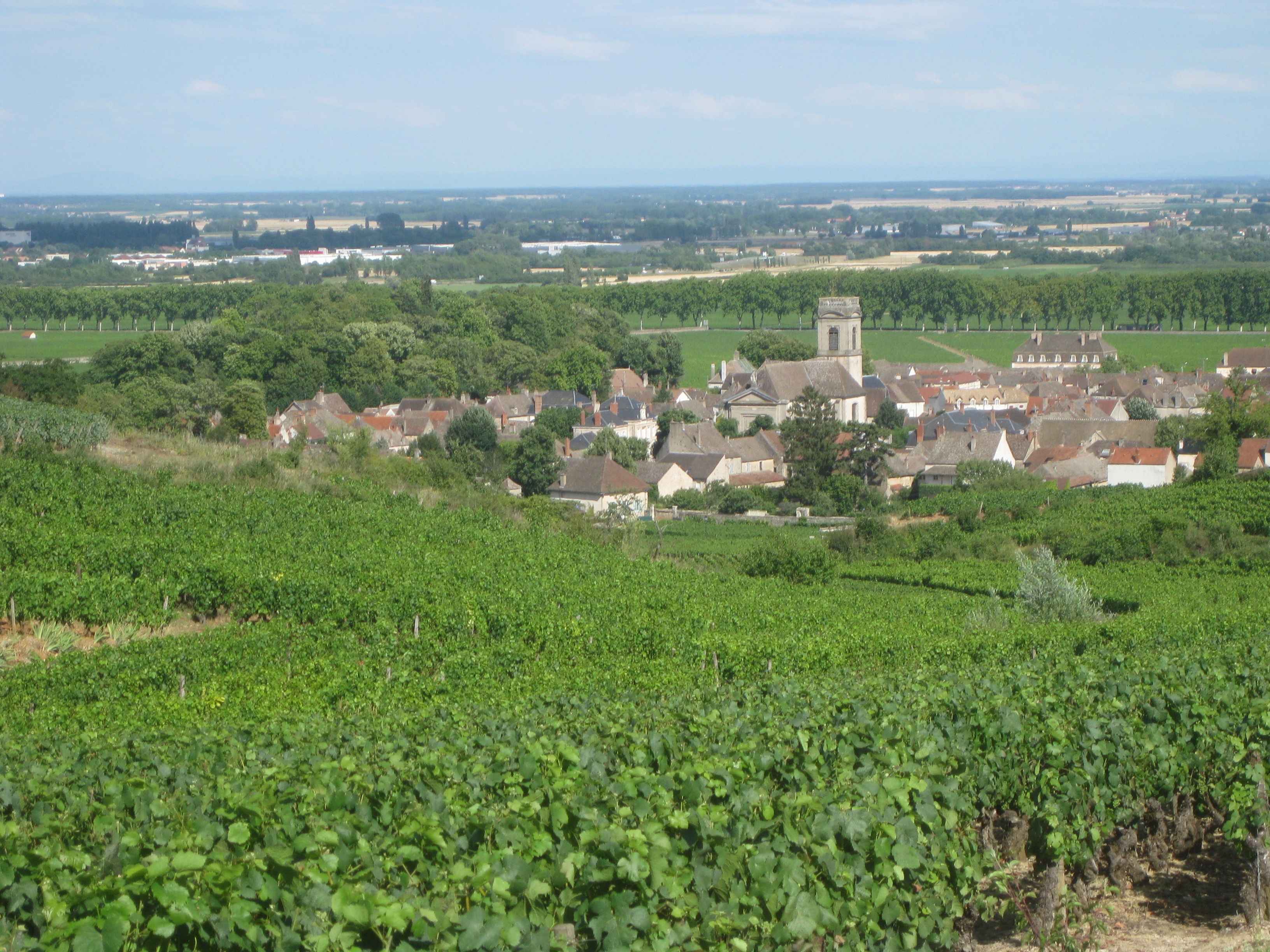 SUMMARY:
2010 is one of the most interesting, and exciting, vintages that I have tasted out of barrel. That said, it is in my view a connoisseur’s vintage, or, to use a word that seems to have become (as it was in the Nixon era) a political epithet, an intellectual vintage. I say this not because these wines will not give great pleasure in the glass—they will—but because the more you know and appreciate the subtle, and not-so-subtle, differences among Burgundy terroirs, the more you will get out of these wines. The best wines of this vintage, and there are many, achieve what Burgundy so rarely does: they are wines of ripeness, balance and transparency, and the more one either brings an understanding of Burgundy to the tasting (or seeks it through vertical or horizontal tastings), the more interesting and rewarding the experience of these wines will be.
The key to this vintage was the poor weather at the time of flowering, which caused a large amount of millerandage (very small berries with thick skins and few seeds), and also a significant number of aborted berries. The growing season was protracted and unstable; as one producer said, it was rare to get three beautiful days in a row. However, by the time of the late September harvest, the grapes had been able to reach phenolic ripeness yet retain a significant level of acidity, a highly unusual occurrence. The best are remarkably balanced, with ripe fruit yet penetrating minerality, wines that clearly reflect their terroir differences and have already begun to develop a silky texture. However, the growing conditions also favored the development of botrytis and mildew, and careful triage was necessary at harvest to eliminate affected grapes. In truth, I did see in a number of wines a significant touch of sucrosity in the back palate just before the finish, and whether this is just a stage in the development and integration of these wines, or something that will ultimately mar their balance and purity, remains to be seen. It also must be said that, unlike 2009, this was not a “no-brainer” vintage; rather, in the words of Aubert de Villaine, it required “skill, experience and rapidity of intervention.” As a result, while there are many great wines to choose from, it may be that the portfolios of the negociants, where there are some very great wines but also generally less consistency, are more representative of the vintage as a whole than, say, the portfolios of Domaine Lafarge or Georges Mugneret-Gibourg.
If small berries produce more concentrated wines, they also yield far less juice, and production levels for this vintage are down 30% and more from the prior year. Compounding this problem, there was a severe frost in December 2009, which killed many vines, particularly in the Cote de Nuits vineyards that abut the D974, the main road through Burgundy. This frost mostly affected Village and Bourgogne appellations, and further contributed to the shortage of wine in this vintage. This is particularly unfortunate in that there were some remarkable wines made among these “lesser” appellations in 2010.
Comparisons with the highly-acclaimed 2009 vintage will be inevitable. Bernard Hervet of Domaine Faiveley noted that while 2009 is a universal vintage, one that will give great pleasure to beginners and sophisticated Burgundy collectors alike, 2010 is more likely to be appreciated by the latter. Certainly the 2009s have their hedonistic side. In side-by-side comparisons with the 2009s, the earlier vintage has richer and denser fruit flavors, but the key to real greatness was being able to preserve the acid balance of the wine. As the notes below indicate, some producers did that very successfully, though elsewhere there are wines that are rich and heavy but lack essential balance. While it seems fashionable in some critical circles to denigrate the ‘09s a bit (too easy, too rich), the fact remains that there are many superb wines in ’09. In many of the cellars we visited, one could find instances of individual wines where the ’10 seemed better, and others where the ’09 seemed better. In the end, these are two first-rate vintages, the ‘09s a warm, ripe vintage that one sees, with pleasure, every decade or so in Burgundy (comparisons have been made to ’99 and ’59, among other vintages), while ’10 is unusual, if not sui-generis, and I am not sure that trying to rank them makes sense at this early stage of their development. As to other vintage comparisons, most producers seemed to agree that the 2010s are not at the same level as the 2005s (a vintage that has it all, but that will take many years to evolve), and also that while they bear some similarities to 2008 and 2001 in their terroir transparency, the ‘10s are much more harmonious and well-balanced than either of those earlier vintages, and have a lot more ripe fruit. In discussions with several dozen winemakers, very few could think of a comparable vintage, and more than one chuckled at the notion that while this was being called a “classic” Burgundy vintage, it was one that was almost without precedent. One grower who did venture an analogy, Michel Lafarge, reached back to 1962, which if it proves true is high praise indeed.
The white 2010s are more irregular; while the best possess the same sense of harmony and balance as the reds, there seem to be fewer successes—mainly because the acidity levels are not always what they should be, and the wines can seem on the fat or even flabby side. Philippe Senard remarked that in his experience, when yields were down considerably for whites, the resulting wines often have had a propensity to top-heaviness. Nonetheless, there are some great successes among the whites, including among the Chablis that we tasted (albeit only a handful, not enough to give a comprehensive picture of the vintage in that region). While the 2010 whites in general seem better than the 2009s, I would approach the vintage with some caution, also keeping in mind also that no significant progress has yet been made on the premature oxidation issue.
Overall, because of the lower quantities and the cult reputation this vintage has already begun to acquire, the 2010s will likely be more difficult than usual to find. And while cellar door prices are not likely to be up substantially, no doubt the ultimate price to consumers will be affected by the shortages.
Another characteristic of this vintage is that the grapes ripened well in the lesser appellations, and there are a number of delicious Village wines, and even some excellent Bourgognes. These should not be overlooked as they will provide excellent everyday drinking and should be accessible relatively early. In terms of drinkability, the tannins in most wines seem ripe and well resolved, and while the top wines may close up for a few years, I would expect that this vintage will be at least accessible early on–though holding the wines will be well repaid in the development of nuance over time.
RED BURGUNDY
THE DOMAINES
Bruno Clair: Great successes in 2010. Bruno Clair referred to 2010 as “la grande petite annee” and, as one of the few producers whose memory and experience extends back far enough, felt Lafarge’s analogy to 1962 was not necessarily a good one, finding ’10 richer than the earlier vintage. He also said that, in his view, 2009 was like 2002 but much more powerful. For those willing to reach down the appellation ladder, there are some excellent Marsannays here, particularly the Longerois, and a fine Savigny Les Dominodes. However, the greatest successes are, not surprisingly, at the top levels—an excellent Gevrey Cazetiers, with great cut and transparency, and tannins to keep it, and an even better Clos St. Jacques, more reserved but with a wonderful purity to it, especially on the long complex finish; followed by a great Clos de Bèze, complex and dense, with sweet fruit throughout, and plenty of tannins, but ripe ones. The best, however, was the Bonnes Mares (from the Terres Blanches sector), an old style, dense wine that keeps its feet, with great tension and a long, high-toned finish.
2009s tasted included the Savigny Dominodes, very ripe but with good balancing acidity (90); and the Gevrey Cazetiers, extremely ripe and rich but possibly a touch heavy (91). As between the two vintages, I preferred the ’09 Dominodes and the ’10 Cazetiers, but we did not see enough ‘09s to get a good sense for how they compared overall at this domaine.
Rousseau: We began in medias res with the Mazis, which was quite a way to begin: floral, transparent, and balanced, without the ponderousness I often find in this wine. The Ruchottes was a bit reduced, which amplified the dryness in the tannins, but it seemed complex, and pure on the finish, and it should be quite fine in time. The fireworks, though, began with the Clos St. Jacques, dense, pure and penetrating, with great black cherry fruit and spice; there is a lot of wine here, particularly for a premier cru. Indeed, for quality it held its own with the Bèze, though the latter was much denser, with the small berry fruit evident and ripe tannins, excellent balance and a long finish. The star, though, was clearly the Chambertin; the nose was more calm and refined than that of the Bèze, there was a lot of power here, and density, but also structure and refinement, and a long transparent finish; if one may anthropomorphize, this is an extremely self-confident wine, as it deserves to be. Bravo!
Trapet: It was a busy morning at Trapet, and Jean Trapet was pressed into service to conduct our tasting, which proved to be a great treat, as he is a font of knowledge about the history of the region and shared some fascinating stories with us. Fortunately, however, he did not distract us from our mission of tasting the wines, as they were a great success in 2010. While I have in the past sometimes been critical of the level of toasty oak used at the domaine, this year it did not seem obtrusive (with the possible exception of the Gevrey Village). The Gevrey 1er Cru Capita (composed of grapes from Combottes, Ergots and Corbeaux) was particularly delicious, with very fine delineation, and the Chambertin was as usual excellent, with lots of spice, grilled meat, depth, power and energy; the tannins seemed fairly prominent but silky. The surprise, though, was the Latricières —not that it is ever a bad wine, but this one was really singing—great penetrating minerality and spicy red fruit on the nose; balanced, charming and elegant on the palate, and concentrated yet transparent on the finish.
Among the ‘09s, I liked the Gevrey 1er Cru Capita, with a lovely complex nose, a soft entry and a good minerally mid-palate (90-91), and the Chapelle-Chambertin was very silky, if a bit dry from the wood (91). The Latricières had a great nose, and was very precise, powerful, balanced and structured—a particularly fine Latricières (93), while the Chambertin was reserved and dignified, a very structured wine with a lovely spicy finish (94). Overall, I had a slight preference for the ‘10s, but the ‘09s are rounding out nicely, particularly the top two.
Ponsot: 2010 was another brilliant success for Laurent Ponsot. Wines that particularly stood out for me included the Chambolle Charmes, which despite a touch of reduction showed concentrated fruit, and “despite” the richness and density also showed great balance and freshness; the Morey 1er Cru Cuvee des Alouettes, reflecting well its terroir; the Griottes, with intense fruit balanced by wonderful fresh acidity, and with refined tannins; an old vines Clos de Vougeot which was extremely expressive on the nose, and quite intense and complex on the palate, yet it kept its balance; and of course the Clos St. Denis TVV, with an intense, deep yet subtle nose, great equilibrium on the palate, black cherry fruit, minerals and spice, it was elegant and even ethereal on the palate, with some very sophisticated tannins. It was a truly great wine, and I even marginally preferred it to the Clos de la Roche, glorious as the latter was, with a broader nose than the Clos St. Denis, complex and harmonious, a wine of texture (silk, to be sure), with a touch of tannin at the end to hold it. Ponsot is clearly on a roll.
Dujac: Comparisons between Dujac and Ponsot, while inevitable, are interesting less from a quality standpoint (both, at their best, can be outstanding) than because the styles are very different, as are the personalities of the winemakers. There are excellent wines here in 2010, including a very good Charmes-Chambertin (not usually my favorite terroir), an even better Vosne Malconsorts, with excellent spice, density and texture; a slightly reduced but nonetheless very fine Clos St. Denis, which if more open-knit and broader than the Ponsot, was well balanced, silky and extremely long; a first-rate Clos de la Roche, with excellent structure and texture and a lovely transparent finish; and finally, a terrific Bonnes Mares, with a very pure fruit expression, density and balance—another quite self-confident wine. Jacques Seysses admitted a preference for the Clos de la Roche, but on this morning at least, I gave the nod to the Bonnes Mares.
Among the ‘09s, I found the Vosne Beaumonts a touch heavy (89), while the Charmes was delicious but lacked grand cru weight (91). From there, the wines just got better and better: the Vosne Malconsorts, with much brighter acidity and better balance than the Beaumonts (92); the Echézeaux, with great balance and depth (93); the Clos St. Denis, with excellent vibrancy and balance, a fair amount of tannin still, but elegant and relatively dense for CSD (94); an even better Clos de la Roche, with great presence and balance, silkiness developing, and good density (95); a powerful Bonnes Mares, with lots of minerality and dense black cherries (94); Chambertin, which was rich, meaty and powerful, well-balanced, but with just a hint of baked fruit that kept the score from being higher (93-94); and at the head of the class, the Romanée-St-Vivant, with remarkable Asian spice, black fruit and minerals on the nose, and real delicacy on the palate, silky, elegant and balanced, no heaviness here, to be sure, and a very persistent finish (96). It will be interesting to see ’09 and ’10 side-by-side as they mature, but today I think I had a slight preference for the ‘09s here.
Clos des Lambrays: After a few years in which this Domaine seemed to have lost its way a bit, the good news is that their 2010s are flat out terrific. Even the Morey Village is a great success, with great freshness, sweet fruit and a silky texture. The Clos des Lambrays, of course, is in a different category, with a perfumed, almost musky component to the nose, and on the palate, great charm and lovely texture, and a minerally finish with excellent tension. We also tasted the ’09 Clos des Lambrays, which was quite dense, richer than the ‘10 but without the balance (89). My clear preference here was for the ’10.
Clos de Tart: After a fascinating tasting of various components (young vines, top, middle and lower slope, 0, 50 and 100% stems), we tasted the final blend, which was dense, spicy, complex and balanced, with well-resolved tannins and a glorious long finish; this is a wine of finesse and harmony that will be a great Clos de Tart. (As an aside, while I am certainly a believer in the centrality of terroir to an understanding and appreciation of Burgundy, we had the benefit of a number of component tastings this year, including also Comte Armand’s Clos des Epeneaux and Christophe Roumier’s Bonnes Mares, all of which benefit greatly from the blending of different sub-climats, and even in this terroir-dominated vintage, one should not lose sight of the complexities of this subject. But that is a discussion for another time.)
Mugnier: Not surprisingly, several superb wines from the always-modest Freddy Mugnier in 2010. The Village Chambolle was a lovely example, with a nose of cherry and spice, a nuanced and expressive palate, excellent balance, and a charming finish. The Fuées seemed more serious and restrained, with a fair amount of tannin, and the Nuits Clos de la Maréchale (shown after the Musigny, which is understandable on one level but nonetheless jarring) seemed a mélange of Nuits and Chambolle. The Bonnes Mares, though good, still lacks the depth of great Bonnes Mares. The Amoureuses, however, was in another league, with a nose of ripe red fruit, lavender, and minerals, excellent tension and purity on the palate, and ripe, silky and fine tannins, and the Musigny was in another universe, with a deep nose showing great purity and elegance, a silkily-textured palate, delicate balance, a bit more power perhaps than is usual for this wine, but the quintessence of power without weight; a wine of enormous subtlety.
Great ‘09s here, as noted last year. The Chambolle Village had riper and deeper fruit than the’10, but retained its balance—two great Village wines that will be interesting to compare as they mature (90). The Chambolle Fuées was full of black fruit and spice, again, richer than the ’10, but perhaps not quite the same balance, though it did keep its feet well (91). The ’09 Nuits Clos de la Maréchale was ripe and beautiful, a bit less rustic than the ’10 (91), while the Bonnes Mares had an extremely expressive nose of black cherry, hay and cassis, with lots of power, minerality and density on the palate, and today it was showing more complexity, richness and concentration than the ’10. The Chambolle Amoureuses was quite intense for Amoureuses, with a lot of tannin but beautifully refined, and notes of cinnamon and mocha that carried through from nose to an almost endless finish (95). The Musigny showed ultra-ripe black cherries on the nose, citrus and an almost tarry note, on the palate it had ripe fruit, a touch of soy, minerals, and was powerful, rich and dense—a relative heavyweight for Mugnier Musigny. Certainly it is an exceptional wine, but the ’10 seemed purer and more refined to me. Here, at a domaine that is among the very best in Burgundy, there are wines that are better in ’10, and others that are better in ’09, which to me only shows the foolhardiness of making definitive pronouncements on the comparative quality of these two vintages.
Roumier: It is always interesting to taste at Roumier and Mugnier on the same day; two of the greatest winemakers in Burgundy, next door to one another, making many of the same wines, in two very different but equally compelling styles, yet both always respectful of the underlying terroir. As at Mugnier, not every wine is compelling in ’10, but the best will rank among the monuments of the vintage. Here, even the Bourgogne is tasty, and the Chambolle Village is a delicious wine, with bright fruit and a purity that will emerge more fully once the wine is racked. The Clos de la Bussière seemed quite elegant for Morey, and the Chambolle Combottes, while a little reticent (like Mugnier’s Fuées in this regard), nonetheless had a pure spicy long finish that suggests this will be quite fine. The Chambolle Les Cras, though, was a step up, pure, balanced, with lovely sweet red fruit, and a finish that displayed great energy (a word one heard a lot in describing the better ‘10s). The Charmes, while charming (!), for me lacks Grand Cru weight, though Christophe said he liked the stem touch in the finish here. The Ruchottes was several steps up from the Charmes, with gorgeous silky fruit, great balance and, despite its power, it was remarkably elegant for Ruchottes—I very much liked this wine. The Amoureuses had a brooding black cherry nose, a velvety texture, and a lot of minerality, with a long, pure and elegant finish. The Bonnes Mares, a blend of Terres Blanches and Terres Rouges, was complex, nuanced and powerful, with lots of small berry fruit and minerality, and the balance of this vintage; this will be a really fine Bonnes Mares. The Musigny, as always in heartbreakingly small quantity (why, one wonders, can’t the wine gods intercede and give de Vogüé’s Musigny to Christophe to make, as his grandfather did during de Vogüé’s golden era?), was simply amazing, with a sensational nose of small red berries, minerals, lavender, citrus and spice; on the palate, this wine is a lesson in purity, balance and elegance, with the finest possible tannins and an almost endless finish. Breathtaking.
As at Mugnier, we tasted a broad range of ‘09s. The Chambolle Village had creamy dense Chambolle fruit, a velvety sense that began even on the nose, and a long spicy finish (91), while the Morey Clos de la Bussière was quite spicy and powerful, but still balanced, and a creamy finish (90), and the Chambolle Combottes was quite well balanced, with no sense of heaviness and a strong spicy finish (90). The Chambolle Les Cras had a wonderful perfumed nose, and was very pure and minerally, with excellent density (92). The Chambolle Amoureuses was still a bit locked down, but had exceptional balance and harmony, with spicy black fruit, minerals, a floral touch and citrus and mocha notes on the finish (94). The Bonnes Mares was powerful, dense and complex, with a lot of acidity to balance the fruit, and a long, glorious finish (95). Christophe preferred the Amoureuses, for its floral qualities, while Freddy Mugnier, who was at the tasting with us, preferred the Bonnes Mares (as did I). As at Mugnier, these ‘09s are undeniably great wines, and the only proper answer to the question of “which is better, ’10 or ’09?” is “why not have both?”
Château de la Tour: A very nice Gevrey Chambertin V.V., still a bit reduced, but underneath there was a lot of structure, and a long sweet fruit finish–a nice Village wine. The Clos de Vougeot was also very good, but of course the star was the Clos de Vougeot V.V. (from vines now 100 years old), with a deep, almost purple color, this is a wine that is dense, layered and intense yet has a silky texture, and excellent balancing acidity.
Hudelot-Noellat: Though Madame still putters around the office, responsibility for this estate has now fully devolved upon the 23-year old Charles van Canneyt, and despite his relative youth, he is off to an extremely promising start. While the Village-level wines showed a bit too much reduction to get a clear view of their ultimate quality (reduction being quite common, for whatever reason, in the wines of this vintage at this stage), the premiers and grands crus were generally more accessible and several of them were particularly outstanding. I once again was surprised by the quality of the Vougeot Les Petits Vougeots (one more year, and I’m going to have to stop being surprised), which in the past has been rather rustic, but here had a silky texture and an interesting cherry and mineral finish. The Nuits Meurgers was also excellent, if slightly rustic, while the Vosnes were particularly outstanding, the Beaumonts beautifully balanced, pure, delicate and silky, the Suchots, with a finish that seemed even richer and creamier than the Beaumonts, and the Malconsorts, which was in another world: dense sweet fruit, great Vosne spice, silky, intense, pure and extremely long. It even showed up the Clos Vougeot, which was very nice but not necessarily better than the Vosne premiers. The Romanée St. Vivant, despite some reduction, still showed huge spice on the nose, anise and clove, great balance and density, and a lovely silkiness at the finish, with the tannins well resolved. The Richebourg was at least as good, and although the nose was restrained, there was a gorgeous silkiness here too, with delicacy, purity and balance and an exceptionally long finish—an elegant Richebourg.
The ‘09s were also showing extremely well. The Chambolle Village was juicy and rich, and an initial hardness gave way eventually to a silky texture and a charming finish; this had a lot of finesse for a Village wine (90+). The Nuits Meurgers had a pure, minerally earthy Nuits nose, surprising elegance on the mid-palate and a penetrating spicy pure finish (92-93), while the Vosne Suchots had great presence and density, a sweet, slightly gamey mid-palate, and a long charming finish; indeed this wine was almost too charming, if that’s possible, but it kept just short of going over the top (92-93). The Clos Vougeot, while very dense and powerful, was not expansive on the mid-palate; perhaps it is slightly shut down, but today it was not as impressive as its stable-mates (90). The Romanée-St-Vivant, however, had beautiful weight and density, great charm, silky refined tannins, and a lovely primary fruit finish that gave way to deep spice (94). The Richebourg had hints of game, violets and lavender, and a lot of tension, plus power (95). Overall, a highly impressive range of ‘09s.
DRC: Bernard Noblet thought hard about what vintages might be analogous to ’10, before finally saying that it had some affinity with 2001, which he described as complex to understand for most consumers (unlike 2009), and also perhaps with 1991. Allen Meadows added that there was greater phenolic ripeness in 2010 than 2001, as well as lower yields. In any case, the ‘10s here are, not surprisingly, hugely successful. The Corton certainly had the hallmarks of this terroir, though I found it perhaps a touch light in the mid-palate. The Echézeaux was not dense but elegant and very well-balanced, while the Grands Echézeaux was, as usual, a big step up, powerful, mineral-driven yet beautifully balanced, with polished tannins. The Romanée-St-Vivant, which Bernard thought a little tired from its recent racking, nonetheless displayed a great sense of equilibrium, with typical spice and lovely sweet fruit; overall, it is a wine that still seems coiled and not ready to show everything just yet. The Richebourg also showed a lot of reduction right now, but there was a sense of harmony and power nonetheless–a brilliant and powerful wine not yet emerged from its chrysalis. La Tâche was finely defined on the nose, with the spiciness still slightly suppressed but excellent balance and transparency, and a super-long finish with some highly polished tannins. Romanée-Conti showed much more density and intensity of fruit on both nose and palate, with perfect balance and its typical gracefulness on the finish; a very concentrated wine with a finish that seemed almost endless, it is a wine of great subtlety and finesse.
We only tasted one ’09 here, the Echézeaux, a dense spicy wine that exuded confidence, with sweet black fruit, good minerality and tension, and lovely structure (93). I found it more compelling than the ’10, but it is only one wine and one day. (As an aside, while usually the person conducting a blind tasting gets to be omniscient while making everyone else look foolish, for once the tables were turned: Bernard had intended to show us the ’09 followed by the ’99, but mixed the two up so that the ’99 went first, and drew puzzled stares and much head-scratching when he announced that the 12-year old wine we had just tasted (as had he, though to his credit he seemed perplexed as well) was the ’09.)
Georges Mugneret-Gibourg: One day, perhaps, this Domaine will command prices equivalent to the quality of the wines, but for now, the wines, though no longer a secret, still represent a bargain relative to the quiet brilliance of the winemaking. In 2010, the Vosne-Romanée was a standout among the Village wines tasted on this trip, with dense fruit and spice on the nose, it was soft and approachable, yet pure, on the palate, and had a charming finish. The Nuits Chaignots had bright small-berry fruit, and was dense and earthy, with a fair amount of tannins still, though the finish was long and pure. The Chambolle Feusselottes had classic Chambolle fruit, but also excellent presence, while the Gevrey 1er Cru (the “Ruchottes Junior”, so-called informally because it is young-vine fruit from the Ruchottes vineyard) was light but charming. The Echézeaux, while still quite primary, had real presence and purity, and was dense, complex and long. The Ruchottes was even better, with a gorgeous nose of black cherry and grilled meat, as well as minerals, a wine with a wonderful silky texture and a very long finish. While in most vintages I put the Clos de Vougeot ahead of the Ruchottes here, it was a close race today, with the Clos de Vougeot being denser than the Ruchottes, and while the Clos de Vougeot was also quite pure, I found the Ruchottes a bit brighter, though this takes nothing away from the quality of the Clos Vougeot.
The ‘09s here were also brilliant, beginning with the delicious Bourgogne, which had dense black cherry fruit, and while it was a touch heavy it had a rich aftertaste (89) (according to Allen Meadows, these vineyards were considered Vosne Village prior to the establishment of the AOC). The Vosne Village was also quite rich, and also a touch heavy, with a long fruit finish (89). (I did think the ’10 of this was better.) The Nuits Vignerondes was earthy, dense and ripe, showing its Nuits origins, with fresh acidity at the end (91), while the Nuits Chaignots was very spicy, and perhaps a bit lighter-bodied than the preceding wine (90). The Chambolle Feusselottes was especially fine, with sweet red and black fruit, great balance and purity, a minerally finish and excellent tension (93). Here I preferred the ’09 to its ’10 counterpart. The Gevrey 1er Cru was a nice drink but a little slight (90), but the Ruchottes was powerful yet still graceful (93-94). The Echézeaux had a confident nose of black fruit and delicate spice, and was dense but still transparent (93), and the Clos de Vougeot had a glorious nose, with strong mocha notes along with black fruit, spice and lavender, and was dense but with lots of balancing acidity—a long distance runner with polished tannins and a long spicy minerally finish (94-95).
Liger-Belair: Typically excellent wines here in ’10, though I found a little bit of inconsistency. The Village wines had recently been racked, and perhaps suffered a bit from it (I have somewhat better notes for the Village wines from this past summer, though my notes for most of the wines are consistent), however, the Vosne Clos du Château was more approachable than the Colombières or the Vosne Village, with very good balance, spice and power. The Vosne Petits Monts, while not racked and showing some reduction, nonetheless had a spicy transparent finish, small berry fruit, great transparency and length. The Vosne Brulées, with a touch (19%) of whole cluster, was even deeper and more interesting, with great presence to it (though unfortunately it is available, if at all, only through the occasional charity auction). The Nuits Cras has never been a favorite of mine here (though Louis-Michel is at pains to point out it is Nuits from the Vosne side, with very old vines), and I found it overweight and possibly a bit too extracted for my taste. However, with the Vosne Reignots we were once again back on solid ground, with deep spice and sweet fruit on the nose, lots of density and complexity on the palate, and a spicy finish (some of it from Vosne and some from the new oak), yet the lift of the acidity gives it great balance–a wine of real elegance, (We did not see the Suchots in November, but it was showing extremely well in July.) The Echézeaux was also marvelous, a wine that spreads its wings in the glass and keeps going, with more presence, and indeed charm, than the Vosne 1er Crus. La Romanée, despite some reduction on the nose, showed itself to be a pure, almost delicate, La Romanée, a very elegant wine, with very ripe tannins and a hint of game on the long finish.
The ‘09s also showed a little bit of inconsistency, though the best are quite superb here. The Vosne Colombière was showing a lot of spice, and while it had rich fruit, it seemed less earthbound than usual (90). The Vosne Clos du Château was even better, quite open at the stage, with red fruit, perfume and some lavender on the nose, and while it was sweet and open it also had good acidity and minerality (92). The Nuits Cras had a bitter edge on the nose, and though there was sweet fruit, the wine seemed a bit heavy and rustic (88). The Vosne Reignots was superb, with dense ripe black fruit on the nose, and excellent balance, spice, minerality and density on the palate; this is a very rich wine but keeps its balance, and the tannins are present but polished (93). The Echézeaux had good pure fruit and a balanced, spicy finish, a very good wine but without the presence of the Reignots (90+). La Romanée had a restrained, spicy nose, hinting at great depth; it was an elegant wine, with coiled power, just beginning its evolution (95).
Grivot: I am increasingly impressed with the results at this Domaine, where the ever-modest Etienne Grivot has quietly but effectively ratcheted up the quality level. This is particularly good news given the range of Vosne premiers crus that the Domaine owns, in addition to their signature Richebourg. The Nuits Charmois (a Village lieu-dit) had a lovely bright sweet fruit nose and a lot to it for a Nuits Village, while the Village Vosne-Romanée, despite some reduction, seemed to have balance and purity. The Nuits Roncières was also quite good, though it is an earthy rather than an elegant wine. The Vosne Brulées was a bit too reduced to fully evaluate, but the Vosne Beaumonts, while also showing some reduction, was a brilliant wine: a calm, spicy, elegant nose; with great balance and transparency on the palate, a touch of wood but not obtrusively so, and a long lovely transparent finish. Etienne said it represented what he was trying to make: wines of elegance, power, sensuality, energy and luminosity. The Vosne Suchots, though very good, perhaps suffered slightly from being served after the Beaumonts; while the Reignots, though showing considerable reduction, impressed with its density, power and balance. The Clos Vougeot, a mid-to-heavyweight wine, seemed dense and tarry; its future was a bit opaque at the moment. The Echézeaux, however, had lovely line and balance, with real grand cru weight and good purity on the finish, while the Richebourg had a sensual nose, and had power without weight—beautifully balanced, pure and long, with ripe tannins.
Regrettably, we only had time to taste three ‘09s here. The Vosne Village had beautiful pure black cherries and spice on the nose, a touch of cream, and charm, only the slightly short finish betraying its plebian origins (90). The Nuits Boudots was spicy and earthy, with great presence and excellent acidity (92), while the Vosne Beaumonts had deep spice on the nose, and was packed with rich fruit but completely balanced, with a significant level of tannins—great Beaumonts (94-95).
Anne Gros: As readers of past reports will know, I have been critical of Anne Gros in recent years, as I think she is a very talented winemaker who seemed to take her eye off the ball, and even her ‘09s did not seem to reach the full potential offered by the vintage. The good news, however, is that Anne is very much back on form in 2010. If the Bourgogne and Chambolle Combe d’Orveaux still seemed to suffer from too much new oak, the Vosne Barreaux seemed to be eating it well, and was a wine of great spice and black cherries, with excellent acidity to give it lift. The Echézeaux was well balanced, with pure sweet fruit; though dense, it felt a bit more ponderous than the Vosne. The Clos de Vougeot, however, had good lift from the acidity to match the density, and a long brambly blackberry finish. The Richebourg, despite some reduction, was concentrated and complex—an elegant Riche with great balance.
The ‘09s seemed much as I remembered—good but not great wines. The Vosne Barreaux was a little curious, with a ripe spiced pear nose, and cloves, plus sweet cherry fruit (86), the Echézeaux had strong wood tones on the nose, some nice acidity and lift, and seemed charming if not very deep (89), while the Clos de Vougeot had prominent wood notes, and despite good depth and penetration seemed ponderous, with some sharp tannins at the end (89). The Richebourg had more fruit than oak on the nose, and some elegance, but overall seemed a bit light for Richebourg, especially given the vintage (90?).
Méo: I confess to some puzzlement here. There are certainly some great wines here, but there seems in recent years to have been, overall, a greater inconsistency than in the past, which I am at a loss to explain. Possibly it is because we are being shown an increasingly higher percentage of the negociant portfolio (and some of the key domaine wines, most notably the Cros Parantoux, were unaccountably missing from the tasting); certainly I find the negociant wines less compelling than those of the domaine overall, but whether this is as a result of having somewhat less gifted terroirs in that portfolio, or of the wood treatment, or of simply not having the same level of control (though the domaine does all the vineyard work for at least some of these wines), I just don’t know. In any event, while I thought the negociant wines we tasted had good fruit expression and density, I missed the purity I had seen elsewhere, though I did like the Nuits Perrières the best among this side of the portfolio. Among the Domaine wines, the Vosne Chaumes, Echézeaux and Clos de Vougeot seemed good but at the moment the wood is a bit too prominent, while the Corton seemed more expansive, with fat rich cherry fruit, excellent balance, and a nice texture developing. The Vosne Brulées, always one of my favorite wines here, had excellent tension and balance, though it seemed, at least today, to have a bit of blunt tannin at the end. The Richebourg was quite dense, rich and spicy on the nose, but the wine seemed to require a lot of work to get at its underlying depth, before coming up nicely on the finish. Perhaps these wines are simply going through a phase right now; certainly that is always a danger, and given Méo’s track record, I would not want to bet against him. Still, having had so many great wines here in the past, I confess to longing for more.
We only tasted one ’09, an excellent Vosne Chaumes, with an effusive nose of rich ripe fruit and Vosne spice and excellent acid balance on the palate, and with the tannins evident but dominated by the ripe fruit on the long, spicy finish (91). Jean-Nicolas had a lot to say about the two vintages: in his view, the ‘09s have structure and need time but will age well; he views criticism of the wines as too ripe or easy as misplaced. He does see the ‘09s as more voluptuous than the ‘10s, and finds the ‘10s difficult to compare to any other vintage, though he said it might be seen as a mix of ’05 and ’08. He said he regards ’05 as potentially the greatest vintage of the last 20+ years, though the wines are still austere and closed.
Comte Senard: Philippe Senard embodies joie de vivre, and it is always a pleasure to pass several hours in his company. He has now turned the Domaine’s winemaking over to his daughter Lorraine, who is definitely gaining not just in experience but in confidence. This year, several of the wines were not easy to evaluate, with many of the noses seeming suppressed, and relative to many other wines tasted on this trip, the future of some of these wines seemed uncertain. However, there were several standouts, including a very good Corton Clos des Meix, with touches of cinnamon and cardamom; Corton Bressandes, which stood out for its sense of balance between fruit and minerality, as well as its charm; and Corton Clos du Roi, which despite some heavy reduction, showed great balance, transparency and elegance.
We also tasted the two top crus in‘09: Corton Bressandes, which had a lot of lush fruit and spice, and high-toned acidity; while it was a powerful and dense wine compared to the ’10, it seemed a little short, though Philippe said it was suffering a bit from recent bottling and not fully integrated right now (NR); and Corton Clos du Roi, which had a nose of iron filings and meat, plus open black fruit, and on the palate it was rich without being heavy, with excellent acid balance and real grip and harmony (93).
Comte Armand (Domaine des Epeneaux): Both the Auxey-Duresses 1er Cru and Village Volnay were quite good, as was the Volnay Fremiets, with a sweet red fruit nose, excellent delineation, and a very nice cherry finish. The Pommard Clos des Epeneaux, which we tasted first as four different components, was absolutely beautiful, with a nose of black fruit, spice and a touch of earth, while on the palate it was unusually elegant for a young Pommard (Pommard seems to have done quite well in this vintage), with a long, pure, spicy finish. The ’09 Clos des Epeneaux had a lovely nose, with spicy, transparent, ripe fruit; it was dense and intense but kept its feet, and had strong but ripe tannins. Nonetheless, it seemed heavier and more earthbound than the ’10 (92-93).
Michel Gaunoux: The Domaine does not offer barrel samples, so we did not taste the ‘10s. However, we were able to taste the ‘09s in bottle, and were among the very first to do so. The nose of the Bourgogne Rouge seemed reticent, but there was lovely bright fruit on the palate; a straightforward wine (87). The nose on the Pommard Grands Epenots was also a bit unforthcoming, though one sensed the red fruit underneath; on the palate though, there was lovely bright red fruit, an excellent balancing acidity, a touch of sucrosity, and a lovely spicy complex finish, with great minerality (93). The Pommard Rugiens had deeper-pitched fruit than the Epenots, with bright acidity, great balance, and a dense, earthy, rich spicy fruity finish (94). The Corton Renardes was even better, with ripe red fruit and a touch of bacon on the nose, grand cru weight and depth on the palate, and a great high-toned finish of sweet red fruit and minerals, pure and in excellent tension (95).
De Montille: Some excellent wines here, though not uniformly successful. I quite liked the Beaune Grèves, with its light red fruit and earthy notes, and touch of stem tannins (1/3 whole cluster), the Volnay Champans, with ripe black cherry fruit on the nose, and real delicacy on the palate; and especially the Volnay Taillepieds, elegant, minerally and restrained, with a creamy texture developing (100% whole cluster). I was less persuaded by the Pommards, and the Corton Clos du Roi seemed top-heavy. The Clos de Vougeot however was very good, with delicate perfume and spice, very well balanced and delivering power without weight, though there were some strong dry tannins at the end (100% whole cluster) that will need time to resolve. The regular cuvee of Vosne Malconsorts was quite good, but the Cuvée Christine was even better: a floral nose, with Asian spice and small berries; great lift on the palate from the acidity, and intensely long on the mineral/fruit finish, with lots of tannin but the finish almost endless.
Marquis D’Angerville: Great wines from Guillaume d’Angerville. This Domaine has been producing top-flight Volnays for many years, but in recent years they seem even more polished and precise, and in ’10 the wines are pure, terroir-specific, restrained and elegant. The Village Volnay showed the way with excellent balance and transparency, and the Volnay Clos des Angles was concentrated yet had real delicacy and persistence. The Volnay Frémiets had a nose that jumped out of the glass, but seemed more in need of a racking than some of the other wines. Volnay Caillerets had black cherries, stones, hints of cinnamon and clove on the nose, and overall was stony and balanced, though perhaps it lacked a little seductiveness. Volnay Taillepieds was dense, pure and minerally, with sweet fruit on the palate and excellent texture, and a high-toned finish; it was, in Guillaume d’Angerville’s words, “a serious wine.” The Volnay Champans was denser, with a sense of small berry, cassis-like fruit on the nose, balanced and pure but powerful, with great density and weight on the finish. Guillaume said that the Champans is to him the archetype of Volnay, but I do have to say that this year at least, I preferred the stylishness of the Taillepieds. Best, though, was the Volnay Clos des Ducs, with a brilliant, layered and complex nose, and though it had power on the palate it very much kept its feet, and if it had a bit more tannin on the finish than the others, it was ripe tannin, and the finish itself was quite long and elegant.
Lafarge: This was one of my favorite tastings this year, as the wines were hugely successful from the bottom to the top of the range, while the terroir differences quite clearly stood out. Michel Lafarge remarked that while in 2009 the flavors were closer together from wine to wine, in 2010 one can see the differences in terroir very clearly. The Bourgogne Rouge was quite attractive, with lovely red fruit and spice, and texturally a hint of silk to it, and the Village Volnay was also excellent, with a surprising density and richness for Village wine, and a lovely pure finish. The Volnay Vendages Selectionnées was even better, soft, silky and delicate, elegant even, with some tannins and a bright pure finish. (Michel Lafarge said this comes from old vines bordering the premiers crus.) The Beaune Aigrots had deep spice and earthiness, and spicy, sweet cherry notes, though the tannins were a touch dry; I preferred the Beaune Grèves, with an earthier nose than the Aigrots, and finer tannins on a spicy, minerally, citric finish—a really great example of Grèves (followed a few days later by a brilliant bottle of the ’66 Grèves from Lafarge, which shows what this terroir can do at its best). The Volnay Mitans, never my favorite Volnay, was good (less lumpy than the de Montille, for example), but the Clos du Château des Ducs seemed much more interesting, a distinctly charming and seductive wine, soft and a little forward, though not without very nice minerality in the mid-palate and on the finish. Volnay Caillerets was a star, with a nose that paired pure ripe red and black fruit with an austere minerality, great purity on the mid-palate, with cherries, spice and even a hint of violets, and a long, transparent, highly cut finish. Somehow, though, the Volnay Clos des Chênes managed to be even better, with a nose of flowers, cherries and hints of strawberries, plus minerals and mocha; on the palate, it was developing a silky texture already, and was balanced and transparent, while on the finish, the tannins were evident but ripe, and the finish as a whole was long, minerally, pure and subtly elegant.
We then tasted several ‘09s. Michel Lafarge said this was the best vintage of the decade after 2005 (though he did not clarify whether he considered the decade to end with ’09 or ’10), though he sees the ‘09s beginning to close up a bit. The Volnay Vendages Selectionnées had pure sweet fruit on the nose, with spice and a touch of creaminess; on the palate it had red fruit, a silky texture, and a touch of dry tannins leading to a spicy sweet finish (90). The Beaune Aigrots was more minerally and earthy on the palate, with good balance, and a strong amount of tannin, albeit ripe (90). The Volnay Caillerets had a beautiful transparent nose, great minerality, an elegant wine with ripe fruit and a very pure finish (93-94). The Volnay Clos des Chênes had a nose of very ripe fruit and a contrasting deep minerality; it was a highly structured wine, with great balance and purity, developing a silky texture, and very refined tannins on an aristocratic and refined finish (94-95).
THE NEGOCIANTS
Drouhin: Some brilliant wines here, particularly at the upper levels. The Village Gevrey was quite nice, with lots of sweet fruit, a meaty element, and good transparency, and the Chambolle 1er Cru, which is almost always a great value, was transparent, long and lovely. The Vosne Petits Monts was, as usual, at another level, with incredible rich primary fruit, spice, and great presence and power, but still the acidity to balance it out beautifully, and today it outshone the Clos de Vougeot, though the latter is certainly a very good wine. The Grands Echézeaux was particularly fine (other than DRC, it is hard to think of a Grands Echézeaux that is equal to or better than this, though it is a bit of a sleeper in the Drouhin portfolio), with a nose of black cherry, spice, and a creamy note; on the palate, it is an extremely elegant wine, with great balance, medium body, and some strong but quite ripe tannins on the spicy, incredibly long finish. The Griotte-Chambertin was also excellent, with deep black cherry notes and meat, a fairly powerful yet transparent wine with ripe tannins, and great presence and purity on the long finish. Chambolle Amoureuses did not suffer from being shown after these grands crus; the nose was deep, with small-berry fruit (currants?) and minerals, adding spice and citrus notes on the palate; plenty of tannin but ripe, with great purity and presence, and sweet fruit and deep spice on, again, an almost endless finish. Good as this was, the Bonnes Mares was even better, with a classic high-toned Bonnes Mares nose, and in contrast, more soft red fruit on the palate, yet great intensity and purity under, with a velvety texture, and a very long finish with some dry but resolved tannins present. The Musigny was nothing short of brilliant, with an intense, sweet, small-berry nose, penetrating minerality, and the characteristic citrus top note—pure yet rich; on the palate, a soft entry, lots of fruit, then minerality in suspension, still restrained over all; and on the finish, deep spice, power without weight, a fair amount of polished tannin, and an intensity that carries on and on.
Faiveley: As with any range of this breadth, there is going to be variation, but there are a lot of terrific wines here, and a handful that are truly standouts even in a vintage that produced so many great wines. Among the premiers crus, I quite liked the Volnay Frémiets, with an amazing silkiness and harmony, the Nuits Damodes, which reflected its terroir quite well, a bit rustic perhaps but to be expected, the Nuits Porrets St. Georges, more stony and yet silky, the Chambolle Fuées, quite integrated and with a lovely raspberry finish, and the Gevrey Cazetiers, surely a crowd-pleaser with its lovely red and black fruit notes, meatiness, and soft tannins. The star among the premiers crus, though, was an utterly brilliant Nuits Les St. Georges, with an amazing silkiness (it even smelled of silk, if that’s possible), remarkably elegant for Nuits, with a great balance of red fruit and acidity that carries through the finish. Among the grands crus, standouts included the Latricières, complex, reserved, with a characteristic cool minerally nose, a wine that is less evolved than most but is quite serious and will be excellent. Corton Clos des Cortons was typically intense, rich and fruity–and delicious–while the Clos de Bèze had a complex nose, ripe fruit balanced with a spicy component, again rich on the palate, and a developing silkiness, and the Musigny was an extremely classy wine, with serious if highly polished tannins to keep it, an incredibly long finish, and a great deal of elegance. However, the show was stolen by a special cuvée of the Clos de Bèze, called “Les Ouvrées Rodin.” This comes from parts of the vineyard that Bernard Hervet feels consistently produce a superior cuvée, and he is certainly on to something here. The wine is much more minerally on the nose than the regular cuvée, smoky, and very complex as it opens; on the palate, there is an amazing balance, silkiness, and great delicacy, with a subtle spicy element, followed by a long finish; overall, this is a wine of brilliance, grace and harmony, an extremely sophisticated Bèze that will be well worth the trouble to seek it out. (We did not retaste the ‘09s here; however, an ’09 Nuits Les Damodes, tasted at dinner, had great fruit and structure, as well as clarity and precision (91-92). It was only one wine, but confirmed the positive impression I had last year of the Faiveley ‘09s).
Bouchard: As with the other negociant firms, mixed results but some very fine wines in the portfolio. Among the “smaller” wines, I quite liked the Monthéie Clos Les Champs Fuillot (located next to Clos des Chênes, interestingly). It had bright fruit, good tension, and a good bit more interest than one usually finds in Monthélie. The Beaune Grèves Enfant Jesus was particularly fine (there were some especially good wines this year from Beaune Grèves, for whatever reason), with a lovely silky texture and a sense that this could develop real elegance. The Volnay Caillerets Cuvée Carnot was a touch light, perhaps, but drinking well, while the Pommard Rugiens, despite a rustic touch, was transparent and had a very good minerally finish. Le Corton was relatively open and charming, and should be a crowd-pleaser. The Gevrey Cazetiers was particularly fine, showing real Gevrey character, with excellent balance and a long minerally finish. Echézeaux was very nice, despite carrying a fair amount of wood (though in general the wood has been considerably dialed back here, which has helped the quality of the wines considerably), while the Bonnes Mares was outstanding: a restrained, typical Bonnes Mares nose, rich ripe fruit on the palate, good balancing acidity, grand cru weight, power and a long precise minerally finish, and refined tannins.
Jadot: A good range of wines from Jadot, though curiously I was more impressed overall by the premiers crus than by the grands crus. The Beaune Clos des Ursules was excellent, really showing its terroir, with earth, cherries, spice and minerals, and tannin to keep it. The Pommard Rugiens was also good, as was the Nuits Boudots, a nicely balanced wine, again reflecting its terroir well, and with a long finish. The Gevrey Clos St. Jacques was, as usual, a great success, with excellent presence, balance, density and length. Among the grands crus, I liked the Latricières and Mazis but neither seemed completely put together at this stage. Bonnes Mares, while not without its virtues, was surprisingly soft, and in my view could have used more precision, while the Musigny was soft and charming, with a lovely texture, a very good wine to be sure, though not in a league with the very best Musignys we saw. The Clos de Bèze, though also exhibiting a touch of softness, had good red fruit, some power, smoked meats, and the tannins were fairly resolved on a spicy, minerally, sour cherry finish that was quite persistent.
Olivier Bernstein: Our first visit here. Certainly they talk the talk, about seeking purity and terroir expression, and about the technical means they use to try to achieve it. The results, however, are wines of deep color and high extraction that, quite frankly, resemble each other entirely too much, and were difficult to tell apart. Well-made, certainly, but not at all in a style that I esteem.
WHITE BURGUNDY
This year illness as well as some scheduling conflicts kept me from seeing several producers I normally would visit, and so I did not get as full a view of the vintage in whites as I would have liked. However, I did taste enough to suggest to me that the whites are much more irregular than the reds, and in part that may be, as I quoted Philippe Senard earlier, an effect of the small crop, which resulted in many wines being too heavy. Another factor, which I discussed with Bernard Hervet, is that whereas one could with little trouble rattle of the names of more than a score of red wine domaines that are committed to excellence and willing to take risks to make great, rather than merely good, wine, one is hard-pressed to name more than a small handful of white wine domaines where that same spirit and determination prevails. Unfortunately, too many are content to produce a good quality commercially acceptable wine, and leave it at that. Sadly, even among those who do strive for the best, all but two have had serious and persistent problems with premature oxidation (there is nothing, I regret to say, new to report on that depressing subject).
All this said, there are some great successes among the whites in 2010, but careful selection is going to be critical.
Leflaive: A very nice range here, with the individual terroirs very much on display. Even the Bourgogne was lovely, with white flowers, minerals and spice, and the Village Puligny had good weight and balance. The Puligny Clavoillon had more to it than usual, though a touch of acid sticking out at the end. The Puligny Folatières was a big step up, with excellent density, spice, white flowers and peaches; it was elegant and long, while the Combettes, tasted next, had perhaps even more tension to it. The Pucelles was the best of these, with hints of citrus cream on the nose, and a long, lean, racy finish. The Bienvenues-Bâtard was a charming middle-weight wine, balanced and elegant, with good acidity, but the Bâtard had a good deal more tension to it, with notes limewood, spice and sweet fruit, as well as excellent power and structure—I quite liked this. The Chevalier, however, had still other dimensions: perfect harmony on the nose, with wet stones, white flowers, and great elegance; on the palate, it was soft and spicy, balanced, with acidity underneath, and a very long, focused, spicy finish.
Roulot: Curiously, several of the wines here had not finished their malolactic fermentation and so were not shown; while malos were quite protracted in general in this vintage, this was the only cellar we visited where a significant number of wines had not finished malo. Still, those we saw were quite good, including a charming and delicious, if slightly simple, Meursault Vireuils; a spicy, rich Meursault Luchets that showed excellent terroir; a nicely balanced Meursault Tillets, and a reserved and still gassy Meursault Tessons Clos de Mon Plaisir that nonetheless had excellent structure and a very fine finish. The Meursault Charmes, the only premier cru that was showable, was rich and creamy but with a lovely minerally edge, a nice limestone finish, and good structure. Based on the wines shown, I would expect the range to be quite fine this year, as it was in ’09. Indeed, we retasted a few ‘09s, which showed quite well: the Meursault Tillets, with a pure minerality to the nose, good weight, and a pear spice finish (91), and the Meursault Perrières, with a beautifully cut, precise nose showing white flowers and minerals as well as cinnamon and mocha notes, then sweet fruit on the palate, spicy, dense and complex with a very precise finish (95). Roulot is clearly one of the great success stories in ’09, which is not a particularly outstanding white wine vintage.
Latour-Giraud: Jean-Pierre Latour loves his ‘10s, which he considers very complete, and with reason. While the Meursault Cuvée Maxime was perhaps a bit simple, if pleasant, the premiers crus all were quite good, beginning with a floral, balanced Narvaux and moving up the ladder to a rich and crowd-pleasing Charmes, and a more serious Genevrières, with lovely white flowers, anise, juniper and spice; though a touch soft on entry, there was some strong minerally acidity which gave boldness to this wine. The minerality dominated the Perrières, but there were white flowers, citrus notes, and a very spicy long finish. The Puligny Champ Canet was, as befits its terroir, a very different wine on the nose, but it had tension, power and drive. Finally, the Meursault Genevrières Cuvee des Pierre was a complete and balanced wine, with a racy quality and a long, minerally spicy finish. The ‘09s here I found mostly soft and charming, but with considerable sucrosity—pleasant wines, to be sure, but not at all at the level of the ‘10s.
De Montille/Chateau de Puligny-Montrachet: Alix de Montille’s style in making the whites is biased towards acid, and while that is not usually a bad thing, there were a couple of these wines that could have been better balanced. Among those I liked were the Village Puligny, with a great floral quality and quite a bit of richness for a Village wine; the Meursault Bouchères, with a floral and perfumed nose, fat on the palate but with nice balancing acidity and an excellent finish; the Meursault Perrières, minerally and rich, with a long if slightly dry finish; and especially the Puligny Caillerets, its nose hinting of licorice, white flowers and citrus, still a bit closed on the palate but showing great cut and structure, and a very long, lingering finish.
Bouchard: The range of whites was a bit disappointing this year, compared to recent years, and in general I found them to be fat and superficially charming, but lacking classic structure. This was not the case with the Chevalier La Cabotte, which clearly had a wonderful nose, but at this point still lacked integration on the palate, or the Montrachet, which was a massive, powerful wine, aristocratic even, but even here, I’m not sure it has the balance to evolve well. Very different, however, were the Fèvre Chablis, which really were quite fine. The Bougros Côte de Bouguerots had nice medium body and balance, a bit of tannin, and a long, flinty and minerally finish, while the Valmur was a real heavyweight, very steely, the fruit discreet but present—this wine could be a long distance runner. The Preuses was better still, with anise and spice, lemon cream and gingerbread and excellent acidity; it was a more complete wine than any that preceded it. However, the best was Les Clos, with great presence on the nose, with touches of lemon cream, minerals and steel, some reticent fruit on the steely palate, and a very long, spicy finish with an oystershell aftertaste—a very fine, very characteristic bottle.
Drouhin: Here we started with the Chablis, and again this seems, at least from the distance of Beaune, to be a very promising Chablis vintage. The Chablis Les Clos was particularly good, with spice, gingerbread and minerals on the nose, a soft floral style on the palate, great charm, and a steely edge on the finish which I liked. The whites from the Cote de Beaune seemed more variable; among the better bottles were a soft and quite charming Meursault Village, a similarly soft Puligny Folatières that, while not racy or taut, had much charm with white flowers, lime and peaches as well as spice; a well-cut Chassagne Morgeot Marquis de Laguiche, more my style with some knife-edge minerality and purity; a good, spicy, minerally Meursault Perrières; and a very fine Beaune Clos des Mouches, with a black fruit element, spicy, earthy, transparent, long and racy. The Montrachet Marquis de Laguiche was quite fine also, very minerally, still evolving, with great volume, complex spice and stone fruit (peach, quince, pear) and very long.
Jadot: Jacques Lardière felt that the usual practice here of blocking completion of the malolactic fermentation of the whites was particularly justified this year, as it preserved the acidity and freshness of these wines and kept them from becoming top-heavy. Certainly these wines do not lack for acidity, though whether allowing the green apple flavors to mature into something softer and possibly more elegant would have helped the wines rather than harmed them, is something we can’t ever know. Overall, I thought the results here were mixed; while I liked the Chassagne Morgeot Clos de la Chapelle (from the Domaine de Magenta) and the Puligny Folatières, I wondered about the ultimate balance in each case. I was more impressed with the Bâtard, which was very tightly wound, with good cut, power and a dry racy minerally finish, the Corton-Charlemagne, with real minerally depth to it and spicy, creamy notes as well as white flowers and red fruit; and I especially liked the Chevalier Les Demoiselles, with a complex nose of minerals, white flowers, garden spices and heather, a superb palate expression of sweet fruit melded with a minerally cut, and a long dry minerally finish. Sadly, however, the Demoiselles has been suffering particularly badly from premature oxidation in recent years (currently including the ’05), a fact that Lardière dismissed with a wave of his hand.
Faiveley: Most of the Côte de Beaune whites had only recently finished their malolactic fermentations, and were still cloudy. As a result, they were not showing particularly well, and will need to be retasted at a later time to get a more accurate view of their ultimate quality. However, here too the Chablis were better, with a good Fourchaume (from Vaulorent) that came on strongly at the finish, and an easy and delicious (if not quite classically structured) Les Clos.
Other Whites: My colleagues reported excellent results at Paul Pillot and Bernard Moreau, as well as Bonneau du Martray, which sadly I did not have an opportunity to verify. Among the wines I encountered elsewhere, and liked, were a very fine Meursault Village at Domaine Lafarge, with a spicy, floral, butterfat nose, good acidity and a long spicy finish—an excellent Village wine (and also a good Beaune Aigrots from Lafarge that was floral and spicy, if not as interesting as the Meursault Village); a Nuits Clos de la Maréchale Blanc from Mugnier that was quite delicious, with spicy limestone notes, white flowers, and sweet fruit; very good Clos Monts-Luisants and Corton-Charlemagne from Ponsot, and a brilliant Montrachet (one barrel, from the Puligny side), with a wonderful spicy, floral minerally nose with great energy, while on the palate it was honeyed, minerally, intense and very long. Roumier’s Corton-Charlemagne was also first-rate, with white flowers, minerals, spice and beeswax on the nose, great balance, and lots of spice, stone fruit and minerals on the palate. Senard’s Corton Blanc was also attractive, with rich buttery, floral and citric notes on the well-balanced palate. Finally, one of the most interesting whites of the trip was ’09 Morey-St.-Denis En La Rue de Vergy from Bruno Clair (as the ‘10s had just finished malo, Bruno did not feel they were ready to be shown), a spicy wine with a lot of charm and rich fruit, some acidity, and pineapple and orange notes, not a grand wine, but a very good one (89) from deep in red wine territory.
© 2011 Douglas E. Barzelay
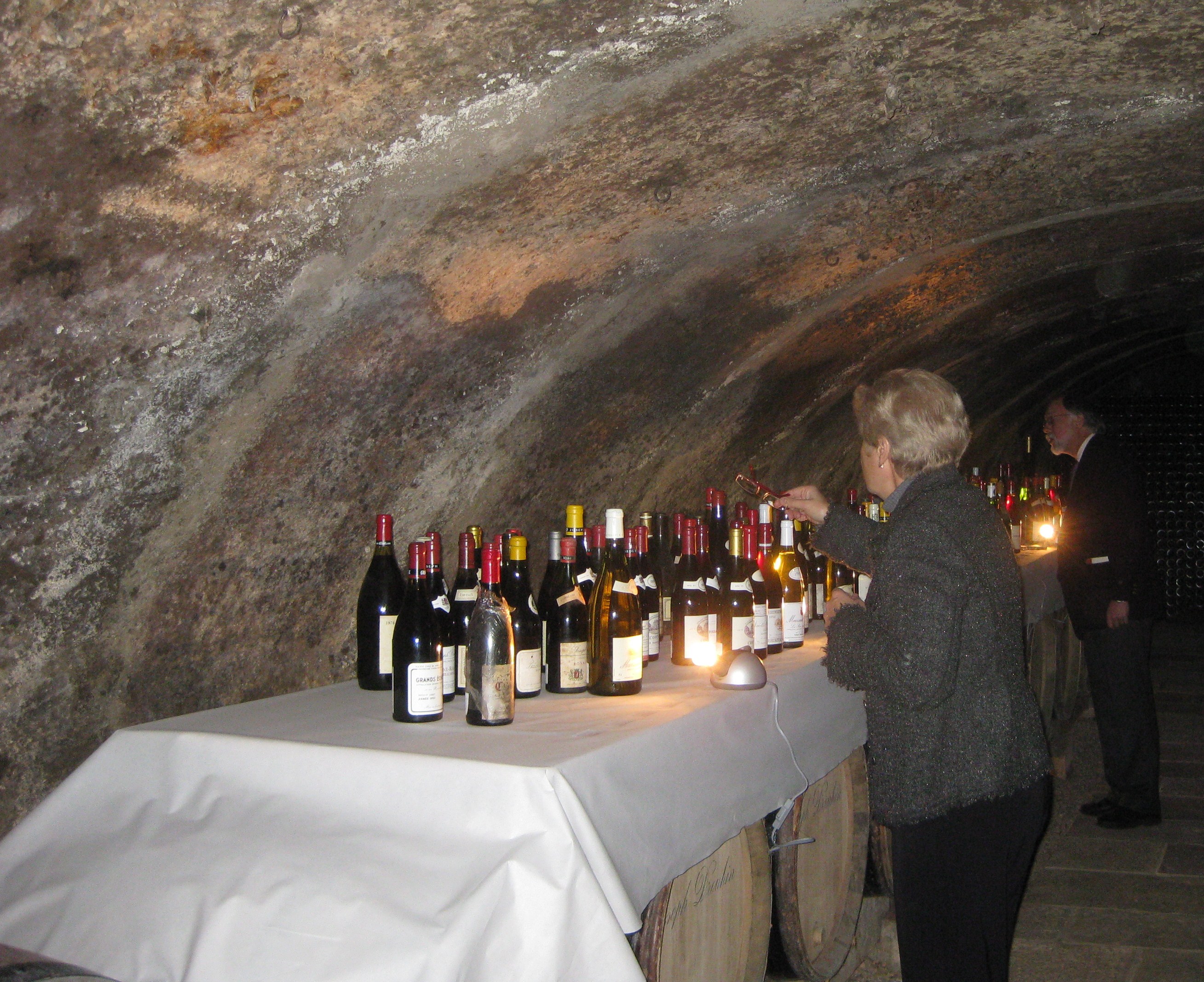
Drouhin Cellar - November, 2010
2008 Revisited, and Other Notes
In last year’s vintage report, I noted the difficulties of tasting the 2008s in November 2009:
“Malos often did not finish until August or September, and in a few cases were not finished even at the time of our visit in mid-November ….Many of the wines we tasted had only recently been racked, or were in need of a racking, and as a result were much more difficult to assess than is typically true at this time of year. In addition, the vintage is characterized by high acidities, and often as well by dry tannins, which frequently made tasting a chore and left one’s palate exhausted at the end of the day. More importantly, it made judgment difficult. In the best of times, barrel tasting is an inexact art ….This year, it is even more problematic, and one kept wishing for the opportunity to taste these wines in 3 months, when they surely will have become less obdurate.”
While the main focus of our trip in November 2010 was on the ’09s, we did have an opportunity to taste a good sampling of ’08s, and I am happy to report that there are a number of wines that have turned out well, especially among the whites, but also among the reds. That said, on the red side my view is more one of relief that there are wines that will give pleasure, rather than that this is somehow a great, underrated terroir vintage. While I heard many comparisons of 2008 to 2001 during our trip, I am not convinced that 2008 is at the same level as 2001. Of course, when making comparisons, one has first to define what is being compared, and while 2001 was a very uneven vintage in the Côte-de-Nuits, and problematic (among the reds) in the Côte-de-Beaune, I think that among the producers that I follow in the Côte-de-Nuits, their 2001s are ultimately better balanced, more serious wines than their 2008s. Nonetheless, time will tell, so for those of you who disagree, come back in twenty years and let me know what you think! As for the whites, this is an interesting vintage, with some first-rate wines but also a lot of wines that are still unbalanced and acidic. Above all, careful selection is critical.
REDS:
Michel Gaunoux: I never know quite where in my reports to include Michel Gaunoux, as they make a point of not showing wines in barrel, and their focus is generally on vintages that have been in bottle for quite some time. However, as they did begin this year with their ’08s, I include them here. The Pommard Grands Epenots had bright red fruit on the nose and palate, lively acidity and good balance (90), while the Corton Renardes, if a touch light for a grand cru, was quite charming, with notes of cherry and spice and added depth on a long finish (91). The ’05 Pommard Grands Epenots and Rugiens were in a different league: the former with a dense brooding, earthy and minerally nose, but lots of fruit on the palate, a sense of raciness, and excellent weight and density (93)—the makings of a delicious Pommard in 30 years!–and the latter showing lovely red fruit, minerals and perfume, with a beautiful transparency, earthy, medium weight yet powerful and tightly wound (94). The 2005 Corton Renardes was also very nice, but lacked a little elegance (92). An ’03 Pommard Grands Epenots was surprisingly forward and drinkable despite the tannins (89-90), while the ’03 Rugiens seemed much more serious, with a perfumed quality, excellent minerality and a great fruit finish, not overripe, tannins relatively in check, and also drinkable now though it will improve (93). An ’01 Pommard Rugiens had all the elements, but seemed still shut down and unready (90?). A ’98 Corton Renardes was foxy, alright, but not in a good way (84), while an ’88 Pommard Epenots had black fruit, earth and minerals, possibly a bit unbalanced to acid but the tannins at least were fairly resolved for an ’88 (90+). The last wine served was a mystery vintage of Pommard Rugiens, with rich red fruit, minerals, spice and a touch of VA on the nose, and wonderful sweet fruit plus prominent minerality on the palate, and despite a hint of sous-bois on the palate, it was complete, silky and charming (94). Your faithful correspondent earned himself considerable brownie points with the Gaunoux—but alas, not a free bottle—by correctly guessing the vintage, 1947.
Dujac: Jacques Seysses, while not quite admitting that ’07 was a very weak vintage for this domaine, expressed great pride in the ’08s, saying he felt that Dujac was near the top in the vintage. The Morey Village had a lot of rich red fruit, some green olives, and good minerality, tho a somewhat dry finish (87). Gevrey Combottes was excellent if a bit dry at the finish, though with plenty of sweet fruit after (90+), and I liked it a bit better than the Charmes-Chambertin, which despite some nice red cherry fruit on the nose, was very meaty, with a lot of dry tannins at the back (88). The Vosne Malconsorts showed nice medium weight, sweet red cherries, minerality, spice and a touch of the stems, with a lovely spicy red fruit finish, light tannins and slight dryness on the finish (92). Regrettably, we had to leave for our next appointment before we could wrest the Clos-de-la-Roche or Clos-St.-Denis away from les journalistes (Messrs. Meadows and Kolm) in the adjoining cellar.
Grivot: We had the opportunity to taste a range of ’08s here, and they were quite interesting to see. The Vosne Village did not seem well put together (84) and the Vosne Beaumonts, while pleasant, seemed dry at the back (87) but the Nuits Boudots was a very nice wine, with an excellent nose of spice and strawberries, and an earthy, minerally and transparent palate, with the tannins in check even though there was slight dryness at the end (91). The Clos-de-Vougeot had a subdued nose of strawberries and spice, minerality and good balance, and the fierce tannins of a year ago seemed to be rounding out a bit (90+). The Echézeaux seemed pleasant but less interesting (89), while the Richebourg was quite powerful, and dense for an ’08, and though the tannins were prominent, the red fruit on the finish superceded them (92).
Hudelot-Noellat: Another nice range of ’08s, beginning with a spicy Chambolle Village (88), a rather subdued and unforthcoming Chambolle Charmes (87), and a lighter-style Nuits Meurgers with nice strawberry fruit and earth notes, slightly dry at the end (88). The Vosne Beaumonts had a very pretty red fruit nose, and good minerality, though it too was a tad dry at the finish (90). Clos-de-Vougeot had good density and sweet fruit, good balance and the tannins were not overbearing (91), and Romanee-St.-Vivant had lovely red fruit and spice and was rich, elegant and long (92). To me, this range epitomized a lot of the better ’08s I saw: very nice, with good fruit and transparency, but still a lot of tannin and acidity to work through and clearly not the depth or balance of a top-quality vintage.
Lafarge: Not much at the lower or even middle levels: a Bourgogne that seemed a bit underripe; a Volnay Village that also seemed slightly underripe but had nice minerality; a Beaune Aigrots that had good transparency and was long if slightly tannic; a Beaune Grèves that had a good perfumed nose but a hardness on the palate that would not give up; a Volnay Mitans that was perfumed, but in the style of a painted lady, earthy and coarse; and a Volnay Clos-du-Château- des-Ducs that had more moderate tannins, but also a lack of structure in the middle. Things got much better with the Volnay Clos-des-Chênes, with spice, black cherries and minerals on the nose, a balanced minerally wine with more covered tannins (90?) and the Volnay Caillerets, which was very transparent, a slight bit chunky on the mid-palate but not obtrusively so, and had a lovely finish of black cherries and minerals, with tannins modulated (90).
Lambrays: I include the Domaine des Lambrays here because it is a good example of the less successful side of ’08. 100% whole clusters were used here in ’08, and the results are dry, tannic wines that certainly aren’t showing much balance at any level: Morey Village (86), Morey 1er Cru Les Loups (87) or Clos-des-Lambrays (?).
Liger-Belair: While the ’08 Vosne Reignots seemed at this stage to be cloaked in an impenetrable armor of oak, the Echézeaux was much more forthcoming, with light cherry flavors, strong minerally acidity, and good spice, and of course plenty of tannin after (90), while La Romanée showed excellent Vosne spicebox character, nice transparency, and a defter touch of oak; it is a lighter style of La Romanée, but the tannins are not overdone and it should round out nicely (91-92).
Georges Mugneret-Gibourg: Given the steadily high quality of the winemaking at this domaine, I see these wines as a bellwether for the vintage: weaker at the lower levels, very nice for the most part among the premier and grand crus, but rarely exciting. The Bourgogne was not fully balanced (82) and the Vosne Village was barnyardy and seemed under-ripe (?) but things improved considerably from there. The Nuits Les Vignerondes was light but pure (88) and the Chaignots had light sweet fruit and minerals, citrus and spice and a nice minerally earthy finish (88+), while the Chambolle Feusellottes had very nice light Chambolle fruit on the nose, with good minerality, excellent equilibrium, a touch of hardness on the finish but also spicy sweet fruit (89). The Echézeaux had good balance, red fruit, a chocolate note, some citrus and acid at the end but overall was a pleasant wine (91). The Gevrey 1er Cru (young vines Ruchottes) had good presence and transparency and a decent amount of fruit (90), and while there was more complexity to the Ruchottes, with purity and balance, it seemed a little sappy and dry on the back, and so I scored it the same as the jeunes vignes (90). The Clos-de-Vougeot was very minerally, a touch meaty, with light spice and citrus; though it seemed slightly ponderous, it had a lot to it, with surprisingly silky tannins and a nice pure citrus and mineral finish (91+).
Mugnier: Another bellwether. The Chambolle Villages had pleasant fruit, but was a bit dry and short (87); the Nuits Clos des Fourches was also a bit light, rustic but also pleasant (86), and the Nuits Clos-de-la-Maréchale seemed to me to have too much rustic tannin despite its sweet rich fruit (87). The Chambolle Fuées, however, was a lovely wine, if slightly simple (89) and the Bonnes-Mares was earthy and minerally, with spice and black cherries, a nicely blanced wine that reminded me in style of a ’98 (90). The Chambolle Amoureuses was a big step up, with lovely red fruit and spice on the nose, minerals, anise and a long spicy finish—there is a lot of charm in this wine (92). The Musigny had deep red fruit, spice and minerals on the nose, lovely weight and gracefulness to it, a fairly dense wine with a vibrant finish and still a lot of tannin, again analogous to the ’98 in its overall quality level though not necessarily in its flavor profile (92-93).
Roumier: These wines were showing far better than a year earlier. Christophe thinks his ’08s will drink soon. The Chambolle Village had a lot of lovely red fruit, if slight sappiness at the end (87), while the Chambolle Les Cras was much more serious, with light spicy fruit on the nose and palate, a touch of lavender, and acidity that is clearly present but not overwhelming, leading to a spicy finish (90). The Chambolle Amoureuses had a lovely nose of small berry fruit and deep spice; on the palate there were also hints of smoke and wild mushrooms, and good minerality, with the acidity not overwhelming; on the finish the tannins seemed slightly hard but there was luscious fruit there as well (92-93). The Bonnes-Mares started with an odd hint of buttered popcorn but then became dense and minerally with both red and black fruit notes, while on the palate it was intense and spicy (93+?); I thought it had more to it in terms of density than any other ’08 I tasted this trip (which unfortunately did not include a revisit of the DRC or Rousseau ’08s tasted last year).
Other ’08 Reds: A very transparent Clos-des-Epeneaux from Comte Armand, though showing some heavy tannins at the end (90) and a Nuits Aux Thoreys from Benjamin Leroux that showed great purity on the nose, ripe fruit and earth, citrus, and a reasonable level of tannin (90); a spicy Clos-de-Tart, with sweet red fruit, still a bit high in acidity (89); only two wines from Méo, neither showing at all: a funky, stripped Vosne Village with very dry tannins (82) and the unfortunate Nuits Aux Argillas I referred to in my report on the ’09s (70); from Chateau de la Tour, a regular Clos-de-Vougeot that seemed a bit marked by the stems, with good minerality but dry tannins (87) and a Clos-de-Vougeot Vielles Vignes that had nice purity, density and depth, with spice and cherry fruit and finer tannins than the regular version (89-90); and a decidedly mixed bag from Trapet, beginning with a Gevrey L’Ostrea and a Gevrey Clos Prieur, both opened two days earlier, that showed chemical notes, then a Chapelle-Chambertin that had transparency but also quite strong tannins, and a Latricières-Chambertin that seemed quite representative of the vintage in that it had nice transparency but a bit too much acid and not quite enough fruit (88), and finally a Chambertin that displayed an aristocratic nose, a lot of very precise fruit and minerals, but just too much acidity to achieve balance (89-90).
WHITES:
Côte-de-Beaune
Leflaive: While the bottling here normally takes place in the spring, the ’08s were not bottled until just before our visit, because of the prolonged malos. Interestingly, the Meursault 1er Cru Sous le Dos d’Âne (from a vineyard planted to pinot noir until 1995, with a little even remaining until 2002) had a rich, creamy, bacon fat nose, a lot of minerals and spice, and a strong strike of acid in back (90). The Puligny Combettes, while showing a lot of SO2 that for the time being seemed to suppress the nose a bit, was very minerally, with excellent weight, energy and drive. There is a good bit of acidity at the finish, and this wine needs time (91+). Antoine Lepetit believes that 2008 has more maturity and concentration than 1996; if true, it portends a brilliant future for these wines.
Lambrays: A fairly nice Folatières, with a hint of apricots, soft for an ’08 with lots of white flowers, but more tension than the ’09 (89-90). The Clos du Caillerets, however, had a curious note of torrefaction on both the nose and palate, and a touch of caramel, which I disliked (84).
Latour-Giraud: Though the Meursault Cuvée Charles Maxime and the Narvaux were not showing particularly well, and the Genevrieres had an off-putting note of asparagus on the palate, the Meursault Charmes showed well, with good minerality covered by white flowers, apples and spice (90), as did the Meursault Genevrières Cuvée des Pierre, with hints of wildflowers, stones and honey on the nose; on the palate it was somewhat brooding but very pure, with a stony element but a nice balancing floral component and a touch of spice—a concentrated wine that needs time to come together (92). By contrast, the nose of the Meursault Perrières leapt out of the glass, with notes of stoniness, white flowers, anise and pear; on the palate it had similar notes, great balance and a spicy long finish—a long distance runner (93-94).
Bernard Moreau: The ’08s here (as at several other stops) very much outclassed the ’09s. The Chassagne Maltroie had some nice peach spice, ginger and a hint of clove, along with some fat but lots of minerally acidity to balance (91), while the Chassagne Chenevottes was more restrained on the nose, but had a creamy texture notwithstanding the acidity, a lot of power, and a licorice note on the finish (91). The Chassagne Vergers ran more to russet apples, with a dense, driven minerality, though a touch of dryness on the finish led me to mark it slightly below the two prior wines (90). Still more impressive were the Chassagne Morgeots, with spicy apples and smoke on the nose, and powerful, sweet fruit to balance the minerality, plus a long fruit-driven finish, very pure, and needing two years or more (93), and the Chassagne Grands-Ruchottes, with a brilliant nose of spice and white flowers, and great balance and delicacy on the palate, a wine that stays up gracefully on its feet (94).
Paul Pillot: I wish we had had a chance to sample more ‘08s here. The three we did see all had more weight than the ‘09s. The Chassagne Clos St.-Jean had a spicy, floral nose with good balance (89-90), while the Chassagne Grande Montagne had a penetrating nose of spice, honey and lemon cream, became even creamier on the palate, and ended with a dry minerally finish (90). Best was the Chassagne Caillerets, with anise, minerals, spice and lemon on the nose, a lot of tension on the palate, a floral touch, and a racy, tense minerally finish, with great drive—“my kind of white Burg,” I noted(92).
DRC: Tasting the prior vintage Montrachet was a pleasure we don’t always get at the Domaine. The nose had spice, honeysuckle, pain d’épice and minerals; these carried through on the rich and complex palate, with a hint of sweet plums as well as a touch of oak at the back, and the finish was powerful and extremely long, with pain d’épice, minerals and bracing acidity—Aubert noted that this is one of the most minerally Montrachets the Domaine has ever made. For me, though, there is a slight hint of fattiness that makes it not quite in the class of the ’96. (93-94).
Roulot: This was one of the few domaines where I tended to prefer the ’09s to the ’08s. The Meursault Luchets had a rich nose of honeysuckle, smoke and a touch of bacon fat; on the palate, there was an asparagus note I didn’t care for, with minerals after, and a short finish (84). To pause here, we also tasted the ’07 Luchets, a far better wine, with minerals, anise, spice and fat in the nose, a ripe and round wine with nevertheless a minerally streak, and a long minerally finish (90). Jean-Marc commented that the ’07 was “very Roulot.” We then retasted the ’09 Luchets, and while it was more linear than the ’07 it had more weight and intensity, and may well have more potential than the ’07; the ’08 was a very distant third in this race. We then segued back to the ’08s, with a Meursault Tessons Clos de Mon Plaisir that had a vegetal note on the nose and artichokes on the finish, though some good minerality and tension (86), and a decent but not exciting Meursault Perrières, with smoke and a hint of cardoons on the nose, a lot of flesh for an ’08, minerals, red currants and allspice on the medium-weight palate, and a finish with spice, slate and a hint of caramel (88).
Chablis
Fevre: We only tasted two ’08s, but they clearly overshadowed anything we tasted among the ’09s. The Bougros (Côte de Bouguerots) was much spicier than the ’09 version, with more acidity in evidence as well, an intense rich racy but balanced wine, leaner than ’09 though there was sweet fruit in evidence, with a long minerally uncompromising finish (92). Didier Séguier thought it was the best Côte de Bouguerots in the twelve years since Bouchard had taken over the estate. Les Clos, while not giving too much away just yet, had even more depth—more “civilized” than the Côte de Bouguerots, with notes of apples, spice, pears and minerals, a large-framed wine, with pain d’épice and brioche on the finish; this wine needs time (93+).
Christian Moreau: While the ’08 bottles we tasted had been open for several days, they were holding relatively well—indeed in a couple of cases still seemed relatively unforthcoming. The Chablis Vaudésir, from relatively young vines, was slightly toasty on the nose and very minerally and powerful, if a bit dry at the finish (90), while the Chablis Valmur seemed very cool and austere, not especially forthcoming or knit, though perhaps it will come together in time (89?). Les Clos was considerably better, and despite a discreet nose of toast and gingerbread, it had lovely weight, knife-edge minerality, and a rich, long, if slightly hot finish (92). Best of all, though, was the Clos des Hospices, with a nose of spice, licorice, minerals and a touch of honey, lovely weight and balance between the fruit and minerality on the palate, and a long, spicy finish (95).
Other ’08 Whites: Among the other ’08 whites we tasted were a pleasant Corton Blanc from Senard, with some nice spice and minerals, a touch of sweetness and a nice minerally finish with good cut (though the ’07 was better), and a surprisingly good ’08 Chablis Montée de Tonnerre from La Chablisienne (I found it more racy and appealing than either the Vaudésir or the Preuses from the same source).
An Update (If You Can Call It That) on Premox: Finally, and sadly, no report on white Burgundies is complete without a note about premature oxidation. In brief, the problem continues, with the ’02s becoming increasingly affected and some of the ’04s beginning to show signs of it as well. While, as I reported last year, the focus has partly shifted from the corks, as concerns are increasingly voiced that various elements of the winemaking process have been making the wines more susceptible to oxidation, and that the cork issues then determined which and how many of the resulting bottles would be affected. Much attention is now being focused on the pressing process, with the theory being advanced that the wines are not getting enough exposure to oxygen early on, and that, as with children, exposure at a young age to certain maladies helps build greater immunity to them later in life (this is not to ignore the role of other factors, particularly earlier in this ongoing saga, such as increased use of battonage and lowered SO2 levels, but these are not currently issues for the better producers). While more producers are admitting that there is a problem, denial itself remains an issue, particularly as sales do not yet seem to be seriously affected. The mixed mindset of many Burgundians was strikingly evidenced in one cellar we visited, where the producer, among the most thoughtful in the region, had just finished telling us about an experiment he was conducting beginning with his ’09s to see if (to greatly simplify what he is doing) changes in the winemaking process that would expose the wine to more oxygenation early on would, in effect, inoculate the wine from future problems. It sounded like a very interesting experiment but it will take years to see if it’s working (the producer asked not to be named until he has some indication of the results). After this discussion, he served us one of his ’02s, which we found to be seriously premoxed. Before serving us another bottle, he asked us to taste an ’04, and then retaste the ’02. He admitted that he had at first felt that our reaction to the ’02 was overblown, and might have resulted from the transition from ’09 to ’02, but as he went back to the ’02 he (somewhat reluctantly, it seemed) admitted we were right. He then opened a second bottle of the ’02, which also had a clear touch of premox, though it was not as prominent as the first, and a lively debate ensued in which the producer took view that we were overreacting and that the wine was still drinkable. My view, which I expressed to him then and continue to hold, is that while it might well have been “drinkable,” it was not what it is supposed to be, and furthermore not something one would voluntarily pay $100 or more for in a store, or several times that in a restaurant. I thought it a sad portent that a producer who on one level is at the forefront of recognizing and dealing with the problem, should on another level still be reluctant to acknowledge its effect on his own wines. Plus ça change….

Clos Vougeot November 2010
During November 2010, I visited nearly 40 producers and negociants to assess the 2009 vintage in barrel. Part 1 of this report summarizes my overall conclusions about 2009 and also my views on each of the domaines/maisons visited. Part 2, which will be posted separately, summarizes those 2008s that I was able to taste in bottle.
2009 — An Outstanding Red Wine Vintage
The old Burgundian expression is “Août fait le moût” (August makes the must) and in 2009, following unsettled weather earlier in the season (including hail in Morey and Gevrey in May), sunny and hot weather settled in around the 10th of August. With brief exceptions, fine weather lasted well into the harvest, which began in early September. Important choices had to be made about picking dates, not so much because of weather changes but in determining the balance between ripeness and freshness (as one noted critic commented, everything in Burgundy involves trade-offs). The white wines in particular were susceptible to becoming overly rich and losing their balancing acidity and terroir character, and perhaps nowhere on this trip were the differences in result more starkly in evidence than between the early-picked Chablis of Fèvre and the late-picked Chablis of Moreau.
For the reds, the question is not whether 2009 is an outstanding vintage—it assuredly is—but how great. There was much discussion, but no consensus, among the producers, as to what the vintage might be compared to. 2005 was not viewed as a comparable vintage, though there was debate as to which vintage was preferred. My own view is that 2005 is a denser vintage than 2009 and over the long run will be more complex, longer lived, and more consistent across the board. But there are producers (albeit a minority of those I spoke with) who disagree, and while admitting that 2009 is not nearly as consistent as 2005, believe that the 2009s at their best show their terroirs better than 2005 and that the seductive ripe fruit will bring more pleasure. Bernard Hervet of Maison Faiveley compared 2009 to 1959, a great Burgundy vintage of rich, ripe fruit that maintained its balance and charm for close to 50 years, though many are now tiring. For Hervet, as well as for Robert Drouhin, 2005 is more reminiscent of 1961, a vintage that took nearly 40 years to begin to show well, and that now, for the best wines, is characterized by outstanding balance and finesse, with a striking linearity and presence, though many wines dried up without ever having fully opened. I am not entirely convinced, however, by the ’05/’61 analogy, as too many ’61s never really had the right balance (though to be fair, the general quality of winemaking in 1961 was not nearly what it is today). Other producers see ’09 as a cross between ’99 and ’90, and the interesting part of this analogy to me is that while ’99 is a vintage that combines excellent ripe fruit with great balance (and high yields), ’90 is a more problematic vintage: one that was expected to be great but that has often proven, other than at the very top levels, to be unbalanced and overripe. See my summary of the 1990s in A Tale of Two Vintages. While I think ’09 will prove to be a much better vintage overall than ’90, there are likely to be a significant number of ’09s that will suffer the same fate as the lesser ’90s, in that they will show overripe (or deliberately over-extracted) flavors and will ultimately lack balance and grace. While we do not visit many of the over-extractors, there are still more than a few of them around, some with very high reputations, and in this vintage there was much to over-extract. But even among the stylistically more proficient, there are enough chocolate overtones in the wines to give one pause about overripeness. (Here too, Bernard Hervet has his own take on matters: he sees ’09 as more “mocha/coffee,” which he feels is a positive sign of ripe seeds, rather than “mocha/chocolate.”) In short, discrimination is still necessary, even in a vintage such as 2009.
Despite these caveats, I do think that the best ’09 reds show ripe fruit, excellent terroir, great balance and silky tannins. Even among the best, though, there are significant stylistic differences, with some excellent producers striving for, and succeeding, in producing wines of balance and delicacy, and others that have produced deeper and more powerful wines, while still avoiding over-extraction. I also believe there is a good chance that many of the wines of this vintage will not close up, or will do so only for a short time, and will produce great pleasure throughout their lives.
The white wines are a somewhat different, though related, story. As noted above, the vintage tended to produce fruity, slightly blowsy wines that lack balance. However, the quality of winemaking at the top in Burgundy is such that a number of producers were able to exceed the general standards of the vintage by producing wines of balance and finesse. Here, for the most part, it was a question of picking early to avoid overripeness, and though many producers seem to have been seduced by the prospect of achieving great richness, a few of the best had the confidence to pick earlier and achieved stunning results.
Finally, a word about the 2008s, particularly the reds. In last year’s report, I noted that the barrel tastings had been among the most difficult of my experience, as the late malos had resulted in wines that, last November, were marked by hard tannins and raspy acidity. As a result, I felt that ultimate judgment should be deferred, though the auguries did not seem auspicious. I am happy to report that the wines have improved considerably in the intervening year, and while this will never rank among my favorite vintages, there are a number of wines that have lovely red fruit and are quite pure, and where the tannins have become less obtrusive. That said, there are also still many unbalanced and unlovely wines, and even the best reds (among those we tasted) seem to lack a degree of grace and finesse. I have included those notes in a separate Part 2 of this report.
REDS
The Domaines:
CÔTE-DE-NUITS
Bruno Clair: First rate wines from this domaine, which has had a string of successes yet does not get the acclaim it deserves. One of the hallmarks of the 2009 vintage is that the “lesser” appellations got ripe and that there are some potential bargains among these wines; at Bruno Clair, for example, they produced an excellent Marsannay Grasses Têtes and an even better Savigny Les Dominodes, from 108-year old vines, both showing rich fruit but also great purity. However, it is among the higher appellations that the domaine particularly shines, having produced a fine Gevrey Clos du Fonteny and very good Cazetiers, as well as an outstanding Gevrey Clos-St.-Jacques, with a lot of minerals and sweet fruit, a penetrating wine with almost grand cru weight that finished with firm but ripe tannins. Even better was the Clos-de-Bèze, from vines planted in 1912, showing spice and smoked meat on the nose, and a nice citrus note, powerful but with great balance and very fine tannins, and a long, complex, subtle and transparent finish. The Bonnes-Mares was equally excellent, showing black cherries, hay and spice and a hint of chocolate on the nose, and great drive and energy on the palate, with a spicy finish and a touch of dry tannin at the end.
Trapet: Jean-Louis Trapet has made significant strides in the last several years in bringing these wines back towards the level of greatness they had achieved through the early ’70s. However, the 2009s still seemed somewhat inconsistent to me, with some showing too much oak influence, though the Clos Prieur, Latricières and Chambertin were very good–particularly the latter, which had power, minerality and lift; the oak was still a little prominent but likely to be absorbed, and the finish was subtle and long.
Rousseau: Not surprisingly, brilliant wines in ’09. The wines were picked relatively early, beginning September 7th. The Gevrey Village was excellent, as were the Lavaux-St.-Jacques, the Charmes and the Clos-de-la-Roche; only the Cazetiers did not seem quite on form, at least the day we were there. The Mazis was a further step up, with a complex nose, a rich yet transparent middle palate, excellent weight, and a long transparent finish. The Ruchottes was even better, with incredible spice and deep fruit on the nose; it was a powerful, dense wine, but with silky tannins and great persistence. In this vintage, I slightly preferred it to the Clos-St.-Jacques which followed it, though the latter was certainly very fine, a harmonious wine with great density of fruit. The Clos-de-Bèze was slightly reduced on the nose but still showed huge fruit and power on the palate, an intense wine that nevertheless kept its balance. The star, however, and one of the best wines of the vintage, was the Chambertin: a complex, aristocratic nose, with great power, balance and presence on the palate, already developing a silky texture; a profound wine that managed to keep its delicacy despite its stuffing. Brilliant!
Clos-de-Tart: As is typical, we tasted 6 different cuvees that will be used in the final blend, including a blind tasting of three different cuvees: 100%, 50% and zero whole cluster (an interesting exercise for those who were there). The blended ’09 had gorgeous black fruit, minerals and pain d’épice on the nose, and on the palate the rich fruit was balanced by a lovely minerality; this was a harmonious, elegant wine with some new oak presence but not an obtrusive one, and a spicy long finish.
Dujac: A fabulous success for Dujac in ’09. While I have been critical of some recent vintages here, particularly ’07, Dujac did very well in the difficult ’08 vintage (see Part 2 of this report) as well as in ’09. Dujac is one of the participants in the Climats du Coeur, a charity bottling of four premier cru wines from this vintage, each from a range of climats within the four appellations, which contributed by participating producers. Dujac is doing the elevage for the Gevrey-Chambertin 1er Cru, and it had a spicy, meaty nose, with a touch of wood still evident, excellent weight and presence on the palate, sweet fruit and good minerality, and a deceptively long finish. Among the successful wines from the domaine itself were a very minerally, spicy and restrained Vosne Malconsorts, which perhaps lacked just a little concentration; an elegant (and also restrained) Clos-St.-Denis, with excellent balance and sophisticated tannins; and Romanée-St.-Vivant that was quite spicy, with rich cherry, mineral and game notes and a very long, transparent and spicy finish—an elegant and even delicate RSV. The Clos-de-la-Roche was particularly lovely, very minerally, with excellent fruit and great balance, a fascinating and elegant counterpoint to Ponsot’s dense and rich CDLR tasted just before; really, it’s a question of what style one prefers, not of quality. Jacques was careful to credit Jeremy and Diana, who surely deserve kudos for a great range of wines in ’09.
Lambrays: A crowd-pleasing Morey Village, a slightly soft Morey 1er Cru, and a nice but not profound Clos-des-Lambrays, in the fleshier style of ’09, which will be very easy to drink and enjoyable from a young age. While this was certainly a nice wine, I confess to a degree of disappointment with these wines in the last several vintages, compared to what I believe winemaker Thierry Bruin is capable of.
Ponsot: You would expect great wines from Laurent Ponsot in a vintage such as ’09, and he has not disappointed. Even the basic Bourgogne was a very nice wine, as were the Chambolle Cuvée des Cigales and, at more exalted levels, the Chambolle Charmes and then the new Corton Cuvée du Bourdon (a blend of grand cru vineyards which on this day outshone the Corton Bressandes), the Clos-de-Vougeot, and the Clos-de-Bèze. Laurent particularly loves his Chapelle-Chambertin this year, and while certainly I found much to admire in its intensity and richness, I personally preferred the Griottes, which despite its dense rich fruit retained a great sense of balance, helped by an intense minerality that runs through the palate and into the finish. The Chambertin, not always a top wine here, was particularly good this year, with deep spice and sour cherries on the nose and an elegance on the palate, a spicy middleweight with excellent power. The Clos-St.-Denis, from 100+ year old vines, was very gracefully balanced, with deep fruit, meat, spice, leather and minerals, suave tannins and a long and lovely minerally finish. The Clos-de-la-Roche, however, took the palm, with a penetrating complex nose, rich sweet fruit on the palate, complexity, balance and harmony, and fully resolved tannins on an amazingly long finish of minerals and citrus.
Mugnier: Freddy Mugnier summed up the ’09 vintage thus: “2009 will be a great vintage when it’s old. The only problem is that when it’s old, I will be dead.” Freddy also was in the minority of producers who said they found ’09 more concentrated than ’05, but given the style of his ‘09s, I can to some degree understand this comment. To me, Mugnier’s wines epitomize elegance, and they are usually wines that strive for finesse, not concentration. Yet his ‘09s surprised me by their weight and power. However, if they are somewhat atypical Mugnier wines, they are nonetheless superb. The Chambolle Village is a great success, with a lovely transparency and expressive fruit. The Chambolle Fuées is extremely concentrated yet has the acidity to balance it, with lovely spice, currant and blackberry notes, fine tannins and a dense finish. The Bonnes-Mares was smoky and huge, intense and minerally—this wine still is the slight laggard in the Mugnier stable, but it’s a good wine in ’09. The Clos-de-la-Maréchale had a nose of red currants and earth, with slightly rustic tannins, again good but not inspirational. However, the Amoureuses was a different story, with a wonderful calm nose of red currants, minerals and a touch of mocha, and some fairly strong though refined tannins; unusually for Amoureuses, it seemed more a wine of weight and power than of elegance, though with a long and lovely finish. The Musigny, though in need of a racking, had a beautiful equilibrium despite its density and power, being blessed with great lift from the acidity, and a finish of immense length.
Roumier: Commenting on the analogies made to the ’90 and ’99 vintages, Christophe said that in his view ’09 was lighter and fresher than ’90, but that he found his ’99s more concentrated and tannic. While all his wines had been recently racked, one still could discern the high level of quality, which began with the Chambolle Village and continued through the Chambolle 1er crus, Combettes and Cras, and the Charmes-Chambertin. But the fireworks really got going with the Ruchottes, which had recovered nicely from its racking nine days earlier and displayed dense spice, meat and black fruit on the nose, great lift, balance and complexity and excellent fruit expression. The Amoureuses, despite some effects from the racking, showed great vibrancy and elegance, with some strong tannins, which as noted above also seemed present in the Mugnier Amoureuses. The Bonnes-Mares had a brilliant nose, with spicy dense black fruit and hay, great presence on the palate—a dense yet balanced and elegant wine—and some strong yet paradoxically silky tannins and impressive length. The Musigny had even greater density and energy, and the classic Musigny sense of power without weight, with a spicy long, brilliant finish underpinned by very silky tannins. Overall, these wines are among the most successful of the vintage.
Château de la Tour: An excellent Clos-de-Vougeot, with rich raspberry and other red fruits on the nose, yet fundamentally a mineral-driven wine, very structured, with stems that give it a lot of dry tannin, but also the beginnings of a velvety texture on the long rich finish. The Clos-de-Vougeot Vielles Vignes was not just a more intense version but a very different wine, more marked by new oak, and one of the few wines of this vintage that showed fierce tannins. There is a lot of sweet fruit, though, and dry extract; this is a wine clearly built for the long haul.
Domaine de la Romanée-Conti: In 2009, DRC=OMG. Aubert de Villaine is justifiably proud of his ’09s, which he likened to the ’59 vintage. The tasting began with the Vosne 1er Cru Climats du Coeur, which as noted above is a special cuvee produced for charity from eight premier cru vineyards belonging to different Vosne producers. The nose had a strong black cherry component and the wine was medium-bodied with a complex finish showing mocha and spice notes. There was ample wood in evidence, but Aubert feels it will integrate well over time. We next tasted the Corton, the first vintage of this blend of three grand cru vineyards from the Prince de Merode estate, Clos du Roi, Bressandes and Renardes (the Maréchaudes is not included as it remains subject to a separate metayage agreement). I asked Aubert why he had chosen to blend the vineyards and he said that they had first separated the wines into old and young vine cuvees, and that because not all the old vine cuvees were large enough to vinify separately, they had chosen to blend them instead. The wine had notes of black cherry, spice, coffee and bacon fat, and on the palate it was very transparent if in a distinctly lighter style than the wines that followed. The Echézeaux had a huge nose, excellent balance on the palate, and suave tannins. While both it and the Corton were certainly very fine, the Grands-Echézeaux was a noticeable step up, and the Romanée–St.-Vivant a further large step from there. The Grands Ech was highly concentrated, dense, and very spicy, with a very long finish that had an almost blackstrap quality to it. The RSV, while large-framed for this vineyard, had characteristic notes of spice and violets and maintained an elegance and density at the same time, and its silky tannins and immensely beautiful spicy finish made the Grands Ech look a little earthbound by comparison. The Richebourg, unfortunately, seemed a little tired from its recent racking, although its powerful minerality and incredible length promised much to come in the future. The La Tâche was in still another world, its nose just beginning to hint at extraordinary depths, with great minerality and transparency on the palate, and notes of spice, green olives, violets and game–an incredibly elegant wine, with an almost endless spicy finish and extremely sophisticated tannins. I don’t know how long the finish might have gone on, had it not been time to taste the Romanée-Conti. If the La Tâche was from another (and better) world, the RC was truly from another dimension. The nose had overtones of violets, spice, minerals, fruit and game and that touch of “green” as Aubert calls it (from the stems), that he says gives freshness and guarantees the future. This was a deep, layered and profound RC of incredible complexity yet grace, with silky tannins and a finish that left one fumbling for words—truly an emotionally thrilling experience. I probably can’t afford it, and it probably won’t be ready in my lifetime, but I’m buying it anyway. The wine of the vintage, without a doubt.
Grivot: This was, not surprisingly, a highly successful vintage for Etienne Grivot, who seems in recent years to have matured into one of the better winemakers in Vosne. The Vosne Village was quite enjoyable and the Nuits Roncieres and Pruliers were good, but things really got rolling with a very fine Nuits Boudots, a rich wine with very nice transparency. Here, Etienne commented that the wines of power in this vintage seemed to be showing better at the moment than the wines of finesse, but that the opposite had been true a few weeks earlier. The Vosne Beaumonts was excellent, with dense chocolate and black cherry flavors on the palate, and an attractive soft silky quality on the finish; Grivot noted its “purity and energy.” The Vosne Suchots seemed softer and more approachable than the Beaumonts, and while many in the group preferred it, my vote remained with the Beaumonts. The Reignots had a more introspective nose, hinting at a lot of depth but not giving it away, and was well balanced on the palate, and although Etienne served it after the Beaumonts and Suchots, there were strong differences of opinion among the group as to where it stood among the three. The Clos-de-Vougeot was more Grivot Clos-de-Vougeot than ’ 09, by which I mean that the fierce tannins that always seem to be present in this cuvee were not modulated by the vintage, and the wine seemed almost tarry. It will be interesting to see how it turns out, but it clearly was in a different category from anything else in the Grivot cellar. The Echézeaux, while still carrying a fair amount of tannin, had more generous sweet fruit and good acidity; the wood here was a little more evident on the nose. The Richebourg was the star, however, with a calm, spicy and rich nose that had gamy notes, plus sweet red fruit, game and chocolate on the palate, suave tannins and a silky, long, transparent yet powerful finish. Etienne feels this is his best Richebourg so far, and I wouldn’t disagree.
Hudelot-Noéllat: The torch has been passed at this estate: grandson Charles van Canneyt has increasingly taken over responsibility for running the domaine (except at the caisse, where Odile Hudelot still indomitably presides), while young winemaker Vincent Mugnier, after about 5 vintages here, is showing an increasing sense of confidence through his wines. These were reliably good wines across the board, with standouts including the Vosne Village, and the first really fine Vougeot Les Petits-Vougeots I have ever had (here or elsewhere), which had ripe cherry fruit and good minerality, especially fine balance and a silky quality to it. The three Vosne premier crus were all excellent, though here (in contrast to Grivot) I preferred the Suchots to the Beaumonts and my colleagues the reverse. (What is wrong with these people?) The Malconsorts, exceptionally, was shown after the Clos-de-Vougeot, though this was no insult to the CV, which despite the oak being a little too prominent had both silkiness and volume. However, the Malconsorts was, as Charles commented, more intense than the Clos-de-Vougeot, with great balance notwithstanding its density, again the silkiness that characterized so many of these wines, good transparency and a slightly dry (from the oak) but very persistent finish. The Romanée-St.-Vivant was even better, with a discreet nose, some oak on the palate but mostly ripe fruit and minerals, a silky texture, and tannins that were strong but covered—a wine that will mature into great elegance. By contrast, the Richebourg was more powerful, with great presence and density, a powerful driving black cherry and mineral finish, polished if firm tannins, and excellent length.
Liger-Belair: Not surprisingly, a first-rate range of wines here. The Vosne Clos du Château, a village lieu-dit, had a fine perfumed nose, with strong spice and mineral notes, all of which carried through the wine to a long, pure finish. The Vosne Chaumes (from the estate) was particularly pure and delicate for this cuvee, with great balance, in contrast to the Vosne Petits-Monts, which was cooler and took more time to emerge, showing stronger tannins but certainly a very fine wine, and the Vosne Suchots, which despite a little reduction on the nose showed excellent weight and balance. The Vosne Brulées, which is not commercialized as there is only one barrel (it does show up at charity auctions, however), was made with 19% whole clusters; it showed lovely red fruit, cool minerality and spice, and was a very transparent and extremely long wine. The Reignots, as usual, was the star of the premier crus, and despite a touch of reduction on the nose, the elegance and purity of this wine really shone through, and a wonderful kaleidoscope of spice came up on the lengthy finish. We also tasted the Mazis-Chambertin Cuvee Collignon from the Hospices de Beaune (of which I was one of the purchasers), and although it is still marked by the Hospices oak, which will take time to integrate, it is showing rich ripe fruit on the palate, with notes of cinnamon and grilled meat, excellent weight, a very long and lovely minerally finish with great transparency, and strong but quite refined tannins. The Echézeaux was very seductive, with deep spice on the nose along with a touch of green fruit and clove, and was developing a quite silky texture, along with a long, pure finish despite a still significant level of tannins. La Romanée, as always, was in a class by itself, and even a slight touch of reduction did not prevent one from appreciating the amazing depth and complexity of the nose, the purity of the entry, the grace and power of the mid-palate, or the spicy long finish, with bright fruit and extremely refined tannins. A great wine!
Anne Gros: What to say? Anne Gros is a delightful person and a highly accomplished winemaker with a decade and a half of successes behind her; yet her passion for winemaking seems to have gone south (literally, to her winery in the Minervois), and if the results in the ’09 vintage are not nearly as disappointing as they were in ’07 and ’08, still, they don’t quite reach the heights one knows she is capable of. The wood treatment here seems to have gotten more, rather than less, aggressive, and though the grands crus at least should be able to absorb it, even they (Echézeaux, Clos-de-Vougeot and Richebourg) seem characterized by an over-abundance of sweet fruit, at the expense of balance and transparency. That said, they are certainly very nice wines and will give lots of pleasure. But greatness? Sadly, no.
Méo-Camuzet: This is another estate that, while capable of making great wines, seems increasingly erratic. To be sure, the best wines are still superb, but whether the expansion into negociant wines has resulted in some loss of focus, or for other reasons, I did not find the level of consistency here that I expected in a vintage of this caliber. One can forgive inconsistency in difficult vintages such as ’07 and ’08, but less easily in ’09. The negociant wines we tasted, Fixin, Morey Village, and Chambolle Feusselottes, were all over-oaked and indifferent, as was the domaine’s Vosne Village. The Vosne Chaumes, Nuits Meurgers, Clos-de-Vougeot and Corton Perrières were certainly much better, yet even these are a bit too marked by the oak for my taste. Matters got very much better, however, with the Echézeaux, with a spicy deep note of game, mocha and minerals as well as fruit, and a very long finish of high quality with ripe tannins. The Vosne Brulées, always one of my favorite wines here, did not disappoint, with cloves, minerals, mocha and a touch of soy, a silky mouth feel, and a dense finish which, while it did not lack for oak, was very long and showed quite polished tannins. The Cros Parantoux was also exceptional, with the cool fruit and stony quality of this vineyard, an intense and almost brooding wine–unusually for this vintage–with great lift from the acidity, and an elegant yet penetrating finish with lots of spice. The Richebourg as well reflected the greatness this domaine is capable of, with a deep intense nose of mineral, spice, coffee, and morello cherries; on the entry, it was more delicate and graceful than one might expect from Richebourg, but the power showed in the back, with fine but firm tannins and a beautiful minerally finish with red fruit and exceptional length and grace. However, just as I was beginning to doubt my doubts about this estate, we were given two ‘08s to taste, an unpleasant Vosne Village and a Nuits-St.-Georges 1er Cru Aux Argillas, for which I quote my note in its entirety: “What the heck is on the nose? Lighter fluid, I think. Can one die from drinking this?” Fortunately the answer was no, but it still puzzles me how the man who made the ’09 Richebourg (or the utterly brilliant ’99 Richebourg we drank a week earlier) could also have made this—or, having made it, not promptly have sold it for distillation.
Domaine Georges Mugneret-Gibourg: It is perhaps appropriate that the Vosne section of this report is bookended by DRC and by Mugneret-Gibourg: the most renowned estate in Vosne to begin, and the most under-appreciated one to finish. Here, even the Bourgogne rouge is delicious, with rich, ripe fruit and a mineral streak. The Vosne Village possesses surprising depth and a long spicy finish. Among the premier crus, the Nuits Chaignots had a nose that fairly leapt out of the glass, with spice, earth and perfume; on the palate it had deep red fruit, was earthy and had some strong tannins, overall a lovely wine; and the Chambolle Feusselottes had spicy deep red fruit and a touch of chocolate on the nose, with excellent weight, a rich fruity finish, and amazing length for a premier cru. The Gevrey 1er Cru (the Ruchottes jeunes vignes) was the only disappointment here; to me it seemed a little light, though the concentration on the finish might suggest a better future than I give it credit for. Among the grands crus, the Ruchottes had a complex meaty and spicy nose, with lavender and chocolate hints; on the palate it was spicy, with a delicacy given by the minerality, and high-toned. The Clos-de-Vougeot had a deep nose of red cherries, spice and hints of chocolate and truffles, great density but also excellent balance, ripe red fruit, lovely minerality and some significant but quite ripe tannins. Unusually, however, the Echézeaux, which normally ranks a bit behind the other grands crus here, today provided the most excitement, with a gorgeous mix of spices, earthiness, fruits and chocolate, and a long minerally, spicy finish, but most memorably a combination of drive and energy with perfect harmony and balance—a very elegant wine. This is a vintage that perfectly suits the Mugneret sisters’ style, and the results are a delight.
CÔTE-DE-BEAUNE
Comte Armand: A pleasant enough Volnay Fremiets to begin, after which we tasted three cuvees that will form the Clos-des-Epeneaux (plus the young vine fruit that will go into the Pommard 1er Cru). The resulting blend had multiple additional layers of complexity compared to any of the cuvees, with a great balance of fruit and minerality, and the Pommard dirt; it showed great purity yet power, and a rich spicy and minerally finish, with well-defined tannins and it will with (a lot of) time be a brilliant wine.
Marquis d’Angerville: Stunning wines from Guillaume d’Angerville, possibly the best I have tasted here, though it will make an interesting comparison with 2005. Guillaume himself thinks ’09 is a more subtle, less exuberant vintage than 2005. The Volnay Village begins and in a way defines the range, with a creamy texture, rich fruit and good minerality. The Volnay ler Cru had a lot of lovely minerality, but was perhaps a bit too marked by the wood at this stage, and the Volnay Clos des Angles was a bit ponderous. The Volnay Fremiets was considerably better, with great structure and plenty of fruit and dense minerality, and the Volnay Caillerets better still, with black cherry, minerals, anise and mocha notes on the nose, very pure and intense, with great fruit expression. The Volnay Taillepieds was a knock-out, higher-toned than the Caillerets, smokier and more minerally; on the palate it was pure, precise and beautifully balanced, with a very long spicy finish and refined tannins. Guillaume commented that he has rarely seen a Taillepieds so expressive at this stage. My favorite wine here, the Volnay Champans, came next, and it was softer and richer than anything that had come before; with a wonderful velvety texture and great balance and harmony, it seemed to sum up the wines that had preceded it. The Volnay Clos-des-Ducs was served last, and my colleagues liked it a great deal, but to me, while it was denser and had more tannic structure than the other wines, it seemed more brooding and to me, a touch more ponderous than the others, without the impeccable balance those wines showed currently. Nevertheless, the Ducster is a long distance runner and I would not bet against it.
De Montille: Some very fine reds from de Montille this year, both in the Côte–de-Beaune and the Côte–de-Nuits. Among the wines I liked were a Beaune Grèves that had a lovely nose of red and black fruit, earth and roast pheasant, though some heaviness on the palate; Volnay Champans, which had an exotic perfumed element but also fine minerality; a Volnay Mitans that was more aggressive and meatier than the Champans but very nice in its own right; and particularly the Volnay Taillepieds, which stood out for its pure minerality and cherry notes on the nose, and floral and licorice notes added on the palate, and especially for its striking length. The Corton Clos-du-Roi was also quite fine, with red fruit and perfume on the nose, a touch of smoky bacon on the palate, good transparency, and a long, elegant finish. Vosne Malconsorts, while a bit reduced, was rich and minerally, intense without being heavy, and quite precise. The best wine, though, was the Vosne Malconsorts Cuvée Christiane. One could almost drink the nose, which showed mineral, spice, perfume and rose petal, as well as sandalwood and game on the palate, with medium body and great transparency, and some power near the back; on the finish, it had fine tannins and was very long, elegant and spicy.
Lafarge: Michel Lafarge has a perspective that extends further back than most of his compatriots, and he offered a comparison of ’09 to a cross between ’64 and ’66, which is high praise indeed. He described the wines of ’09 as full, yet open, forward and generous. His Volnay Vendages Sélectionnés had quite a bit of density for a village wine and a good bit of tannin, yet it remained supple. The Beaune Grèves was a step beyond the Beaune Aigrots (itself a good wine), complex on the palate, tannic and very long, and the Volnay Mitans was quite rich and transparent, though like the de Montille example, it seemed earthy for Volnay. The Volnay Clos-du-Château–des-Ducs had minerals, spice and violets, with a long transparent finish and silky if persistent tannins. The Volnay Clos-des-Chênes was very fine, with violets, sweet fruit, minerals and allspice notes, complex yet elegant, and with a transparent finish, and again significant but refined tannins. The Volnay Caillerets was even better, with amazing density and richness, and penetrating minerality, yet remained very balanced, with a long clear minerally finish and the tannins more refined than even the Clos-des-Chênes.
Labet: Francois Labet of Château de la Tour also operates a small domaine, producing mostly wines from the Côte–de-Beaune. Among the reds, the Beaune Marconnets stood out, with a mineral-driven nose, red fruit and perfume, and though the fruit seemed a little subdued on the palate, it came through on the finish.
The Négociants:
Before delving into the negociants and their 2009s, an aside on the negociant business as it exists today may be in order. As the quality and breadth of domaine bottling has increased, several things have happened: first, the external sources of high quality wines for the negociants have been steadily shrinking, as producers have learned they can reap greater financial benefits—if they’re good at what they do—by domaine bottling. Second, the domaine/negociants (those domaine producers who have established small negociant operations) have been chipping away at the edges of what’s left, whether through purchases or farming agreements, since wine that carries Meo’s label, or Ponsot’s, is likely to be worth more than wine that carries a large negociant’s label. Third, the large and medium sized negociants have responded by expanding their domaine holdings, and so increasingly what one tastes at the premier and grand cru levels, whether at Drouhin or Bouchard or Faiveley or Jadot, is primarily wine from the domaine, even though these houses may still depend for volume and profitability on their lower-level purchased wines. But smaller negociants, who may need to rely on premier and grand cru wines to establish their reputations in the international market place, often lack the reach or financial resources to purchase vineyards, as well as the infrastructure necessary to enter into farming agreements, and so must rely on the narrowing universe of growers who are conscientious but still not interested in domaine bottling, and on the occasional barrel that a major player decides to sell off to raise cash or to maintain consistency. So while Faiveley, for example, has been aggressively expanding its reach through purchasing vineyards, smaller negociants such as Camille-Giroud or Benjamin Leroux have an uphill struggle to source grapes of the caliber they need (Benjamin Leroux acknowledges as much, and vineyard purchases are very much a part of his thinking for the future). All this said, a number of significant negociant firms, including several that we do not regularly visit, recognize that to prosper they need to upgrade the quality of their offerings, and are making major efforts in that direction.
Drouhin: While concerns had been expressed in some quarters about the consistency of the Drouhin wines following the retirement of winemaker Laurent Jobard after the 2005 vintage, 2009 is massively successful here for the reds. Even the Savigny Clos des Godeaux is delicious. I also particularly liked the Beaune Grèves, while the Chambolle 1er Cru, which typically provides delicious drinking at a moderate price, was particularly dense for this cuvee and showing lots of rich fruit. Up the ladder, only the Chambolle Amoureuses was not on form this day, having recently been bottled; it seemed a bit animale, but it may just not have recovered its equilibrium. The Vosne Petits-Monts was predictably excellent, with deep Vosne spice, anise and mocha, cool fruit, lovely balance and silky tannins, and the Grands-Echézeaux, often underrated here, was also particularly fine (and already in bottle), a dense, powerful, but refined wine that will take time to come around. The Clos-de-Vougeot was highly perfumed, with red cherries and spice; it seemed fairly extracted, dense and chocolaty, with fierce but ripe tannins. The Bonnes-Mares was superb, with great volume, excellent balance, and a particularly magnificent finish, with anise and spicebox, driving minerality, power, and exceptional length. The Griottes however gave it a run for its money, with an expressive nose of ripe cherries, smoked meat, mocha, minerals and spice; it had great density, a lot of drive on the finish, and silky and refined tannins. And then there was the Musigny, which I can still taste as I write this a week later: an incredible classic Musigny nose, with red fruit, spicebox, and an orange top note; great balance and breadth, spice, soy, a touch of roast duck, it almost danced on the palate, before devolving to a minerally, spicy, citrus finish and incredibly refined tannins—and almost endless length. It is a totally brilliant wine that will take its place among the very best of this vintage. And if you are lucky enough to find some, please remember who tipped you off!
Faiveley: Under the direction of Bernard Hervet, the wines here have achieved new dimensions: not only because the serious mistakes of the past 30 or so years have been corrected, but because the wines have taken a different and more refined direction from that of the monuments of Faiveley’s past, which typically were wines of richness and power, but sometimes also rusticity, that could take 30-50 years to come around. The Nuits 1er Crus were all quite nice, the best being the Les St.-Georges, with lovely raspberry and cherry fruit, excellent minerality, good balance, and quite sophisticated tannins for Nuits. The Gevrey Cazetiers was also excellent, showing more grace than this wine typically does. Among the grands crus, while the Echézeaux seemed a bit light and uninteresting, the Clos-de-Vougeot was excellent, with the density, strong tannins and muscularity this climat seems to possess in abundance in this vintage, but also a great finish. Latricières-Chambertin was an elegant wine, and the Mazis even better, a meaty rich wine with power and length. The Corton Clos des Cortons seemed remarkably elegant for this wine, with sweet morello cherries, spice and a touch of bacon, as well as minerality; Bernard thinks it is Faiveley’s best Clos des Cortons since the ’59. But it was the Clos-de-Bèze that showed the best today (the Musigny, though we were privileged to taste it given the minuscule production, seemed a little in shock and not forthcoming). The Bèze had a nose with characteristic notes of spice, as well as grilled meat, minerals, and mocha; on the palate it was deeply minerally and transparent, with accents of black cherry, coffee, raspberries and meat, and suave tannins on the long finish.
Camille-Giroud: I am a great fan of winemaker David Croix, who is a serious craftsman. As discussed above, the position of the small negociant dedicated to quality is not an easy one. Yet if the task is difficult, it is far from hopeless, as the quality of the Camille-Giroud wines attests. Even among the lesser-known appellations, there are some excellent wines here, including a very nice Santenay 1er Cru Clos Rousseau and an even better Savigny Les Peuillets. At the upper levels, the Corton Rognets showed very well, a balanced wine with nice minerality, great length and silky tannins, as did the pure and expressive Latricieres-Chambertin, and especially the Chambertin, a wine of power and balance, with great energy and a long pure finish.
Benjamin Leroux: Some very fine reds here, though a little bit of unevenness. Among the 1er Crus, there was a very nice Volnay Clos-de-la-Cave-des-Ducs and a particularly good Nuits Aux Thoreys, with rich sweet fruit and more refinement than I usually find in Nuits (I seem to be writing that a lot in this vintage). The Corton Cuvée Dr. Peste, an Hospices wine owned by the NY Sous-Commanderie of the Chevaliers du Tastevin for which Benjamin is doing the elevage, had deep rich fruit, spice and minerals on the nose, as well as a touch of the Hospices oak; on the palate it was rich and powerful, with spicy oak and a touch of smoked bacon; the finish displayed a deep minerality and was very long, with the tannins taking on a silky quality. The Mazoyères-Chambertin had almost plummy fruit, yet retained good acidity—a seductive wine. The Clos-St.-Denis had very dense small berry fruit on the nose, with still more rich fruit on the palate, and it was balanced, elegant and, again, seductive.
Jadot: For me, the Jadot wines have always seemed to be well-made, commercial wines that rarely sing. If I was never as negative on these wines as some, including one otherwise respected critic, neither have I undergone the blinding conversion on the road to Damascus (or was it the route de Savigny?) of that same critic. That said, there are certainly some great successes among the ’09 reds, especially in the Gevrey premier and grands crus. Fortunately the tasting was less of a marathon than in prior years, and we “limited” ourselves to about two dozen reds and a slightly smaller number of whites. Among the reds there were a number that I thought were very good though not outstanding, including the Corton-Grèves, the Chambolle Amoureuses (a very nice wine though it frankly lacks the refinement of Mugnier’s or Roumier’s), the Bonnes-Mares, a heavyweight wine with a great deal of material even if it seemed to lack a little precision (but possessed more than the Musigny), the Vosne Beaumonts, and the Grands-Echézeaux, a rich, heavy wine that had a lot to offer but more in the way of power than grace. More satisfying were two of the Gevrey 1er Crus: a Lavaux-St.-Jacques with spicy grilled meat overtones, cool fruit and a long transparent minerally finish; and a Clos-St.-Jacques that was very transparent, with lovely weight and balance, and a lot of finesse; while the entry to the finish seemed a bit meaty, the tannins were ripe and fine and the finish very persistent. Among the grands crus, both Chapelle and Mazis were excellent, and the Latricières even better, with discreet but penetrating minerality on the nose, good transparency, notes of grilled meat, spice and mocha, and a great spicy finish with refined tannins. The Clos-de-Bèze topped this range, with elegant spice and red fruit on the nose, along with hints of grilled meat; on the palate it had lovely penetration and was well balanced, with only the barest hint of heaviness in the middle, and on the finish it had drive, length, and very firm but fine tannins.
Bouchard: A mixed bag, with some wines suffering from overbearing oak treatment and others from over-extraction. That said, there was still a great deal to like here, including a charming Savigny Les Lavières; a Beaune Grèves Enfant Jesus that will be quite nice providing the wood integrates; an excellent Volnay Caillerets Cuvée Carnot, which was complex and elegant, though here too there was more new oak (80%) than I would like to see; a full-bodied, rich Nuits Les Porrets Saint-Georges, less rustic than it can be; a rich and open Gevrey Cazetiers; and a very intense Vosne Beaumonts, with dry tannins that will take a while to resolve. The Clos-de-Vougeot had a lot to it, with good minerality and ripe fruit, and a lovely transparent finish, and the Bonnes-Mares, despite a lot of reduction, seemed to have some real elegance. The Chapelle-Chambertin, from purchased grapes, was really fine, and outshone the powerful Bèze from the same source, with elegant fruit, a creamy texture, good spice, and a nice sense of restraint.
WHITES
Côte de Beaune:
Leflaive: Not surprisingly, some of the best ’09 whites we tasted. The Puligny 1er Cru Climats du Coeur was beginning to round out nicely, with white flowers, minerals and spice on the nose, a citrus note and a lovely finish. Among the domaine wines, the Puligny Combettes was particularly attractive, with a very minerally expression on the nose, plus fruits confits and a touch of lemon cream; on the palate it was stony and very pure, with good tension and density. The Puligny Pucelles was even better, with real delicacy on a palate characterized by minerals, spice, lemon and a touch of anise, and was very long, precise and elegant. The Bienvenues-Bâtard and the Bâtard seemed to have changed places this year (or at least at the moment), with the Bienvenues being the more powerful, dense and four-square of the two, and the Bâtard being more expressive and accessible, with more flesh but also power and precision, and a lovely white flower finish with a kiss of minerality. The Chevalier was everything one could ask of this wine, elegant, pure, balanced, still holding back a bit, but long and with great tension on the finish.
Latour-Giraud: Jean-Pierre Latour prefers ’08 to ’09, though he thinks the press and many consumers will flock to the ’09s. His ’08s are discussed in Part 2. In ’09, the wines are quite good, including a Meursault Narvaux that has kept its freshness even if it could use a tad more fruit, though Jean-Pierre said he expected to see more generosity in the wine by the time it is bottled. The Genevrières and Perrières were both very fine, the former with notes of anise, pears, spice and orange, and a floral component emerging, and the latter, surprisingly, even more floral, and rounder, but with a long minerally finish. By far the most outstanding wine, though, was the Meursault Genevrières Cuvée des Pierre, from 55 year old vines, which had a gorgeous nose of juniper, anise, minerals and white flowers; on the palate it had great minerality, spice, and floral notes, and was balanced, deep and intense, with a long minerally finish.
Roulot: Jean-Marc Roulot said he had deliberately picked quite early in ’09, and it seems to have paid off. He is justifiably pleased with his ‘09s. Among the Village lieux-dits, the Meursault Luchets stood out for its balance and tension, and the Meursault Tillets was also very attractive, a kind of high-wire act with dense minerals and honeysuckle on the nose, a lot of fruit but also excellent tension. Even better was the Meursault Tessons Clos de Mon Plaisir, which was more fleshy and rich than the Tillets, but still had fine balance, with a finish of excellent weight and great persistence. Jean-Marc said he found Tillets more minerally, marked by its length, while the Tessons was a rounder, more classic Meursault. We then tasted the fourth Climats du Coeur wine, the Meursault 1er Cru. The nose showed spice, honeysuckle and anise, and on the palate it was quite round and ripe, with tree fruit notes, anise, citrus and some smoke. It is a wine that will give a good deal of pleasure. Among the Domaine’s own premier crus, the Meursault Charmes stood out, with a calm, discreet nose that draws you in, pear spice and minerals; on the palate, notwithstanding a strong fruit component, it remains well balanced, with a spicy slightly dry finish. The Meursault Perrières was even better: despite a nose that said “go away and don’t come back for several years,” it proved to be a mineral-driven wine with power, excellent tension and balance, and a long and elegant finish—a wine of great precision.
Bernard Moreau: Some nice wines in ’09, though I preferred his ’08s. There is clear terroir delineation in these wines, but also a good bit of variation in the ultimate quality. The Chassagne Maltroie had a fair amount of puppy fat and a complex finish, and will be a crowd-pleaser, but the Chassagne Vergers was more serious, with a lot of minerality underpinned by honey and white flowers, plenty of power for a 1er cru, and a long, consistent, gingery finish. The Chassagne Chenevottes also showed well, with an understated minerality, a flinty note, citrus and a bit of creamed corn, plus a ginger note on the finish; overall, it showed very good tensile strength. The Grands-Ruchottes, normally the top wine here, was a bit of a puzzle: it had the best “line” of any of Moreau’s ’09s, with real balance and delicacy on the nose, plus racy acidity and good tension, but there was a bubblegum note on the palate that I found troublesome. The Bâtard was first-rate, with a calm spicy minerally nose followed by a driving, intense palate–a tightly-wound, very young wine with lots of dry extract and great balance. Good luck, though, in finding any—there is one barrel of it.
Paul Pillot: Young winemaker Thierry Pillot is serious and ambitious. He was among those who started picking on the early side in the ’09 vintage, in an effort to preserve the freshness in the wines. The results, however, are mixed, as I found the lower level wines here, particularly the St. Aubins, to be a bit thin. The top Chassagnes, however, showed much better, with a Grands-Ruchottes that was lighter weight but quite fresh, and had an intense finish of anise, lemon, spice and minerals. Better still was the Caillerets, with a lot more density and a creamy citric texture as well as pear fruit, hints of anise and mint, and a nice spicy finish. As usual, though, La Romanée topped its stable mates, with excellent balance, lots of minerals and spice, some floral notes, hints of strawberry and lemon, good tension and a very long finish.
Bouchard: Bouchard did an excellent job with their ’09 whites. The Meursaults were an interesting study in contrasts, with the Genevrières, often my favorite here, being my least favorite today, showing too much sweetness for my taste despite its strong minerality; the Gouttes d’Or showing much better balance but still a touch of sweetness, and a bit of hardness at the end; the Charmes, less rich and more minerally than the Gouttes d’Or with an excellent white flower and spice finish and a fair amount of power, was a wine that needed some time; while the Perrières was the best by far, with floral, mineral, clove and honey notes on the nose, real richness in the mid-palate and a long minerally transparent finish that moved to white flowers at the end. The Corton-Charlemagne and the regular Chevalier-Montrachet were not showing especially well on this day, but the Chevalier La Cabotte was first-rate, with white flowers, minerals and smoke, great balance and tensile strength, apricots and other sweet fruit, and a long finish where the minerality clearly dominated the fruit. The Montrachet was an aristocratic wine, with a discreet nose, sweet fruit and honey notes, white flowers, and minerals; it had impressive length and transparency, and remained powerful yet restrained—a very fine Montrachet.
Benjamin Leroux: Some good whites here, including a St Aubin 1er Cru Les Meurgers-des-Dents-de-Chien, with medium weight and nice high-toned minerality; a charming Meursault Vireuils; a Meursault Narvaux with more depth than the Vireuils, plenty of sweet fruit and a strong balancing minerality; a Meursault Poruzots Dessus which had a lot of fat but just kept from being blowsy; and a Puligny-Montrachet Les Trézins, which showed a lot of depth for a village wine. Chassagne-Montrachet 1er Cru La Tête du Clos is a wine that is usually sold under the better-known Morgeot appellation but that is increasingly being seen separately; Benjamin thinks that, with Chassagne La Romanée, it is the finest appellation of this village. His example was quite nice, if a bit of a crowd-pleaser with its rich fruit and long spicy finish, though there was a hint of slight bitterness in the tail. I liked his Chassagne Embrazées better, with a lovely nose and great balance, and development still to come. This was followed by an elegant Bâtard, with beautiful white flowers and minerals on the nose, and everything in balance on the medium-bodied palate, good spice and charm, though here too there was a hint of bitterness in the tail that may get resolved—time will tell.
Château de Puligny-Montrachet/Domaine de Montille: Overall, a disappointing range of wines at Ch. de Puligny, and it felt a little bit as though, in an effort to avoid the blowsiness of the vintage, these wines had ended up being too lean. Only the Chevalier-Montrachet showed real promise. The Domaine de Montille whites were much better, with a good Corton-Charlemagne and a really fine Puligny Caillerets: stony, with an orange note, minerals and a touch of honey, a nicely balanced wine.
Drouhin: The whites here do not transcend the vintage. The Puligny and Chassagne Village wines had some fat rich fruit and will be appealing young, as will the Puligny Folatières, a charming but not complex wine. The Chassagne Morgeots Marquis de Laguiche had more depth, though it seemed slightly dry at the finish, while the Beaune Clos des Mouches was a soft style of this wine but lovely, elegant and harmonious, with enough tannins to keep it from falling apart early. The Montrachet Marquis de Laguiche was a different story, having a nose of anise, minerals and a hint of honey, all of which came through on the palate and slowly expanded in the mouth—a wine with excellent presence and balance if still a little closed. Even if it may not rank among the very best vintages of this wine, it will nonetheless be delicious to drink.
Faiveley: Here too the whites were not close in quality to the reds. Several of the wines did not really seem fully integrated, including the Bâtard and Bienvenues. Among the better examples were a Puligny Referts that had lovely fruit, spice and minerals, though it seemed a little earthbound, and the Corton-Charlemagne, with a touch of oyster shell on the nose, and ripe peaches, leading to strong minerally acidity on the palate, excellent spice, medium weight and a long, generous finish.
Camille-Giroud: Another nice example of Chassagne Tête du Clos, with good density, and very minerally, though it seemed a touch lean at the moment. The Puligny Champs-Gain was excellent, however, with lemon cream and spice notes, and excellent purity and focus. The Corton-Charlemagne had just been racked and was not fully recovered, but showed some good promise.
Jadot: The theme (better reds than whites) continues here, despite some successes. The Meursaults were uniformly disappointing, though there were some good wines among the Chassagnes and Pulignys, including a Chassagne Morgeots Domaine Jadot, a bit plush but with nice minerality, for early drinking, and a Chassagne Morgeots Duc de Magenta, more focused than the prior wine, with more depth and complexity, and some tannins that will keep it going; a plausible Puligny Villages; a Puligny Referts that seemed a bit tense at first but then opened a bit, with a complex back palate and finish; and a lovely Puligny Combettes, with spice, minerals, citrus, cloves and flowers on the nose, and a palate that seemed soft and fat at first but that had some tension behind it, and with a touch of golden raspberries. The Puligny Clos de la Garenne, often among the best 1er cru whites here, seemed to lack balance and grip in ’09. The Bienvenues-Bâtard, with a sweet lemon cream nose, and pears, minerals and spice on the palate, was well balanced and complete, and outshone the Batard, which was suffering from some reduction on this day. The Chevalier Demoiselles was a very fine example of this wine, with a subdued nose with hints of white flowers and spice, and on the palate, honeysuckle, golden raspberries and minerals, plus a touch of the new oak—overall, it was a very graceful, balanced wine, still a little tight but with excellent promise. Le Montrachet also showed well, and was more open than the Demoiselles, with pears, light red fruit, spice, minerals, honey, beeswax and anise; it seemed a lighter-style (but not light) Monty, with an incredibly sneaky finish that had delicacy and immense length.
Lafarge: The Meursaults were not particularly interesting, but Lafarge did make a very nice Beaune Les Aigrots, with excellent minerality, white flowers, allspice and honey, a very pleasant and seldom-seen wine.
Lambrays: Two wines from great vineyards in Puligny, the Folatières and Clos du Caillerets, that fully reflected the vintage, with lots of sweet fruit, pleasing wines that lacked the balance they would need to carry them forward. Both had already been in bottle for a month when we saw them.
Miscellaneous Côte de Beaune Whites and a few from the Côte de Nuits: Among the other whites tasted, the best was Christophe Roumier’s ’09 Corton-Charlemagne. While this wine is not always as transcendent as vineyard and producer would lead one to expect, the ’09 showed quite well and had a terrific creamy finish, with great penetration and length. Bruno Clair’s Corton-Charlemagne was a bit fat, though I liked his Morey-St.-Denis En la rue de Vergy, which had some nice fruit and freshness–an interesting curiosity. Mugnier’s Clos de la Maréchale Blanc is also a curiosity, if, in 2009, a decidedly more overripe and less interesting one.
Chablis:
As in the Cote de Beaune, 2009 is a decidedly less interesting vintage in Chablis than 2008. As several producers remarked, these are Chablis for Chardonnay lovers, not for Chablis lovers. That said, there are certainly some very nice wines among the ’09s.
Vincent Dauvissat: Vincent Dauvissat was in a curious mood the day we tasted, seeming distracted and disengaged. The ’09s he showed us were in bottles that had been open for 5 to 6 days, which made the tasting a bit difficult. Also, we were paired on this morning visit with a trio of chefs from a nearby restaurant whose preparation for their lunch service appeared to consist of guzzling everything they were given to taste. Nevertheless, some of the wines showed well, including a very good everyday village Chablis; a 1er cru Vaillons, with a touch of licorice on the nose as well as minerality, excellent balance and purity and a spicy citrus and ginger finish; Les Preuses, which had penetrating spice and minerality and good tensile strength, as well as green apples and chalk on the finish; and Les Clos, with a subdued spicy nose, white flowers and minerals on the palate, and a lot of pain d’épice on the finish. The wine seemed as though it could use more fruit, but that may well have been a question of how long it had been open. ’09 reminds Dauvissat of ’89, and he opened a bottle of ’89 Les Preuses, with a complex nose of apricot, pain d’épice, almonds and spiced pears; on the palate it had very good minerality, and finished with gunpowder, Asian pears, cinnamon and clove (91).
Christian Moreau: Moreau began picking his ’09s on October 1st, and all the wines we saw had been bottled by September 2010. This was not an exciting range of wines, though I did like the Chablis Vaillons Cuvée Guy Moreau, a separate cuvee of this wine from vines planed in 1933, which was much more complex and better balanced than the regular cuvee, with good mineral expression and a long finish, and also liked Les Clos–though the nose was closed and the wine quite firm on the palate, there was good minerality, excellent balance and an expressive floral component. Better ’08s.
Fèvre: Régisseur Didier Séguier noted that Fevre had picked earlier than most others to maintain the acidity levels in the wine, and that decision clearly was a good one, as the range of wines here was better than most we saw. The Chablis Village was soft, easy and pleasant; among the premier crus, Vaillons and Les Lys (from a vineyard within Vaillons) were both good, as was the Montmains, a crowd pleaser if carrying a touch too much sweet fruit for me, and possibly the Montée de Tonnerre, which had richness, power and length but did not seem totally knit at the moment. Better still were the Fourchaume, very floral with a minerally underpinning, and needing a bit of time, and the Vaulorent, much steelier than the Fourchaume, powerful yet still light on its feet. Among the Grands Crus, the Bougros was rich and sweet (Séguier called it Chablis Grand Cru for those who don’t like minerality and acidity) and a Vaudésir which was full and round but also a bit non-traditional for Chablis. The Bougros (Cote de Bouguerots), from the part of the vineyard that is on the slope, facing south, was much more powerful than any of its counterparts, and while I did not find it particularly elegant, it was hard to ignore its power and intensity. The Valmur, by contrast, with its restrained nose of chalk, white flowers and gingerbread, was racy and had excellent minerality and cut, and a long rich spicy finish. Les Clos, while served last, was not my favorite, with a brioche nose, and a rounder, fuller texture—it could be a very fine wine, but has not entirely pulled itself together yet. I much preferred Les Preuses, with its floral and gunflint notes, great purity and balance in the mid-palate, a touch of sucrosity in back, and a nicely balanced floral and minerally finish. Certainly these are among the better ’09s, but as the reviews in Part 2 of this report reflect, the ’08s are better still.
Drouhin: Not particularly compelling Chablis in ’09, though pleasant enough.
Faiveley: In my view, Faiveley achieved more consistent quality in its ’09 Chablis than in its Cote de Beaune whites, though the Chablis are still very much children of the vintage. Les Preuses had a bit of puppy fat but still some nice minerality—a lovely Chablis for Chardonnay lovers. The Vaudesir was more seriously minerally than Les Preuses, with more depth but still some fat to round it out, while Les Clos had a minerally nose of excellent purity, with pain d’épice and licorice, and overall it had some fat but a lot of power and richness, and while not as easy as Vaudésir had a lot to it.
© Douglas E. Barzelay 2010

From its early days, the 1990 vintage in Burgundy was hailed as a very great vintage, with the potential to become the finest vintage since perhaps 1959. The summer had been quite hot and dry, enough to retard maturation, but significant rain at the end of August and in early September restarted development and after three weeks of warm weather a large crop was harvested beginning in late September. In their youth, the reds seemed to be bursting with ripe fruit, and to have a depth and intensity that certainly had not been seen in Burgundy in quite some years. Yet as these wines began to reach adolescence, troubling signs emerged. The flavors often seemed baked, and increasingly one began to see wines whose fruit was drying up, leaving behind an empty shell. However, other wines remained youthful and bright, seeming to retain their early promise. Clearly, as the wines approached twenty years of age, it was a good time to assess the vintage. At a tasting held in Connecticut March 27-28, 2010, organized by Bob Feinn and benignly presided over by the buddha of Burgundy, Clive Coates, we sampled approximately 60 reds from 1990, in three sessions (we also tasted half a dozen whites; more about these later).
The first session included about a dozen wines from the Cote de Beaune, beginning with the Santenay Clos Tavannes of Pousse d’Or and including three Volnay 1er Crus from Hubert de Montille, Beaune Clos des Mouches from Drouhin, Pommard Grand Clos des Epenots from Courcel and Clos des Epeneaux from Comte Armand, and Corton Clos des Cortons from Faiveley. The dominant impression from all of these wines was of baked fruit, and a distressing lack of balance, with several beginning to show oxidative notes and others, most notably the Volnay Champans from de Montille, still retaining aggressive tannins. Most merited scores in the low 80s. Even the Lafarge Volnay Clos des Chenes, while showing some finesse, seemed to be beginning to dry out (89). The situation improved, but only slightly, when we arrived at the wines of the Cote de Nuits, with a pleasant if undistinguished Morey-St.-Denis En La Rue de Vergy from Bruno Clair (accompanied by a curious, almost non-Burgundian version from Henri Perrot-Minot), and a more nuanced Morey-St.-Denis 1er Cru Vielles Vignes from Hubert Lignier, which has some nice old vines complexity, though it seemed lighter and less interesting than it was 5+ years ago. A Nuits-St.-Georges Aux Meurgers from Meo-Camuzet displayed the virtues and flaws that seem to run through all the Meo 1990’s (including the Cros Parantoux, tasted two weeks earlier), with good depth of fruit and complexity being marred by an inexperienced oak regimen that obtrudes on the finish. Only a poised and nuanced Nuits-St.-Georges Les St. Georges from Gouges broke the spell, with excellent balance, sweet, unbaked fruit, earth and mineral tones, and a long, if slightly hot, finish (92).
For the second session, we began with the Vosne premier crus, and while the problems were more varied in nature, things were not necessarily looking up. A Chaumes from Jean Tardy was heavy and ponderous, with too much rustic tannin (85), while the Clos des Reas from Jean Gros had almost dirty off-notes (several people noted that the same was true of a bottle in the Clos des Reas tasting the prior week). The Hudelot Malconsorts, like all of the Hudelot 1990s, began with a fair amount of barnyard and an almost soupy quality, and then transitioned to something that was sweet and easy, pleasant but no more (88), while the Meo Brulees, which had a lot going for it in terms of black fruit, minerals and balance, again was dominated on the finish by the oak (88). A flight of Clos Vougeots raised the bar only slightly, with the Rion, despite some attractive qualities, typically soupy and with enough finishing oak to make the Meo look restrained (87), a good but not profound Arnoux, which had nice clarity and minerality but a touch of heat and burnt fruit at the end (89), an Anne & Francois Gros Grand Maupertuis that was powerful, with rich cherries and plums, though the oak up front and heat on the finish troubled me (88),
a Faiveley that showed a remarkable lack of fruit given the vintage, dried underbrush notes, and raspy tannins (82), and a Hudelot-Noellat that resembled the Malconsorts in being sweet and easy, slightly more weighty though with less minerality than its premier cru cousin (87). Among the Clos Vougeots, the best for me was the Musigni of Gros Frere et Soeur—with good minerality, a gamy note, medium body, excellent balance and a sweet fruit finish (91). (Clive Coates noted that these vines were still relatively young in 1990.) Two Romanee St. Vivants followed: a Confuron which despite some silkiness had too much toasty oak and not very refined tannins for an RSV (86), and a very good Jadot, with a nose of refined Asian spice, excellent power and presence, and only some slightly rough tannins detracting a bit from the overall positive impression (90).
It was with the next flight, however, that we really began to see the “other” 1990 vintage emerge. Finally we saw wines that reflected the full potential of the vintage, and it was a remarkable potential indeed. The most outstanding of seven Richebourgs was clearly the Jean Gros, with a deep nose of smoke, spice, black fruit and game; on the palate it was both intense and refined, with a very long minerally finish (96). Indeed, if any appellation seems to evoke the spirit of this vintage, it is Richebourg, with its predisposition to power and density allied to finesse. The Gros Frere & Soeur was also quite good, showing that density and power, with refined tannins on the finish (93). The Hudelot-Noellat was again a bit too easy but its appealing sweet fruit and charm were hard to resist totally (90), while the Leroy was still young, and a bit idiosyncratic—more Leroy than Richebourg, one felt—but complex, with notes of cinnamon, gingerbread, and gooseberry (!), and quite powerful (91+). (A bottle from Anne-Francoise Gros, though the same wine as the Jean Gros, was distinctly different in both color and flavor profile (87); bottles from Grivot and Thibault Liger-Belair were clearly off-kilter (NR)).
Building from strength to strength, the next up was La Romanee (Bouchard P&F bottling), which had a distinct aroma of violets, spice and game; though to the nit-picky (moi?) it was a bit burly for La Romanee and carrying a bit too much new oak, it was nevertheless a triumph of vineyard and vintage over indifferent winemaking (92). The La Tache was in another realm; while it remains stubbornly youthful, it is also full of promise, with a nose of intense Asian spice, violets and what Aubert de Villaine calls the “touch of green” that turns eventually to rose petal; on the palate it had wonderful sweet silky fruit, great power and highly refined tannins, and after a half hour in the glass, the glorious “peacock’s tail” finish emerged (96+). We then finished the evening, perhaps a little idiosyncratically, with two Musignys. The first, from Drouhin, while still evolving and carrying a fair amount of tannin, was becoming silky and elegant, a wine of great charm and breed, with a long transparent finish (94). Last came the de Vogue, a controversial wine whose last credible defender, Clive Coates, was there to present the defense. This wine, which Clive said was, out of barrel, the best young Burgundy he had ever tasted (and indeed I felt similarly when I tasted the wine newly arrived in bottle), seemed to me—among many others, most notably Burghound–to be coming apart by the turn of the millennium, with drying fruit and screechy tannins. Yet Clive has maintained that the problem was one of the “American stock” of this wine—that something had happened in the shipping process, and that bottles in France, acquired from the Domaine, showed no such problems. To make his point, Clive provided a bottle from his own stock. While this was in relative terms fresher than any bottle I have had in a long time, it still showed signs of losing its fruit and had a raspy tannic finish, suggesting that this bottle was merely a few years behind in its (negative) development, rather than being different in kind to the “American stock.” Even Clive acknowledged that this bottle had not showed as he hoped, and doubt seemed to be creeping in—at least for the moment.
The third session proved something of an anti-climax, though with five Rousseaus in prospect, it should
have been more than that. In brief, there were a number of wines from both the “good” and “bad” 1990 vintages, as well as a number that simply failed to show well, or reflected poor winemaking. Among the wines that showed well were the Drouhin Chambertin, with lovely meat, smoke, spice, lavender and licorice, impeccable balance and a silky texture (96), Roumier Bonnes Mares, showing more density than most examples I have had of this (93), and a first-rate Griottes-Chambertin from Ponsot, now developing a great silky texture despite still carrying a fair amount of tannin (93+). Also showing well were the Ruchottes-Chambertin from Dr. Georges Mugneret, with characteristic meatiness, excellent weight and power, though not an especially elegant wine, and one that still needs time (91), and both the Mazy-Chambertin (90+) and Clos de la Roche (91) from Rousseau, as well as a Drouhin Bonnes Mares that, while still good, had seemed more compelling earlier in the decade (90). Sadly, especially given the performance of the “lesser” Rousseaus, neither the Chambertin nor the Clos de Beze was in form: both seemed reduced, though I’m not sure why that would be, and though they showed elements of greatness, neither of these bottles was what it should have been (at the Chambertin/Beze retrospective in 2002, both showed quite well, meriting 94 and 93+ scores). Other bottles worth mentioning included the Rousseau Ruchottes, which was a bit on the barnyard side (89), its showing consistent with most prior tastings of this wine; and the Vogue Bonnes Mares, from “American stock” and showing about the same level of negative development as the Musigny (88). The Faiveley Gevrey Cazetiers and Clos de Beze were both disappointing, as was a Bouchard Chambertin, but all seemed to suffer more from indifferent winemaking and sloppy oak treatment than from the vintage, and a Dujac Gevrey Combottes was pleasant but anonymous (87). A Remoissenet Charmes-Chambertin is best passed over in silence.
A few brief words on the whites: we only had 6, not enough to be a representative sample (and of these, one was corked), yet they ran a considerable gamut: a dead bottle of Latour Chevalier-Montrachet Les Demoiselles (no surprise there), an aging but still aggressive and idiosyncratic Lafon Meursault Charmes, a youthful but slight bottle of Leflaive Puligny Pucelles, a delicious bottle of de Vogue Musigny Blanc, beautifully reflecting the unusual terroir of this wine (92), and a really fine bottle of Bienvenues-Batard- Montrachet from Ramonet, showing perhaps more power than usual for this vineyard, a classic Ramonet flavor profile, a good deal of intensity and great persistence (93).
In sum, the best reds have rich, ripe fruit, complexity, density and balance, and at age 20 are now just beginning to develop a silkiness that should become more pronounced as time passes, and they possess the tannin and acid structure to age and develop for a considerable period to come. Though this is not a particularly terroir-driven vintage, the terroir is not invisible, and certain terroirs (Richebourg) seem more in sync with the vintage than others (Volnay). But the vintage clearly had its problems, and as noted above many of the wines are unbalanced, with baked flavors and aromas, drying fruit, and the beginnings of oxidative notes. What happened? Allen Meadows offers the best perspective, noting that the cessation of progress toward full maturity as a result of the summer’s heat, coupled with generally quite high yields, often did not allow for fully ripe phenolics despite producing aromas that were initially suggestive of full ripeness. Also, one needs to remember that in 1990, Burgundy was in transition: for example, as Clive Coates notes in his book, canopy management, which would have been helpful in a vintage such as this, was as yet poorly understood, and there was less pruning to lower yields than is the case today. In addition, while most of the then-top producers were represented in this tasting (a significant exception was Henri Jayer, whose Cros Parantoux, tasted two weeks earlier, was stunningly pure and elegant (96) ), among those producers, several–including Meo, Hudelot-Noellat, Arnoux and Grivot (and to an extent Georges Mugneret), as well as Faiveley and Bouchard among the negociants–were not producing wines of nearly the caliber that they are today. Thus, between the problems the vintage turned out to present,
and the smaller number of producers at the top of their game, it is not so easy to find wines that express the full potential of this vintage, and there is probably less great wine than one would see were there to be a comparable vintage today. Nevertheless, the best of them are truly superb, and it is certainly reasonable to believe that they will continue to develop well.
© 2010 Douglas E. Barzelay
 Old Vine Notes